Media coverage of Australia-Solomon security deal full of geopolitical calculations
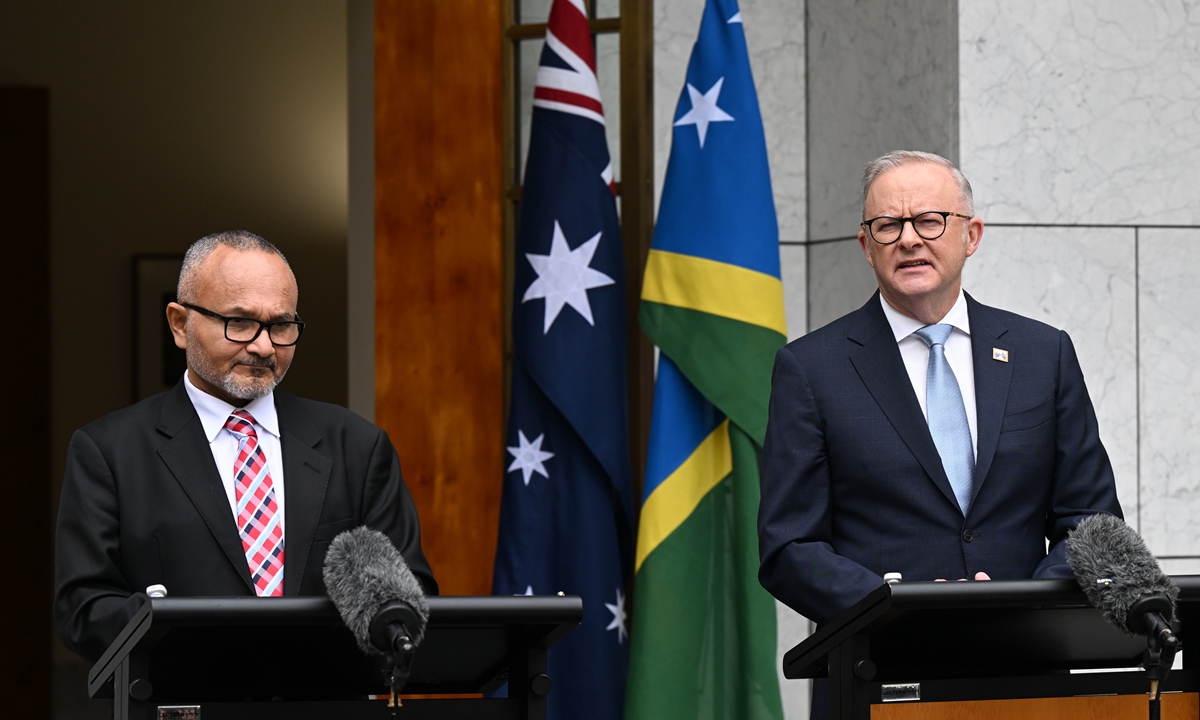
Australian Prime Minister Anthony Albanese (R) speaks during a joint press conference with Solomon Islands Prime Minister Matthew Wale after signing the Australia-Solomon Islands Treaty at Parliament House in Canberra, Australia, November 25, 2026. Photo: VCG
Australia and Solomon Islands signed a security treaty on Wednesday. One day earlier, Australian media had already floated the claim that the Pacific Island Country's (PIC) security pact with China, which will expire in April 2027, is not to be renewed.
The way Australian media and other Western media outlets reported the Australia-Solomon pact is worth a closer look. Australia's ABC News, citing a Lowy Institute analyst, described the pact as a "massive win" for Australia. US media such as Politico and British media such as Reuters and the Guardian called it "a blow" for China's ambitions in the Pacific.
The asymmetry in vocabulary is itself part of the media "script." Unpack it, and the pattern becomes unmistakable: The words routinely applied to Australia are "partnership," "reassurance," "deepening ties," each of which presupposes legitimacy and reciprocity, while applied to China, the cooperation is encoded as "grip," "foothold," "expansion," each term presupposing erosion and threat.
Reading between the lines of such scripts, one cannot help but sense a kind of mean-spirited triumph. When Australia-Solomon cooperation is framed, marketed and celebrated primarily as a means of excluding China, the tell is in the language: The deal is a "massive win" only if someone else has lost; it is newsworthy chiefly as "a blow" to an imaginary rival. The satisfaction that accompanies each "blow" to China and each "win" for Australia is not the satisfaction of a genuine diplomatic achievement, but one of seeing a rival's legitimate presence delegitimized.
For a long time, Australia and Western countries have treated China as a hypothetical adversary in the South Pacific. This framing is not incidental - it is the organizing principle behind much of their commentary on the region. When China provides aid and investment to PICs, or engages in normal cooperation with them, these activities are systematically tagged with geopolitical labels. Development assistance is recast as strategic penetration; infrastructure financing is recast as debt leverage; routine diplomatic engagement is recast as interference. The vocabulary shifts, but the function remains the same: to ensure that any Chinese presence in the Pacific is read through the lens of threat rather than through the lens of what it actually delivers.
Each claim against China, however thinly sourced, reinforces a broader picture in which China's regional role is inherently illegitimate. The reporting is not aimed at establishing facts; it is aimed at establishing a consensus. And that consensus serves a clear geopolitical agenda: preserving the strategic primacy that Australia and its Western partners have long assumed in the South Pacific.
Zhen Feiyang, a research fellow at the Center for Economic Diplomacy, Wuhan University, told the Global Times that since 2025, Australia has accelerated its push for security cooperation arrangements with PICs, including Papua New Guinea, Tonga and Fiji, attempting to build a regional security cooperation network centered on Australia that resembles the US "hub-and-spokes" system in the Asia-Pacific and assertively dominating the regional security order.
The cost of this geopolitical agenda, however, is that it locks the entire region into a script of great-power confrontation. Australia and the West could celebrate the "massive win," but what they have lost is the possibility of making the South Pacific a place of genuine cooperation rather than rivalry. Their dream of primacy, too, becomes a casualty - a hegemony that can only be sustained by scripting every Pacific partnership as a contest with China is not a stable order but a permanent state of suspicion, one that exhausts the very influence they seek to preserve.
As China stated, "There is no element of geopolitical rivalry or bloc confrontation in cooperation between China and PICs, including Solomon Islands." The statement is a reminder of what the Australian and Western media's script leaves out and why the geopolitical calculations are never really about the Pacific at all.
RELATED ARTICLES