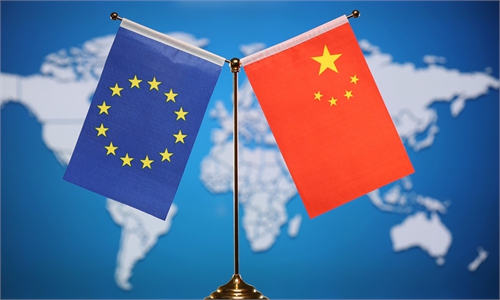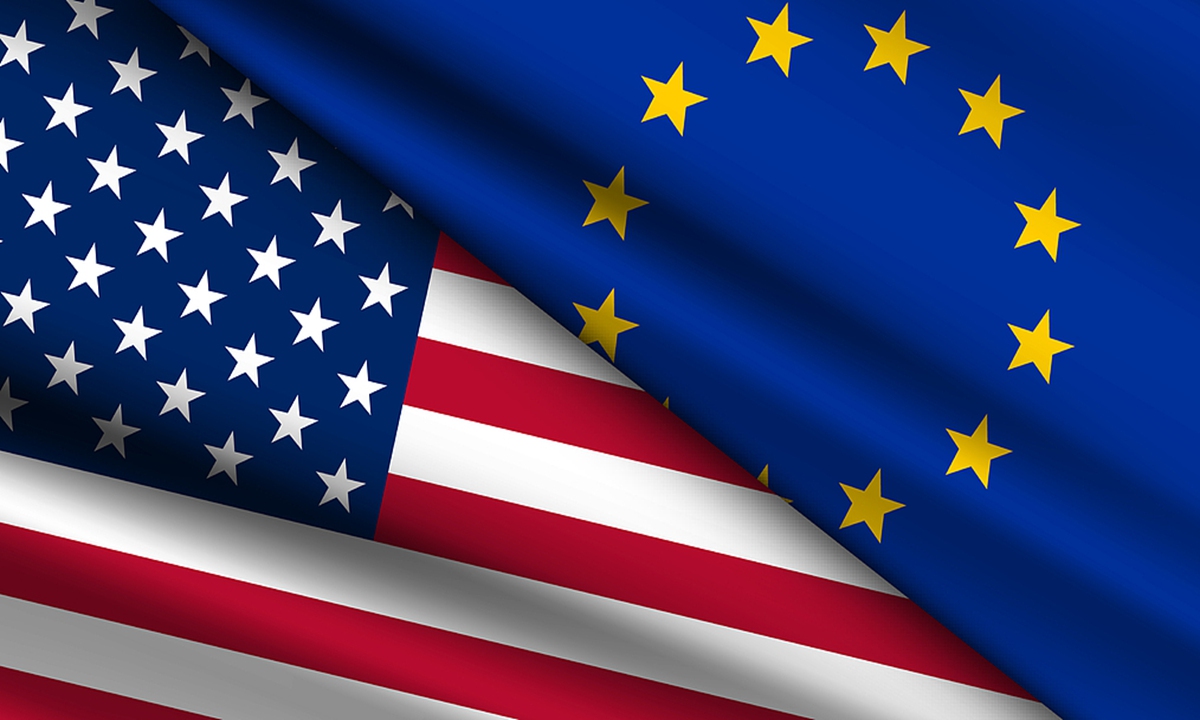
US, EU Photo: VCG
After Washington brandished a new tariff threat against 14 economies - including the European Union (EU) - under the pretext of "structural excess capacity," the affected parties responded in various ways. Whether firmly opposing trade protectionism or expressing a willingness to negotiate a deal, such stances are all standard reflections of national interest. Yet amid these reactions, one voice stood out as particularly bizarre: the European Commission.
European Commission spokesperson Olof Gill first said that the bloc "strongly rejects" the tariff threat. However, his objection was rooted not in morality, rules, or fairness, but in self-exoneration - claiming that Europe is "among those most exposed to overcapacity." He then pointed the finger at "state-driven" overcapacity "concentrated in third countries," hinting that Europe could team up with the US for "joint action." The moment Washington raised its tariff stick, the European Commission immediately waved the white flag, willingly offering itself as an accomplice in exchange for being spared. It is a truly pathetic spectacle.
"Overcapacity" is, at its core, a fabricated unilateral tool steeped in protectionist intent - an utter false proposition. The European Commission's defense that "we are not the source; a third party is" amounts to jockeying for the seat of an accomplice in the defendant's dock. Ironically, the EU itself was one of the earliest adopters of the "overcapacity" narrative. Crying foul only after being beaten with the very same stick is a bit too late.
The larger problem is that the EU is treating its most vital cooperative partner as a bargaining chip to curry favor with Washington. The higher the US raises its tariff stick, the more the EU ought to diversify its trade portfolio to hedge against Washington's unpredictability. Trading concessions for security means actively severing its highest-potential external growth ties just to patch up an already riddled transatlantic front. With declining industries and trade hemmed in on all sides, what leverage will the EU have left to negotiate security with the US?
As one of the world's largest single markets, the EU has every capacity to say "no" to unreasonable US tariffs, and every standing to demand that Washington resolve disputes within the multilateral framework. What Europe needs is strategic autonomy, not strategic subservience; it needs to confront its own structural issues rather than peeling the "overcapacity" label off itself only to slap it onto others. Had the EU chosen to coordinate positions with China and other affected economies to jointly defend the WTO-centered multilateral trading system, its standing in this tariff storm would be far more dignified - and far safer - than it is today.
RELATED ARTICLES