Beyond bloc rivalry: China-Cambodia ‘Golden Dragon’ drills offer an alternative security model
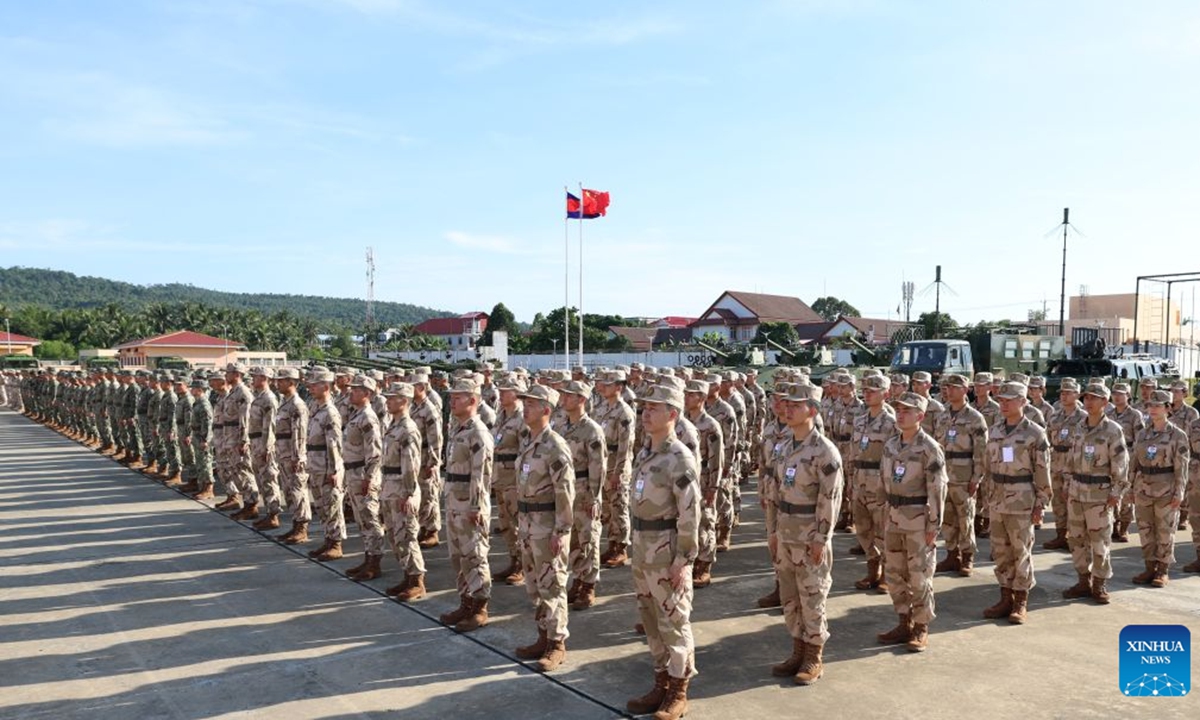
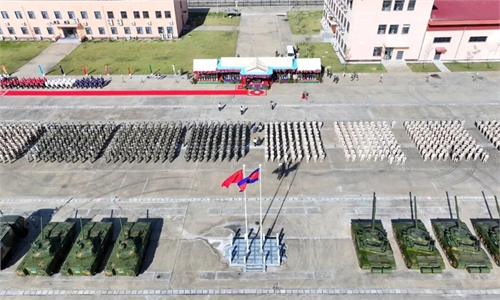
Chinese soldiers participate in the opening of a joint exercise involving the Chinese and Cambodian militaries at a Cambodia-China Joint Support and Training Center at Port Ream, Cambodia on Nov. 25, 2026. The Chinese and Cambodian militaries have launched a joint exercise in Cambodia on Wednesday. Photo: Xinhua
The China-Cambodia "Golden Dragon" joint exercise takes place almost every year, yet some Western media outlets continue to recycle the same narrative in their coverage.
On Wednesday, China and Cambodia launched the largest edition of the exercise to date. An Associated Press report portrayed the exercise as part of China's efforts to expand its regional influence and once again cited the US' ongoing "concerns" about China-Cambodia military cooperation. It also highlighted the expansion of Cambodia's Ream Naval Base with Chinese funding on the southern coast, claiming that the facility "could become a strategic outpost for the Chinese navy in the Gulf of Thailand."
In fact, launched in 2016, the "Golden Dragon" exercises have now entered their eighth edition and evolved into a regular and institutionalized platform for regional security cooperation. The publicly announced scenarios for the exercises focus on counter-terrorism, counter-piracy, humanitarian assistance and disaster relief. Military attachés from multiple countries were invited as on-site observers, and both China and Cambodia have repeatedly stressed that the exercises are not directed against any third party.
However, whenever China and Cambodia stage the "Golden Dragon" exercises, many Western media outlets overlook the actual objectives of the exercises and cast them through the lens of great-power rivalry. In fact, China-Cambodia drills are fundamentally different from US-led exercises across Southeast Asia.
Current-affairs commentator Song Zhongping noted that "Golden Dragon" focuses on non-traditional security and non-combat military operations, without a designated adversary. By contrast, US-led drills in Southeast Asia center on traditional security and wartime scenarios. They deploy a wide array of weaponry and are designed around clearly identified hypothetical adversaries and potential third-party contingencies.
The US-Philippines "Balikatan" exercises offer a case in point. They regularly involve more than 10,000 troops, with participation reaching approximately 17,000 in 2024. The exercises are explicitly framed around the need to "respond to regional threats." The two categories of drills differ at their core.
The facts about the much-discussed Ream Naval Base are straightforward.
Song Zhongping stresses first that Ream Naval Base is fully Cambodian-owned and operated, and China has not leased the facility, which is fundamentally different from US overseas military bases.
According to Song, Chinese naval vessels make temporary port calls there for two main purposes. First, to support the training of Cambodian naval personnel and deliver military and naval-equipment assistance.
Second, to meet the routine logistical needs of Chinese vessels, including resupply and crew rest, while supporting maritime security in the Strait of Malacca and carrying out related training missions.
"The Ream Naval Base is not intended for military confrontation; it is a facility to support training and capacity-building for Cambodia," he said.
By comparison, US overseas bases are frequently established with specific third-country contingencies in mind. Song said that when a host-nation base is leveraged to confront another power, the installation itself becomes a geopolitical target. The host state gets dragged into conflict, threatening regional peace and stability while exposing the host country to unnecessary risks.
Describing the Ream Naval Base as "a strategic outpost of the Chinese Navy" goes beyond what the facts support.
A fundamental flaw in some Western commentary is the assumption that all defense cooperation between China and its neighbors is a tool for geopolitical confrontation. However, Southeast Asian countries have diverse security needs. They need partners to work together to tackle natural disasters and terrorism, rather than being forced to choose sides.
Song believes that the China-Cambodia defense cooperation model offers a model that could be adapted and applied more widely across Southeast Asia. Humanitarian relief, counter-terrorism, anti-piracy and disaster-risk reduction are common challenges facing countries across the region. By sharing its practical experience and providing appropriate technology and equipment, China aims to help regional countries strengthen their capacity to carry out non-combat military operations. For Southeast Asia, this provides tangible benefits without threatening other countries.
"China's participation in the construction of training and support facilities contributes to stability in the host country and across the wider region, producing mutual benefits by strengthening governance and institutional capacity," Song said.
China-Cambodia defense cooperation offers an alternative model to alliance-style military blocs - one built on equal partnership, voluntary participation, a focus on shared security challenges, and a commitment to avoiding confrontation and targeting no third party.
Alliance-driven drills strap partners to a war chariot, while partnership-based cooperation hands neighbors a ladder for development.
Regional security is not about choosing sides; it's about teaming up. That may well be what Southeast Asia needs most.
RELATED ARTICLES