Foreign carmakers tap Chinese tech in global market push
Guangzhou auto show spotlights local partnerships
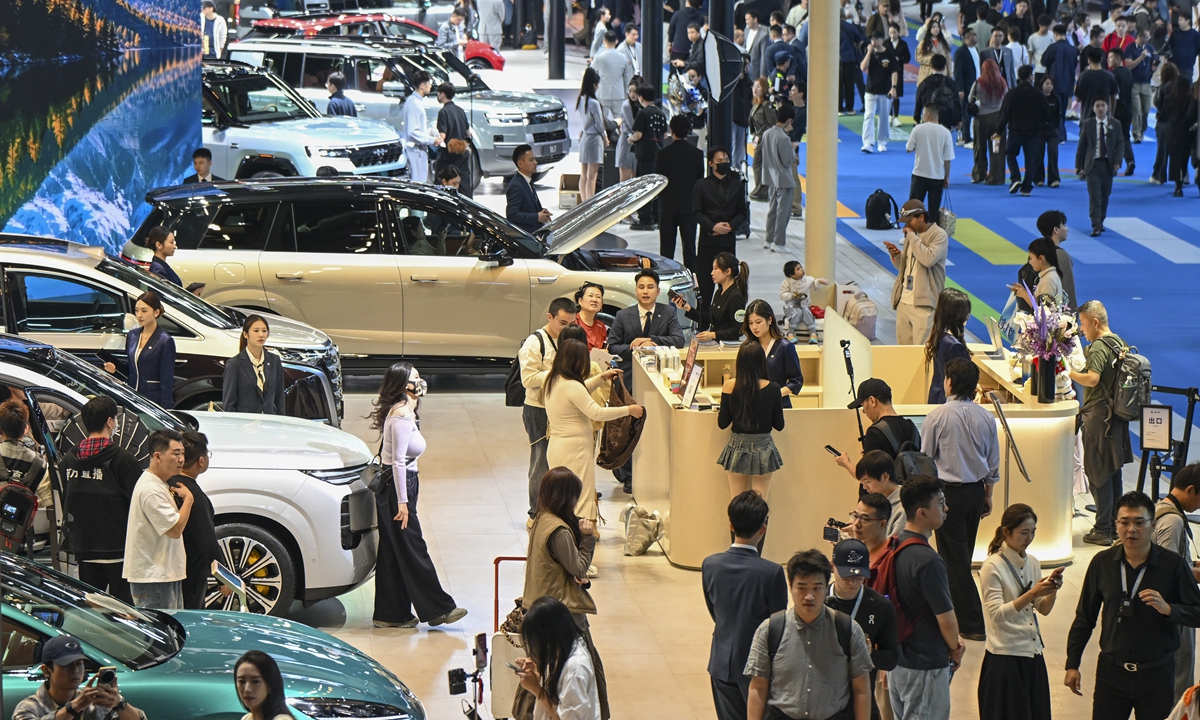
Visitors tour the 24th Guangzhou International Automobile Exhibition at the China Import and Export Fair Complex in Guangzhou, South China's Guangdong Province, on November 27, 2026. The show, themed "New Tech, New Life," covers 220,000 square meters and features 1,106 vehicles, including 115 making their debut and 707 new-energy vehicles. Photo: VCG
From Dongfeng Nissan exporting its China-developed N7 electric sedan to Southeast Asia to Volkswagen showcasing cars built on an electronic architecture co-developed with Chinese partners, the 24th Guangzhou International Automobile Exhibition, known as the Guangzhou Auto Show, which opened Friday, highlighted how Chinese buyers' preferences are shaping foreign carmakers' global offerings. Analysts said China's engineering and supply chains help foreign brands respond more quickly to local demand and compete abroad.Dongfeng Nissan's NX7, a plug-in hybrid SUV launched at the show for younger buyers, comes with a battery supplied by Chinese firm CATL, as well as intelligent driver assistance and a digital cockpit. An earlier model in the same series has already made the trip overseas. The all-electric N7, developed and built in China, debuted at the Guangzhou show in 2024 and went on sale in China the following year. The first batch bound for Southeast Asia was shipped in September, according to Nissan. The company also plans to launch the N7 in Latin America.
At Volkswagen's stand, FAW-Volkswagen delivered its 20,000th ID. AURA T6 model, according a statement sent to the Global Times from the joint venture. The electric SUV and the ID. AURA L5 sedan on display both use the CEA (China Electronic Architecture), which coordinates the vehicles' electronic systems and supports over-the-air software updates.
Volkswagen's China technology and software teams developed the architecture with Chinese electric vehicle (EV) maker XPENG. The companies have extended their collaboration to Volkswagen's plug-in hybrid and combustion-engine platforms in China, according to XPENG.
"In the past, they traded technology for market access," Zhang Xiang, a visiting professor in the engineering department of Zhengzhou-based Huanghe Science and Technology University, told the Global Times on Friday. Now, foreign automakers are paying for technology or using equity partnerships to gain access to Chinese expertise, he said. Developing batteries, digital cockpits and driver-assistance systems independently takes time and several rounds of testing. "Working with Chinese suppliers can help foreign brands bring those technologies to their cars faster," he said.
The technology is also being adopted in vehicles with different powertrains. Mercedes-Benz launched a 48-volt hybrid CLA model equipped with the same driver-assistance system as its all-electric counterpart, jointly developed with China's Momenta, according to a statement from the company. Its electric VLE MPV also made its China debut with a rear entertainment system developed under the leadership of Mercedes-Benz's China R&D team.
Hybrids allow established carmakers to continue using their existing engine technology while improving fuel economy, Zhang said. He added that stricter fuel-consumption and emissions requirements are another reason foreign brands are continuing to introduce hybrid models alongside all-electric models.
BMW launched its long-wheelbase Neue Klasse i3 in Guangzhou, a battery-electric sedan developed specifically for the Chinese market and priced from 249,900 yuan ($37,497). China also supplies vehicles for BMW's global lineup. According to a statement from BMW, Spotlight Automotive, its joint venture with Great Wall Motor, produces electric MINI Cooper and MINI Aceman models for global markets at its plant in Zhangjiagang, East China's Jiangsu Province.
Volkswagen's October deliveries offer an early indication of how its locally developed models are faring in China. The Volkswagen brand delivered more than 28,000 new-energy vehicles in China in October, up 346.9 percent year-on-year and a monthly record, according to figures the company released on November 11. The ID. AURA T6 accounted for more than 12,000 deliveries, while the ID. ERA 5S plug-in hybrid sedan contributed another 7,100.
Wu Shuocheng, an auto industry expert, told the Global Times on Friday that adopting Chinese EV technology was an important factor behind the increase in sales. Volkswagen's early ID. models had lagged behind Chinese rivals in software responsiveness and the breadth of cockpit features, he said. As Volkswagen has shifted more software development to China, it has been "gradually finding its rhythm."
Wu said foreign brands retain strengths in mechanical engineering and established brand equity. Keeping pace with Chinese consumer preferences also requires giving local teams greater room to make product decisions, he said.
The shift was visible in Hefei, East China's Anhui Province, on October 27, the first day of German President Frank-Walter Steinmeier's state visit to China. Steinmeier toured Volkswagen Group's largest research and development center outside Germany and tried out driver-assistance and automated parking features on locally developed vehicles, according to China Central Television. He later said he was pleased to see German and Chinese engineers developing automotive software together and called for closer cooperation between companies from both countries, according to a report by Xinhua News Agency.
A Reuters' report said in October that Volkswagen has announced plans to ship more China-built Volkswagen and Jetta cars to South America and Africa in the coming years. Other auto giants including General Motors, Hyundai and Renault are increasingly adopting similar strategies to globalize their China-developed technologies as they vie with Chinese competitors in international markets, Reuters said.
Wu said the experience foreign automakers gain in China can help them compete overseas as other markets move toward electrification. "If a carmaker can't gain a foothold in China's EV market, it will also find it difficult to carve out a place for itself in the global shift to electric vehicles," he said.
RELATED ARTICLES