Hong Kong completes adaptation of pre-1997 laws, marking milestone in ‘one country, two systems’: expert
By Li Yu and Published: Nov 27, 2026 10:14 PM

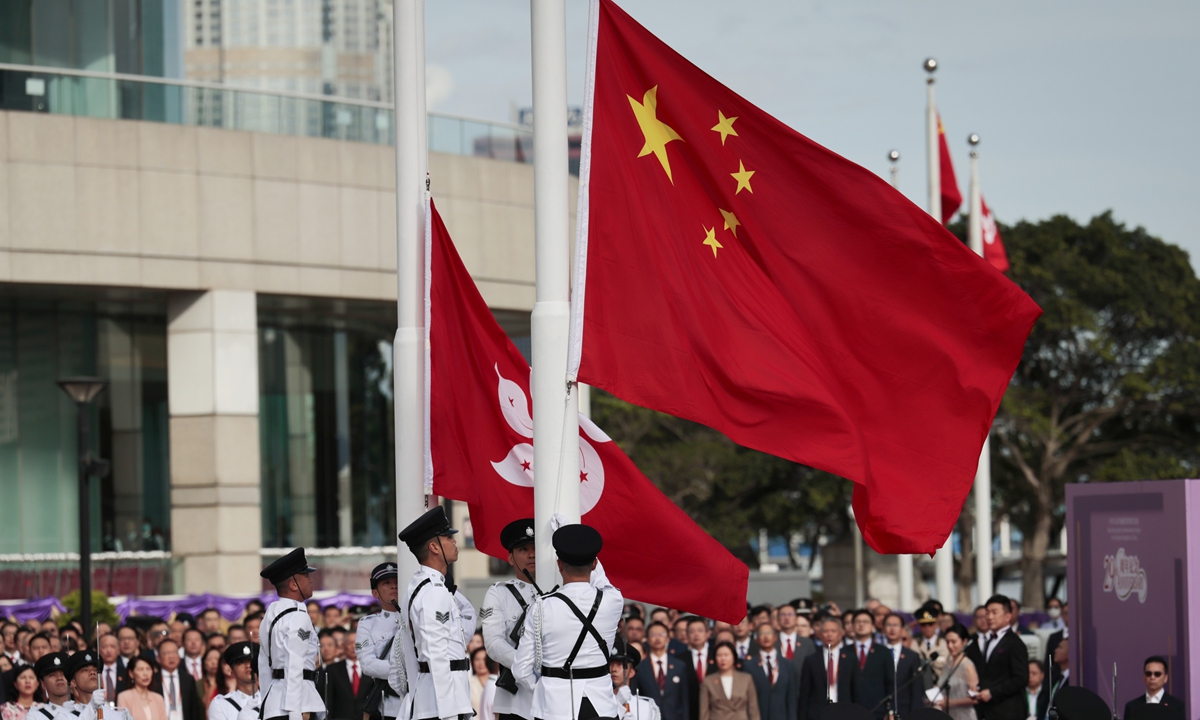
Members of the Hong Kong Police guards of honor raise the Chinese national flag and HKSAR flag during a ceremony at the Golden Bauhinia Square in Hong Kong, China, on July 1, 2026, marking the 29th anniversary of Hong Kong's return to the motherland. Photo: VCG
The Hong Kong Special Administrative Region (HKSAR) on Friday completed the adaptation of more than 1,800 laws that were in force before Hong Kong's return to the motherland, marking a major milestone in the practice of "one country, two systems" and resolving the longstanding issue of decolonization in its pre-1997 laws, according to a commentary published by the Hong Kong and Macao Affairs Office of the State Council on Friday.According to an official release from the HKSAR government on Friday, the completion of the exercise came as the Statute Law (Miscellaneous Provisions) Ordinance 2026 and the subsidiary legislation that amends the rules of court, namely the Rules of the High Court (Amendment) (No. 3) Rules 2026, the High Court Fees (Amendment) Rules 2026 and the Rules of the District Court (Amendment) (No. 3) Rules 2026, were published in the Gazette on Friday.
The government said that the gazetting of the ordinance and subsidiary legislation marked the formal completion of the historic mission of the adaptation exercise, seven months ahead of the original deadline at the end of current government's term.
A spokesperson for the Liaison Office of the Central People's Government in the Hong Kong Special Administrative Region (HKSAR) said in a statement on Friday that HKSAR Chief Executive John Lee and the local government had taken proactive steps and accelerated the adaptation of Hong Kong's previously existing laws. The spokesperson said the ahead-of-schedule completion fully demonstrated the considerable advantages of Hong Kong's executive-led system following the implementation of the principle of "patriots administering Hong Kong" under the safeguards of the Basic Law and the National Security Law for Hong Kong.
The commentary noted that adapting Hong Kong's previously existing laws is an inevitable requirement arising from China's resumption of the exercise of sovereignty over Hong Kong and a constitutional duty that the HKSAR must fulfill. The exercise has eliminated colonial-era expressions and vestiges of colonial privileges from these laws, further consolidating the legal foundations of "one country, two systems."
The completion of the adaptation exercise means Hong Kong's laws now directly reflect the HKSAR's constitutional status without relying on substitution rules, marking a historic transition from colonial governance to the HKSAR's constitutional order. It further strengthens the common law system within the national constitutional framework and marks a milestone in the practice of "one country, two systems," Willy Fu, a law professor who is also a director of the Chinese Association of Hong Kong & Macao Studies, told the Global Times on Friday.
The HKSAR government began adapting the laws following Hong Kong's return to the motherland, completing more than 90 percent of the amendments by 2012. However, the subsequent progress was slowed by anti-China, destabilizing forces in Hong Kong that used the Legislative Council to obstruct the government's efforts, the commentary said.
The completion of the adaptation of laws has also strengthened the advantages of Hong Kong's common law system by eliminating ambiguities and disputes over the application of laws arising from previous reliance on statutory substitution rules, according to the commentary.
The adaptation removes colonial-era references from legal texts, not the common law itself. By directly reflecting the HKSAR's constitutional status, the amended laws enhance judicial efficiency and legal certainty, allowing Hong Kong's common law system to better leverage its strengths in the international legal arena, Fu said.
The exercise has also aligned certain industry standards in Hong Kong's commercial and maritime sectors with national standards and internationally accepted rules, which will help strengthen Hong Kong's position as an international legal hub and boost international investors' confidence in its rule of law and business environment, the commentary said.
Clearer legal texts help reduce legal interpretation costs in areas like due diligence and contract drafting. The systematic completion of the adaptation exercise also signals to international markets that Hong Kong's legal system can evolve in an orderly manner, reducing legal uncertainty for long-term investment and improving international investors' assessment of Hong Kong's risk profile as a legal hub, Fu said.
As Hong Kong approaches the 30th anniversary of its return to the motherland, the completion of the adaptation of its previously existing laws is of profound significance for the full and accurate implementation of the "one country, two systems" policy and the Basic Law, the commentary noted.
RELATED ARTICLES