Chinese goods in focus as US Black Friday shoppers seek value amid inflation, tariff pressures
Flexible manufacturing, efficient supply chains underpin competitiveness despite trade uncertainty
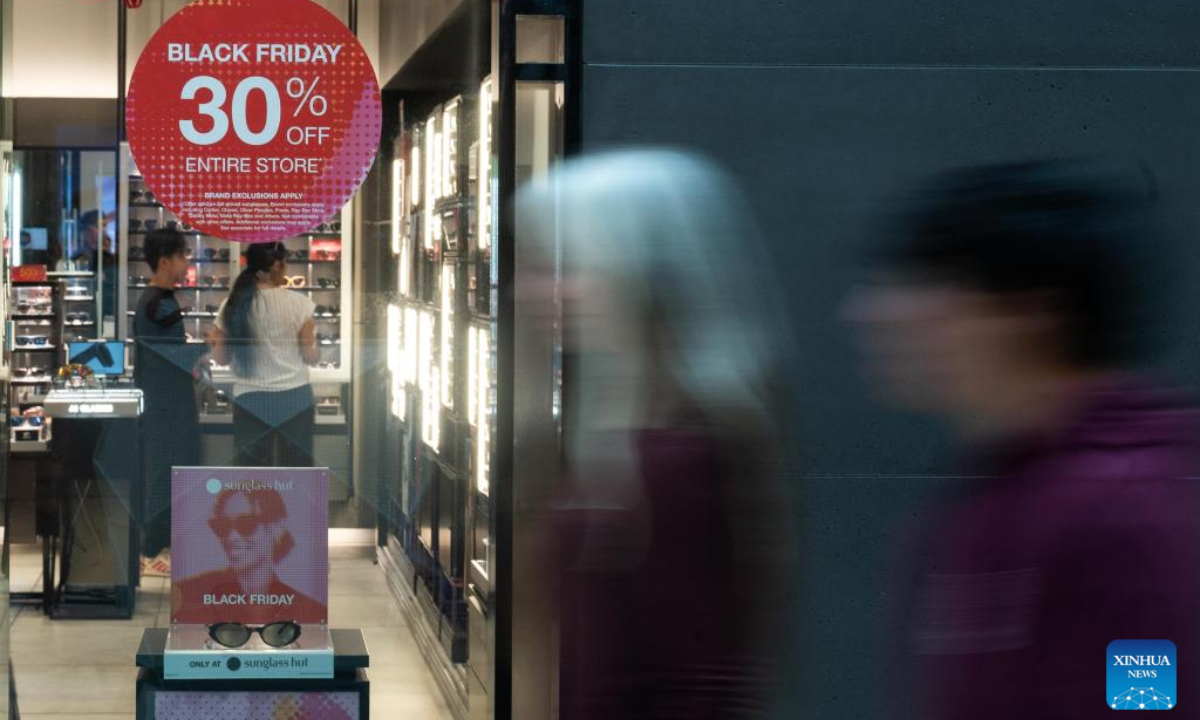
People shop at a store during the Black Friday sales event in San Jose, California, the United States, Nov. 28, 2025. (Photo by Ziyu Julian Zhu/Xinhua)
As the US Black Friday shopping season gets underway on Friday, persistent inflation is prompting American consumers to seek greater value for money, bringing into focus the competitiveness of Chinese products and the resilience of Chinese cross-border e-commerce businesses amid US tariff pressures.
Despite US tariffs and the removal of duty-free treatment for low-value imports have increased costs for cross-border e-commerce businesses, interviews with Chinese exporters and industry data point to continued overseas demand as price-sensitive US consumers are still drawn to Chinese goods' affordability and value for money, thanks to China's extensive manufacturing networks, flexible production capabilities and efficient supply chains helping businesses respond to changing consumer preferences and mitigate the impact of trade barriers.
Growth under pressure
Amid concerns over rising living costs, American consumers have continued to embrace seasonal discounts, with online shopping recording strong growth in the weeks leading up to Black Friday.
US consumers spent $82.5 billion online between November 1 and 22, up 9.1 percent year-on-year, the Associated Press (AP) reported on Friday, citing data from Adobe.
Online spending on Black Friday alone is projected to reach $12.9 billion, up 9.2 percent year-on-year, according to a forecast released by Adobe Analytics in September, driven in part by having the biggest discounts for categories such as TVs, apparel and appliances.
Despite US tariff pressures and high inflation, China's textile and apparel exports to the US rose 20.2 percent year-on-year to $45.49 billion in the first 10 months of this year, accounting for 17.6 percent of China's total textile and apparel exports, according to the latest data provided to the Global Times on Friday by the China Chamber of Commerce for Import and Export of Textiles. Major export categories included clothing, home textiles and fabrics, underscoring the continued importance of Chinese products in the American consumer market.
Signs of export growth ahead of the Black Friday shopping season were also evident in several home appliance categories.
For example, China's air conditioner exports to North America rebounded in October, rising by 6.2 percent, while washing machine exports to the US stabilized after previous declines, edging up 0.5 percent year-on-year. Both improvements were likely driven by inventory stocking ahead of Black Friday, according to data provided to the Global Times on Friday by ChinaIOL, a Chinese industry research and consulting platform.
Meanwhile, despite a decline in China's refrigerator exports to the US this year due to tariff barriers, exports recorded a marginal improvement in September, edging up 0.2 percent year-on-year, possibly reflecting advance stocking for the year-end shopping season, according to analysts at ChinaIOL.
Tao Yang, a businessperson from Yiwu, the "world's supermarket" in East China's Zhejiang Province, echoed the positive trend. "Our orders from the US market this year have increased by an estimated 50 percent compared with last year, partly because our products cater to emerging consumer trends on social media," Tao, CEO of Yiwu KiviBear Household Products Co Ltd, told the Global Times on Friday.
The Yiwu-based businessperson said that her company's main products for this year's Black Friday shopping season are decorative accessories for drinking cups, which allow consumers to personalize everyday items.
Tao said that when household budgets are under pressure, consumers tend to favor affordable products over big-ticket purchases, a phenomenon known as the "lipstick effect."
Such a shift in spending habits is particularly relevant in the US, where persistent inflation continues to weigh on consumer purchasing power.
According to a Reuters report on Friday, US holiday spending is expected to rise by 4 to 6 percent from last year, with rising prices accounting for much of the expected growth. US inflation currently stands at 3.8 percent.
A November survey by the US National Retail Federation found that 82 percent of US consumers are taking steps to manage holiday shopping costs, according to Reuters.
The potential for Chinese suppliers to tap into holiday demand is reinforced by the substantial consumer base that Chinese cross-border e-commerce platforms have established in the US.
A survey released in March by e-commerce marketing company Omnisend found that 71 percent of US respondents had made purchases on one or more Chinese online marketplaces, including Temu, SHEIN, AliExpress and TikTok Shop, during the previous year.
As American consumers become more price-conscious, Chinese products that offer good value for money could gain a competitive edge in the US market, He Weiwen, a senior fellow at the Center for China and Globalization, told the Global Times on Friday.
Moreover, the competitiveness of Chinese goods extends beyond price advantages. China's extensive manufacturing networks, economies of scale and efficient supply chains enable businesses to offer a wide range of affordable, high-quality products while responding rapidly to evolving consumer preferences, He said.
Adapting to changes
US tariffs and the removal of duty-free treatment for low-value imports last year have posed challenges to Chinese cross-border e-commerce businesses, prompting them to adapt their business models to a changing trade environment.
"These policy changes have increased import costs and disrupted established cross-border retail models, prompting businesses to adjust their operations, expand local fulfillment capabilities and improve supply chain efficiency," said He.
Despite these challenges, Chinese cross-border e-commerce platforms continue to attract American consumers. Temu, for example, attracted 108.2 million unique visitors in the US in June 2026, up 79 percent year-on-year, according to a September report by market research firm EMARKETER, citing data from Comscore.
Beyond adjustments in logistics and business models, China's flexible manufacturing capabilities and efficient supply chains have enabled Chinese suppliers to better respond to changing consumer demand, providing another source of resilience amid trade uncertainties, industry analysts said.
Tao said American customers are increasingly seeking distinctive products and placing small initial orders to test market demand before scaling up purchases, sometimes even opting for air freight to expedite delivery.
Thanks to its well-integrated supply chain, Tao's company can accommodate small customized orders and arrange rapid deliveries. Over the past two weeks, the company has been rushing to fulfill orders, with some customers requesting delivery as early as the day after placing their orders.
While Chinese businesses continue to demonstrate resilience and adaptability in the face of trade barriers, Washington's renewed tariff push has drawn fresh concerns from the Chinese business community over its potential impact on businesses and consumers on both sides.
On Friday, the Chinese business community urged the US to withdraw its proposed Section 301 tariff hikes and resolve outstanding issues through consultations. A spokesperson for the China Council for the Promotion of International Trade (CCPIT) warned that sweeping tariff increases would raise costs for downstream US businesses, place additional financial pressure on consumers and disrupt global industrial and supply chains.
The continued demand for affordable Chinese products during the Black Friday shopping season underscores the strong economic rationale for China-US trade cooperation. The competitiveness of Chinese products stems not just from their prices, but also from the efficiency of an extensive industrial ecosystem built up over decades, Hu Qimu, a professor at the Maritime Silk Road Institute of Huaqiao University, told the Global Times on Friday.
For many American households already struggling with rising living costs, additional tariffs risk putting affordable goods further out of reach, Hu said. He noted that stable China-US trade relations, rather than higher trade barriers, would better serve the interests of American consumers and businesses on both sides.
RELATED ARTICLES