IN-DEPTH / IN-DEPTH
Xiong’an puts future urban transport on the road
A smart bus needs a smart city
By in Xiong’an Published: Nov 27, 2026 10:48 PM

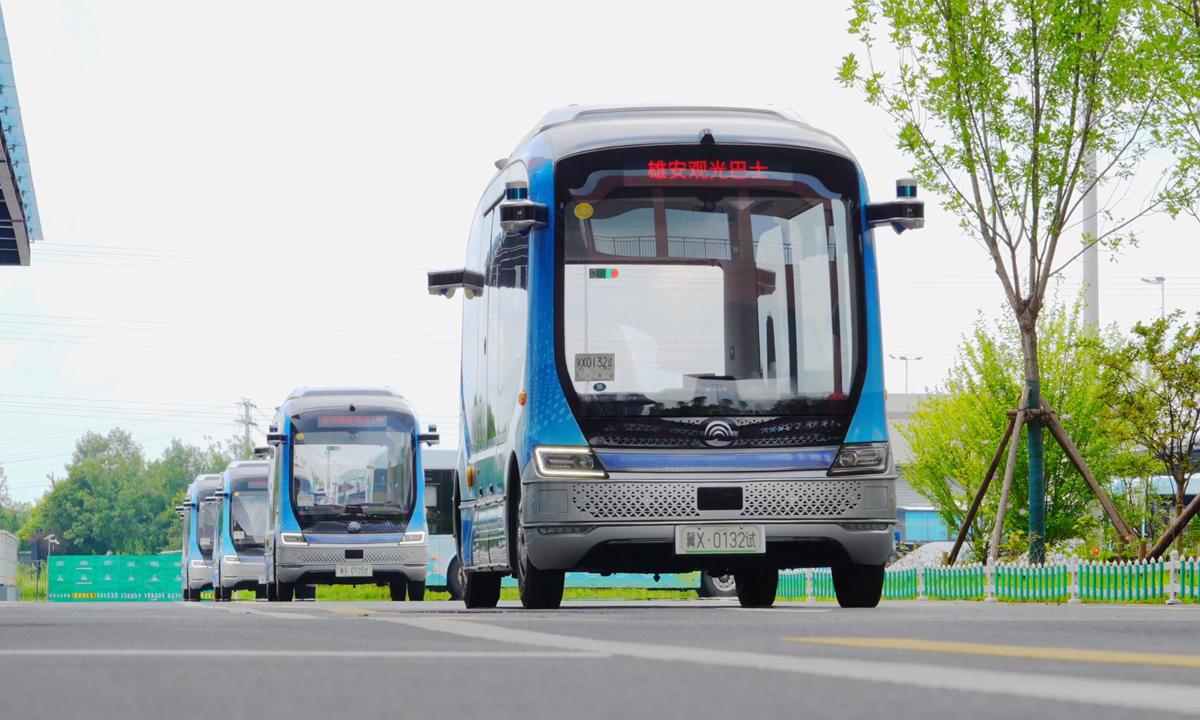
A blue autonomous minibus without a steering wheel travels in Xiong'an New Area. Photo: Courtesy of China Xiongan Group Transportation Co., Ltd.
When a futuristic blue bus glides quietly up to a bus stop in Xiong'an New Area, North China's Hebei Province, it is hard to associate it with the bulky, somewhat clumsy buses people are used to seeing on city streets. With its sleek design, it looks more like a stylish, glass-enclosed capsule gliding on wheels than a conventional bus.
The words "XIONG'AN" are printed prominently on its body, while panoramic windows stretch around the cabin, giving it an almost futuristic, open-air feel.
After booking a ride through the app, the Global Times reporter stepped aboard. There was no steering wheel, no driver behind the controls. This was an autonomous sightseeing bus, and the reporter was about to experience how a future city might move.
As the bus pulled away, the ride was remarkably smooth and quiet. Through the enormous windows, buildings, green spaces and neatly planned streets unfolded like scenes on a moving screen. A display near the front showed the vehicle's speed and real-time road information.
The reporter soon noticed that the bus responded calmly to its surroundings. When another vehicle approached quickly or changed lanes nearby, it slowed down smoothly. There were no sudden brakes or jerky movements. The ride felt surprisingly natural.
But what impressed the reporter was not just the driving technology. It was the attention to small details.
The seats were comfortable, and the interior had clearly been designed with passengers in mind, featuring charging facilities. Small tables came with cup holders, while soft sponge-like padding made certain contact areas more comfortable. Even the AI voice assistant added a touch of personality: passengers could interact with it, ask it to play different songs, and enjoy a more personalized ride.
In other words, the bus was not simply designed to take passengers from stop to stop. It was designed to make the journey enjoyable.
The China Xiong'an Group Infrastructure Construction Co., Ltd. told the Global Times that the vehicle had completed 20,000 kilometers of road testing in the new area before entering demonstration operation on August 26. During testing, it repeatedly identified traffic lights, pedestrians and other vehicles, while its algorithms and hardware were continuously improved. The sightseeing route operates from 9 am to 6 pm, with one bus every 20 minutes and eight stops. By early November, it had served 6,800 passenger trips, with occupancy approaching 90 percent during the National Day holiday in October.
Intelligence behind the ride
The experience also made the reporter look beyond the bus itself. A truly intelligent transport system cannot depend on autonomous vehicles alone. It needs an entire city infrastructure that allows vehicles, roads, traffic lights and people to communicate.
In Xiong'an, that network is already taking shape.
In Xiong'an, building on its well-developed digital infrastructure, AI models analyze factors such as the distance between intersections and traffic volumes to automatically adjust traffic signal timings in coordination. This allows vehicles to pass through successive intersections with green lights or fewer stops at red lights, increasing traffic capacity by 20 percent.
The smart light poles along the streets play a key role in making this possible. These multifunctional poles at intersections are equipped with cameras, LiDAR, millimeter-wave radar and other intelligent devices. They collect, aggregate and transmit image and radar data to a unified cloud platform, where the information can be accessed by different departments whenever needed.
These are small scenes, but together they reveal a much bigger change: transport in the future will be about connecting an entire urban system, not simply making individual vehicles smarter.
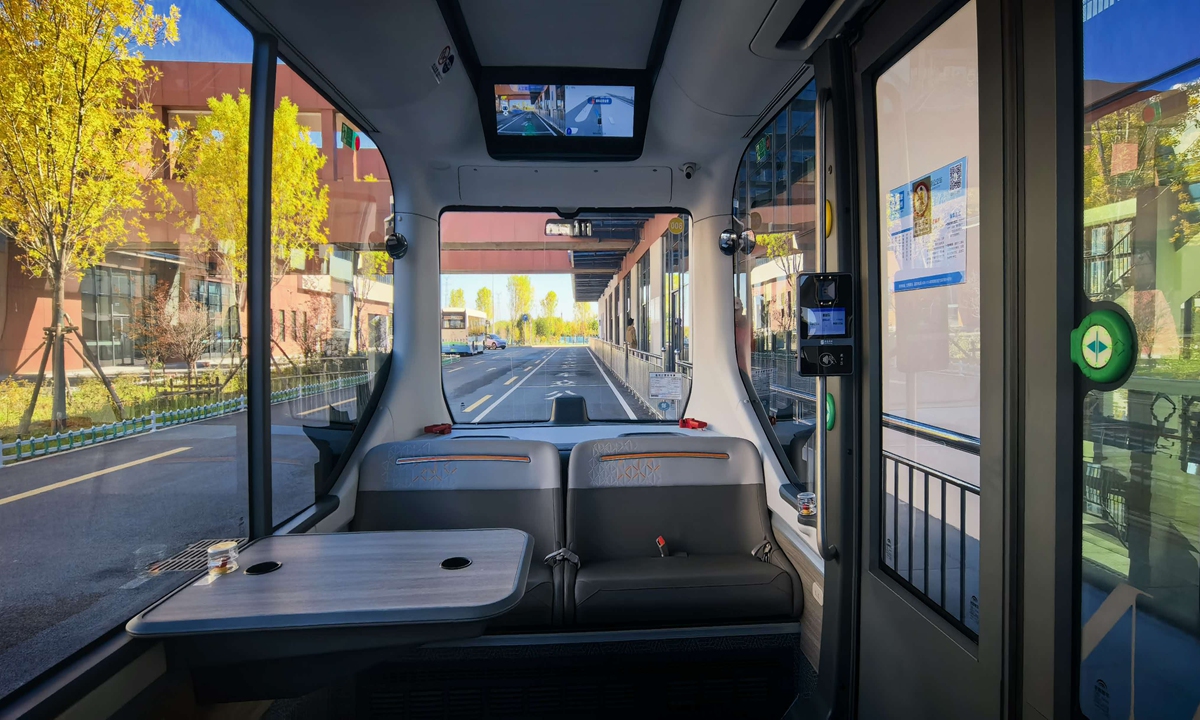
Modern, digitally integrated bus interior Photo: Courtesy of China Xiongan Group Transportation Co., Ltd.
The future is here
What makes Xiong'an particularly interesting is that its transport system has been part of the city's planning from the very beginning.
When the new area was planned, it set out to build a convenient, safe, green and intelligent transport network. Its targets include having green transport account for 90 percent of total travel and public transport make up 80 percent of motorized trips.
This means autonomous buses are not an isolated technology demonstration. They are part of a wider effort to make public transport more attractive, reduce dependence on private cars and improve the way people move around the city.
China's rapidly developing new energy vehicle industry provides an important foundation for this vision. Electric vehicles offer a cleaner and quieter platform for urban mobility, while advances in sensors, computing, communications and autonomous driving make increasingly intelligent transport services possible. Connected digital roads, meanwhile, provide the infrastructure that allows vehicles to work with the city around them.
Of course, there is still work to do before autonomous buses become a routine part of everyday public transport. Routes and service standards need further improvement, and more real-world testing will be needed before the technology can be expanded to a wider range of daily travel scenarios.
As the reporter stepped off the blue bus, one thought stayed: the future of urban transport no longer feels like a distant technological fantasy. With the support of China's new energy vehicle industry and an increasingly connected intelligent transport network, the future bus is already on the roads of Xiong'an, one of China's youngest cities.
RELATED ARTICLES