China’s logistics sector revenue rises 4.2% to 12.3 trillion yuan in first 10 months
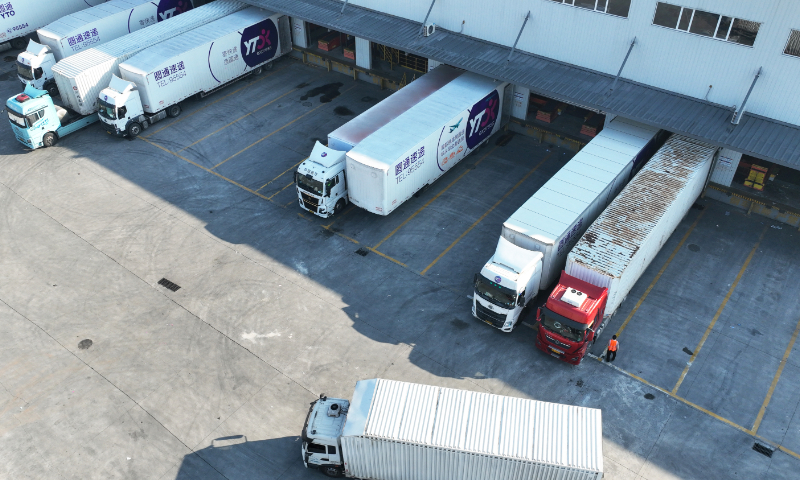
Delivery trucks leave after uploading parcels at an express company in Tangshan, North China’s Hebei Province, on November 11, 2026. Logistics firms are working at full capacity to handle the Double 11 online shopping peak. Photo: VCG
China's logistics sector generated 12.3 trillion yuan in revenue in the first 10 months of 2026, up 4.2 percent year on year, data released by the China Federation of Logistics and Purchasing (CFLP) on Saturday showed. The market expanded steadily while its structure continued to improve, with gains in efficiency and resilience and smoother international logistics links, according to the report.
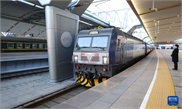
The rollout of a single-document system for rail-water intermodal transport improved coordination between transport documents and the efficiency of cargo transfers. Containerized rail-water and rail-road intermodal freight volumes rose 8.9 percent and 48.4 percent year on year, respectively, as a network linking rail, road and water transport took shape.
China’s import logistics demand is shifting toward higher-value goods. From January to October, the value of imported goods handled by the logistics sector fell 0.6 percent year on year, with the decline widening by 0.4 percentage points from the first three quarters. The average value per unit of imported goods, however, rose markedly.
International freight corridors also strengthened. From January to October, China-Europe freight trains made 18,600 trips, up 14.6 percent year on year, with the share of loaded containers remaining high. China-Central Asia freight trains made 12,100 trips, up 1.9 percent, while rail-sea services along the New International Land-Sea Trade Corridor transported more than 1.13 million twenty-foot equivalent units.
Cross-border trucking also saw a first: A shipment of fresh produce traveled across provincial lines using both the international TIR transit system and China's expressway green channel before leaving the country through the Manzhouli port in Inner Mongolia Autonomous Region. With support from the Ministry of Transport, authorities in Shandong Province and Inner Mongolia used online booking and electronic customs seals to expedite inspection of the cargo at its point of departure, streamlining its journey to the border.
A first trial of a "direct export clearance" service at the Erenhot road port, Inner Mongolia was also completed recently. Under the port's digital supervision system, shipments are screened for risks when they reach the checkpoint. Vehicles not selected for inspection can then be released without repeated checks.
"China is accelerating the development of international logistics corridors, port hubs and cross-border intermodal transport systems, while building international logistics service capabilities and expanding links between domestic and global logistics networks," He Hui, a vice president of the CFLP, said. These efforts have improved the stability and timeliness of cross-border logistics and helped China integrate more deeply into global industrial and supply chains, he added.
Logistics supply and demand remained broadly matched during the first 10 months, with service prices stabilizing at relatively low levels before recovering moderately, while business operations remained generally stable and cost-cutting and efficiency-boosting efforts continued to show results, experts said.
Prices diverged across transport modes. Road freight rates edged down but remained broadly stable. In the express delivery sector, revenue reached 1.298 trillion yuan, up 6.6 percent year on year, growing faster than parcel volume. Average revenue per parcel rose 2.7 percent to about 7.69 yuan, as policies aimed at curbing excessive "involution-style" competition continued to take effect.
Shipping rates rose overall, although domestic coastal freight and export container shipping followed different trends. The monthly average of China's coastal bulk freight index stood at 1,094.8 points in October, down 1.7 percent from September. The China Containerized Freight Index averaged 1,898.3 points in October, up 0.6 percent month on month. Its average for the January-October period reached 1,518.9 points, up 25.1 percent year on year.
"Overall, service prices in key areas have improved, logistics supply is better matched with demand, and business operations remain generally stable," He said, adding that corporate investment intentions and market confidence have also improved.
Data showed that major logistics companies incurred 94.5 yuan in costs for every 100 yuan in revenue during the first 10 months, down 0.5 yuan from the level recorded in the first three quarters. Their supply-chain contract orders rose nearly 14 percent year on year, while spending on digital transformation increased by more than 20 percent. Integrated logistics and other higher-value services became important drivers of revenue growth.
Global Times
RELATED ARTICLES