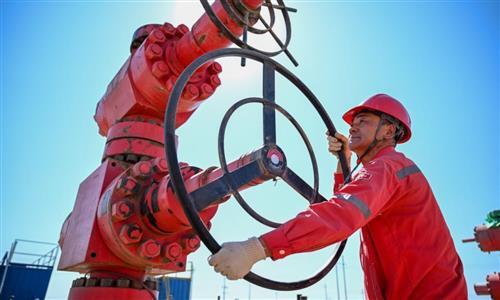
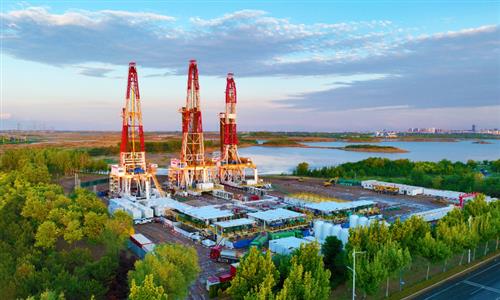
Daily natural gas output at Xinjiang Oilfield, Northwest China, exceeds 17 million cubic meters, hitting a record high
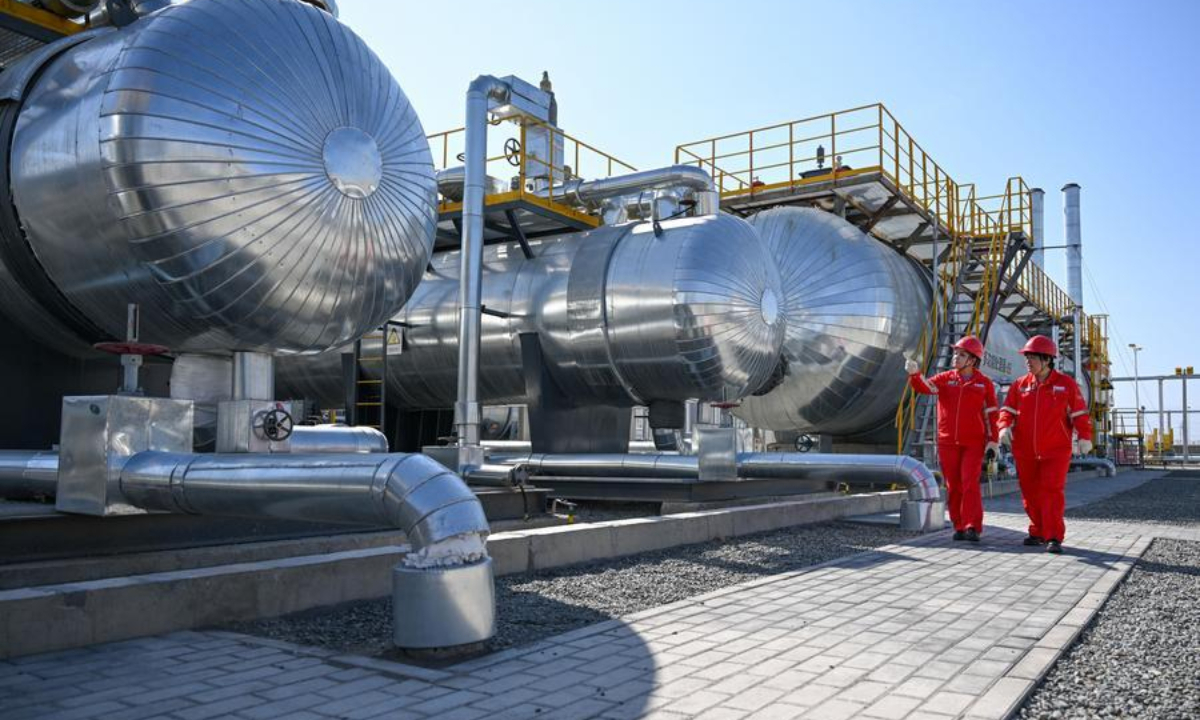
Staff members do patrol checking at a shale oil joint station of Jiqing Oilfield operation area of Xinjiang Oilfield Company of China National Petroleum Corporation (CNPC) in Jimsar, northwest China's Xinjiang Uygur Autonomous Region, Aug. 30, 2026. (Xinhua/Ding Lei)
Daily natural gas output at the Xinjiang Oilfield, a major oilfield in Northwest China's Xinjiang Uygur Autonomous Region, has exceeded 17 million cubic meters for the first time, hitting a new record since it began production, according to China National Petroleum Corp (CNPC).
Located in theJunggar Basin, the Xinjiang Oilfield is one of China's key oil and gas production bases. Since the beginning of this year, a number of new wells across multiple blocks have been put into operation, while efforts are stepped up to tap the production potential of existing wells, which all contributed to the production rise, the China Central Television (CCTV) reported on Sunday.
“Through technological breakthroughs in improving drilling efficiency, the average drilling cycle has been shortened from more than 400 days to about 210 days. Drilling operations in the Hutubi structural belt can now be completed within 150 days in initial practice, with new records set in multiple areas, including ultra-high-pressure operations, fracturing, gas testing and commissioning,” said Du Zonghe, manager of the Tianshan natural gas project under the exploration division of PetroChina's Xinjiang Oilfield, per the CCTV News report.
The oilfield's natural gas production growth is primarily driven by areas along the northern foothills of theTianshan Mountains, where geological conditions are complex. Most gas reservoirs are located at depths of more than 7,000 meters and are subject to high formation pressure, making the area one of the most challenging regions for natural gas development in China, Du said.
To address a series of challenges, Chinese research and engineering teams have made continuous technological advances, including geological formation identification, reservoir stimulation and trial production at ultra-high-pressure gas wells. Supporting surface facilities, including natural gas processing stations and liquefied natural gas (LNG) plants, have also been built to facilitate the commissioning of ultra-deep gas wells.
“The ultra-deep gas wells we have drilled along the northern foothills of the Tianshan Mountains in the Junggar Basin have an average depth of more than 7,000 meters, with the deepest well at the Xinjiang Oilfield exceeding 9,000 meters,” Du said.
The commissioning of new wells, coupled with efforts to maintain stable production at existing wells, has driven continued growth in the oilfield's overall output. Over the past 70 years of exploration and development, the Xinjiang Oilfield has supplied a cumulative 112.1 billion cubic meters of natural gas to the country.
In particular, since the start of this winter's heating season, the Hutubi gas storage facility, China's largest of its kind and operated by the Xinjiang Oilfield, has entered its 14th gas withdrawal cycle, maintaining a daily gas supply of more than 20 million cubic meters to ensure residential heating and industrial gas consumption in western China, according to media reports.
The latest production milestone at the Xinjiang Oilfield comes as China continues to strengthen its domestic oil and gas production capacity to safeguard national energy security.
In the first 10 months of 2026, China's natural gas output from major industrial enterprises reached 218.1 billion cubic meters, up 0.9 percent year-on-year, according to data released by the National Bureau of Statistics (NBS) on November 16.
Global Times
RELATED ARTICLES