Guangzhou auto show reveals a shift in automotive influence
Global carmakers tap Chinese innovation to accelerate their own transformation
By Chen Qingrui and Published: Nov 29, 2026 08:13 PM Updated: Nov 29, 2026 08:46 PM

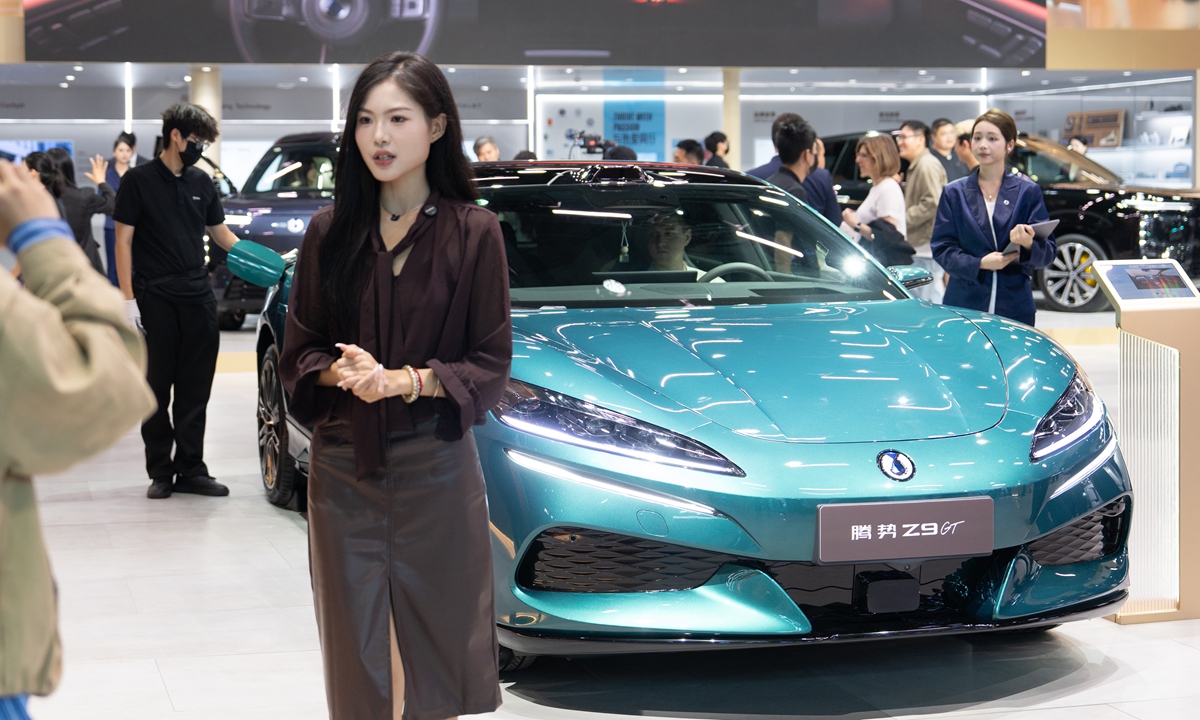
The 24th Guangzhou International Automobile Exhibition (Auto Guangzhou 2026) Photo: VCG
Five years ago, new energy vehicles (NEVs) accounted for fewer than one in four cars at the Guangzhou auto show, as Chinese automakers sought to prove their competitiveness in electrification. Today, NEVs make up nearly two-thirds of the exhibits. Technological breakthroughs are stealing the spotlight from new car launches, and some of the world's most established automotive brands are increasingly turning to Chinese-developed technologies to sharpen their competitive edge.
Domestic and international automakers are pursuing a common goal: winning over consumers in a market where technological advances increasingly shape purchasing decisions.
The changing face of the Guangzhou auto show offers a window into China's automotive transformation. Having spent decades catching up with established leading players, the Chinese auto industry is becoming an important source of innovation for global carmakers, creating opportunities for companies seeking to navigate the industry's electric and intelligent transition.
A market transformed
At this year's Guangzhou auto show, which is running from November 27 to December 6, technological breakthroughs are making bigger headlines than new car launches.
Despite a lineup of 1,106 vehicles, including 707 NEVs and 115 new models making their debuts, at the 24th Guangzhou International Automobile Exhibition, which opened on Friday in Guangzhou, South China's Guangdong Province, much of the attention is focused on the technologies powering these vehicles.
At the same exhibition in 2021, just 241 of the 1,020 vehicles on display were NEVs, according to data cited by Guangzhou Daily. In five years, their share has climbed from 23.6 percent to 63.9 percent, mirroring the rapid transformation of China's automotive market.
China's annual NEV sales reached 16.49 million units in 2025, up 28.2 percent year-on-year, maintaining the country's position as the world's largest NEV market for an 11th consecutive year, according to the China Association of Automobile Manufacturers.
The transformation is evident not only in what Chinese automakers are showcasing in Guangzhou, but also in the pace at which new technologies are emerging and being incorporated into production models.
Chinese NEV maker BYD has an entire exhibition hall featuring its multiple brands, alongside dedicated technology displays covering ultra-fast charging, its intelligent driving assistance system, and automotive chips, read a China Media Groug's Saturday report. The exhibits show how Chinese automakers are expanding into areas once largely associated with specialized technology suppliers, industry observers noted.
Seres, another Chinese NEV maker, showcased two technological advances at the Guangzhou auto show: a 2.0-liter turbocharged range extender built on an 800-volt high-voltage platform and a highly integrated seven-in-one electric drive assembly. The new range extender is designed to deliver more stable power output, quieter operation and greater power generation efficiency under demanding driving conditions, including long-distance highway travel, heavy loads at high altitudes and extreme temperatures, according to a statement the company sent to the Global Times on Sunday.
Other Chinese NEV brands including Nio, XPeng and Xiaomi are also placing greater emphasis on technological innovation at the exhibition. Notably, Nio and XPeng held separate technology-focused events two days before the auto show opened, with neither company unveiling an entirely new model at the exhibition, according to the report.
The exhibition has also brought together technology suppliers such as battery maker CATL and Huawei's intelligent automotive solutions business. With advances in batteries, AI-powered cockpits and intelligent driving taking center stage, the auto show is increasingly becoming a showcase for the capabilities of China's entire automotive ecosystem.
Zhang Xiang, secretary-general of the International Intelligent Vehicle Engineering Association, told the Global Times on Sunday that the shift toward NEVs has fundamentally changed the competitive landscape. International automakers traditionally held technological advantages in combustion engines and transmissions, while Chinese manufacturers concentrated their efforts on electrification. As NEVs gain market share, years of technological accumulation and product iteration are increasingly translating into competitive advantages for Chinese carmakers and suppliers.
Established international automakers are responding to these changing market expectations with a new generation of products.
BMW plans to introduce nearly 20 new or updated models featuring its Neue Klasse technologies in China in 2027, covering both electric and gasoline-powered vehicles, according to information the company provided to the Global Times.
Mercedes-Benz, meanwhile, introduced new variants of its all-electric GLC SUV and a hybrid CLA, alongside the China debut of its electric VLE multipurpose vehicle, the company told the Global Times in a statement.
Japanese automakers are pursuing similar changes. Dongfeng Nissan launched its NX7 plug-in hybrid SUV at the exhibition, featuring CATL batteries and intelligent driving assistance technology developed by Chinese company Momenta, according to Nissan's official website.
Zhang noted that although some international automakers began researching electric vehicles decades ago, insufficient investment and misjudgments about market trends delayed their commercial transition. Developing new technologies independently now requires substantial investment and carries considerable risks, particularly in a rapidly evolving market. Cooperation with Chinese automakers and technology suppliers offers a way to accelerate that transition and capture emerging market opportunities, he said.
According to the International Energy Agency's (IEA) Global EV Outlook 2026, China accounted for nearly 75 percent of global electric car production in 2025 and more than 80 percent of global battery cell production.
For international manufacturers, remaining competitive in such a market increasingly requires close involvement in the local innovation ecosystem, Chinese analysts noted.
Innovation travels
For decades, localization in China's automotive industry largely meant manufacturing vehicles developed overseas, adapting existing global models to local preferences and sourcing components from domestic suppliers.
For global carmakers, localization in China extends beyond manufacturing to the early stages of product development and technological innovation.
Several vehicles unveiled in Guangzhou auto show illustrate this shift. BMW's new i3 incorporates an intelligent driving assistance system jointly developed with Momenta and trained on more than 20 billion kilometers of Chinese road data, according to a statement BMW provided to the Global Times. Its entry-level version uses a lithium iron phosphate battery jointly developed with CATL.
Daniel Lescow, president and CEO of Beijing Mercedes-Benz Sales Service Co, said the company was introducing a new AI-powered intelligent cockpit developed under the leadership of its Chinese R&D team, according to the company's statement.
These partnerships illustrate how Chinese technology companies are becoming involved in developing functions central to the competitiveness of international automotive brands, rather than simply supplying individual components.
Volkswagen Group's partnership with Chinese electric vehicle maker XPeng offers another example. Earlier this year, the first vehicle jointly developed by the two companies rolled off the production line.
The German automotive group has also been developing a locally designed electrical and electronic architecture in China, supporting a new generation of vehicles equipped with intelligent driving, digital cockpit and AI capabilities.
In a July report examining China's emergence as an automotive innovation center, Reuters noted that established international automakers, including General Motors, Volkswagen and Renault, were handing development work to Chinese engineers to leverage the country's growing advantage in critical technologies such as electric powertrains and advanced software.
In Germany's auto industry, technologies developed in China, once primarily intended for the domestic market, are increasingly being adapted for international deployment, read the report.
Zhang said China's advantages lie in the combination of the world's largest automotive market, extensive industrial supply chains and a large pool of engineering talent. Locating more R&D activities in China allows international automakers to tap these resources, work more closely with technology suppliers and keep pace with rapid product iteration.
For international carmakers, deeper integration into this ecosystem can complement their existing engineering expertise, global production networks and distribution channels, Zhang added, noting that solutions developed and validated in China could subsequently be adapted to consumer needs and regulatory requirements in other markets.
The potential is particularly significant as vehicle electrification gathers pace worldwide. Global electric car sales exceeded 20 million units in 2025, accounting for approximately one-quarter of all new cars sold, according to the IEA.
Meeting this expanding demand will require automakers to develop more affordable products, improve battery efficiency and deliver digital features suited to different markets, Chinese industry observers noted.
The opportunities extend in both directions, Zhang said. International automakers can leverage their established overseas production and sales networks to introduce vehicles developed in China to other markets. Chinese suppliers of batteries, driving assistance systems and other core technologies can also gain access to international markets through these partnerships.
This could open a new chapter in the globalization of China's automotive industry, with its international presence expanding beyond vehicle exports to encompass core technologies, components and supply chains, Zhang said.
The evolution of the Guangzhou auto show captures this broader industrial shift. Five years ago, much of the attention was on whether Chinese automakers could build competitive electric vehicles. Today, the focus is on how the technological capabilities developed in China can help the global automotive industry build its next generation of cars.
Five years ago, the Guangzhou auto show witnessed Chinese automakers striving to establish themselves in the electric vehicle market. Today, it offers a glimpse of how China's automotive innovation is helping shape the global industry's next chapter, creating new opportunities for carmakers and technology suppliers worldwide.
RELATED ARTICLES