Exoskeletons deployed under extreme working conditions; market set to expand: expert
By Published: Nov 29, 2026 10:08 PM

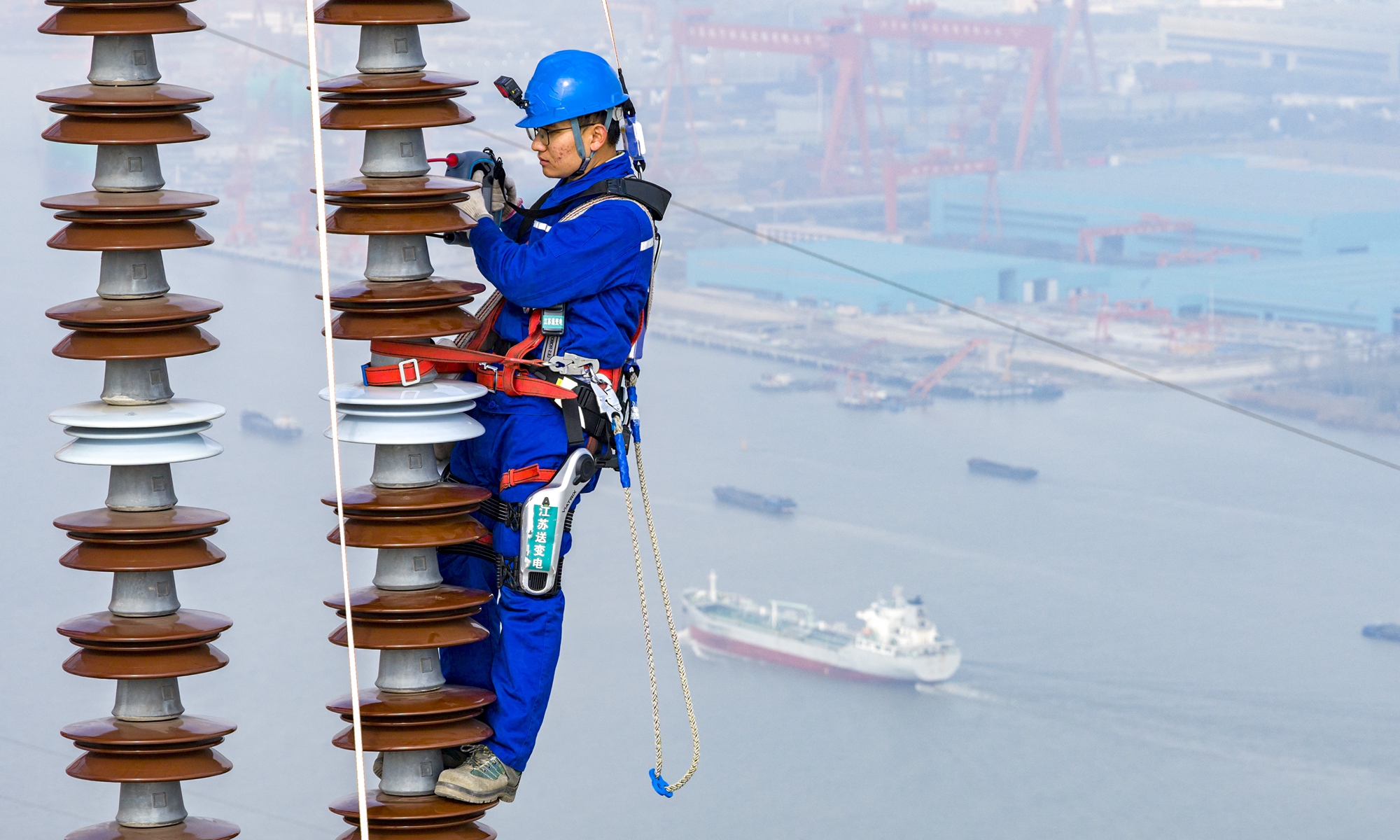
A worker uses exoskeletons to inspect towers of Fengcheng - Meili power transmission line in East China's Jiangsu Province on November 28, 2026. Photo: VCG
Exoskeletons have seen more use in China, with Chinese power workers donning some of these wearable robots to conduct inspections on towers of the Fengcheng-Meili power transmission line - the world's tallest - over the weekend in East China's Jiangsu Province.
At the maintenance site on the Yangtze River crossing section of the 500 kV Fengcheng-Meili transmission line, running from Taizhou to Wuxi in East China's Jiangsu Province, exoskeleton robots were worn by workers at an altitude of about 370 meters above the river, roughly the height of a 120-story residential building.
At that altitude, where winds can reach 50 to 74 kilometers per hour, with constantly swaying conductors, exoskeleton robots effectively cut the physical strain on their wearers. The entire suit weighs just 2.5 kilograms — roughly the same as a lightweight laptop. Built-in smart chips use artificial intelligence (AI) to track step frequency and stride length in real time, while dynamically calculating the working conditions.
As workers bend, step and crouch along the conductors, the device provides upward lift and support while stabilizing from below, reducing the strain on workers' legs in real time. It can cut lower-body muscle load by up to 40 percent at peak, per a CCTV News report.
With constant improvement, exoskeleton robots have seen increased use in China. There have been examples of such robots being used to climb famous scenic sites including the Great Wall and Mount Tai in East China's Shandong Province, as well as to help the disabled.
Li Gang, a manager with the Mount Tai scenic area, told the Global Times on Sunday that during this year's National Day holidays, some 2,000 tourists had tried his company's exoskeleton robots to climb the famous, steep mountain in Shandong.
China's strong manufacturing chain is fueling an exoskeleton boom, with startups popping up across the country, an industry expert said. With a growing elderly population, the consumer market for China's exoskeletons is set to expand, they noted.
China's Ministry of Commerce has reported a 46.4 percent year-over-year increase in sales value for exoskeleton-assist devices on key monitored platforms during the first nine months of 2026.
"The Chinese market has seen a rising number of exoskeleton companies, with relatively mature technologies accumulated in the past two years," Zhang Yi, CEO of iiMedia Research Institute, told the Global Times. "Now, many companies are looking at expanding to more specific scenarios for matching their products with actual working conditions, and rapid development is expected in the next two to three years."
China's exoskeleton robot market has exceeded 1.6 billion yuan ($240 million) in value, with roughly 26,000 units shipped in 2025, according to data from global consultancy International Data Corporation. The segment split reveals a market developing along very different medical, consumer and industrial paths.
About 110 million yuan and roughly 19,000 units were generated from the consumer segment, representing more than 70 percent of reported shipments.
Last week, China's National Development and Reform Commission, the Ministry of Civil Affairs, the National Health Commission and the Ministry of Education jointly issued an implementation plan for building a service system for the elderly and young children. Emphasizing tech input, the plan called for implementing high-tech such as AI agents, service robots, smart wearables and exoskeletons in elderly care scenarios.
In addition to consumer-grade exoskeletons and medical exoskeletons that help patients in their rehabilitation, efforts are also being made to explore industrial usage.
In February, Chinese energy giant China Energy Investment Corporation Co (CHN Energy) unveiled an exoskeleton robot system specifically designed for complex mining environments.
Designed to address critical challenges in mine disaster response, that robot features an innovative "rigid-flexible coupling" structural design, integrating upper and lower-limb power-assist modules with an embedded multi-sensor system and AI controller, with movement recognition accuracy exceeding 95 percent, and a maximum load capacity of 80 kilograms for carrying and dragging. The system reduces human metabolic energy consumption by about 20 percent, according to Xinhua.
RELATED ARTICLES