China’s economy displays strong resilience in April despite intensified external shocks
High-tech manufacturing drives industrial output
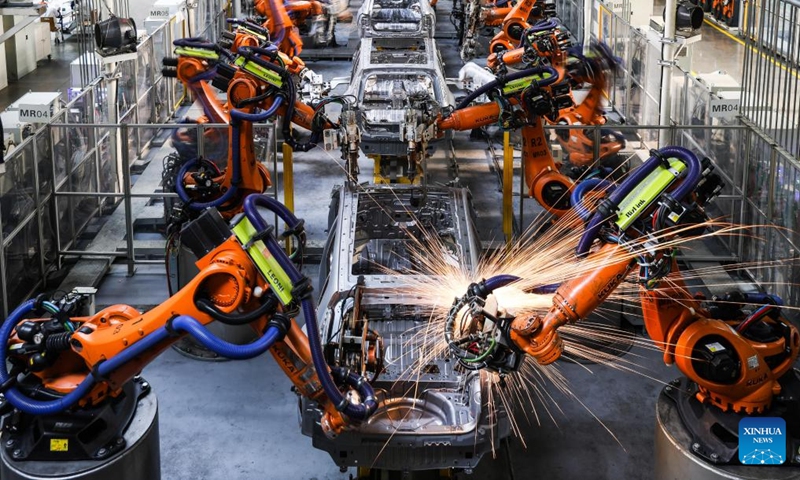
This photo shows an automobile production line of the GAC Group in Guangzhou, south China's Guangdong Province, Feb. 24, 2025. Photo: Xinhua
Facing intensified external shocks and overlapping internal challenges in April, China's economy withstood these pressures to achieve stable growth, with industrial output growing steadily, employment remaining stable, and new growth drivers continuously emerging. The country's key economic indicators fully demonstrated the strong resilience and shock resistance of the national economy, Fu Linghui, spokesperson of the National Bureau of Statistics (NBS), said on Monday.
Three major economic indicators -- industrial output, retail sales and fixed-asset investment -- drew wide attention due to hefty US tariffs on Chinese goods in April. However, despite the unstable external environment, the country managed to withstand the "test" with its strong domestic economic endogenous momentum and resilience, a Chinese expert said.
According to the NBS, the total value-added of industrial enterprises above the designated size grew by 6.1 percent year-on-year in April, beating market expectations of 5.5-percent growth.
Notably, the value-added of high-tech manufacturing increased by 10 percent year-on-year. The output of 3D printing devices, industrial robots and new-energy vehicles grew by 60.7 percent, 51.5 percent and 38.9 percent, respectively, Fu noted.
"The April economic performance featured the output of high-tech manufacturing, driven by the rapid development of artificial intelligence (AI)," Hong Tao, director of the Institute of Business Economics at Beijing Technology and Business University, told the Global Times on Monday, noting that it also demonstrated the results of China's high-quality development.
Marshall Mills, senior resident representative of IMF in China, said in an interview with the Global Times that the further development and adoption of AI holds the potential for renewed productivity gains across the economy.
CNBC on Monday reported that the industrial output figures indicated that the impact of US tariffs was not as harsh as had been expected.
In April, retail sales grew 5.1 percent year-on-year to 3.72 trillion yuan ($515.29 billion), with the growth rate up by 0.24 percentage points month-on-month. Sales of goods under trade-in programs increased significantly, contributing to the growth and support of total retail sales, Fu noted.
"Unleashing China's policy effectiveness promotes smooth consumption development. Boosting consumption can reduce dependence on the external market, while growth in consumption will further stimulate enterprise production and stabilize employment and the economy," Hong Yong, an expert at the Digital-Real Economies Integration Forum 50, told the Global Times on Monday.
In the first four months, fixed-asset investment totaled 14.7 trillion yuan, up by 4.0 percent year-on-year.
In April, China's total goods trade rose by 5.6 percent, with the rate of export growth rising 9.3 percent.
Fu noted that last month, the external environment changed drastically, and the pressure on foreign trade increased. However, China's foreign trade overcame difficulties and maintained steady growth, demonstrating strong resilience and international competitiveness.
Huo Jianguo, a vice chairman of the China Society for World Trade Organization Studies in Beijing, told the Global Times that in April, the external environment of China's economic development was subjected to a significant impact due to hefty US tariffs, but the country's response has been justified -- objective and rational, based on strong domestic economic endogenous momentum and resilience -- and it withstood this "test."
According to Huo, this has provided valuable experience for China to deal with similar external shocks, which is conducive to the nation's ability to "manage the country's own affairs well," and promote the realization of high-quality economic development.
Fu further noted that although the international environment is still complex and marked by instability, uncertainty and unpredictability, the fundamentals of China's long-term sound economic growth will not change, with concerted efforts involving macro policies, the growing momentum of consumption and innovation.
Nomura raised its forecast for China's GDP growth for the quarter ending in June to 4.8 percent from 3.7 percent on the back of robust economic data in April, while lifting the full-year growth projection to 3.7 percent from 3.5 percent, according to CNBC on Monday.
Morgan Stanley also raised its near-term quarterly China GDP forecasts on expectations that companies may try to speed up exports to take advantage of the lower tariffs, CNBC reported.
Looking ahead, Hong Tao noted that China has enough policy space to meet the challenges. "The foreign trade enterprises can continue to diversify their markets such as Latin America, Africa and ASEAN. In addition, the government should input more efforts to boost domestic demand including rural consumption, in order to promote the stable development of the national economy," he noted.
Fu said that at present, the international environment remains complex and severe, with the rise of unilateralism and protectionism, which have seriously impacted the international economic and trade order and constrained global economic growth. However, the general trend of win-win international cooperation will not change, nor will China's resolute expansion of opening up, the spokesperson noted.
RELATED ARTICLES