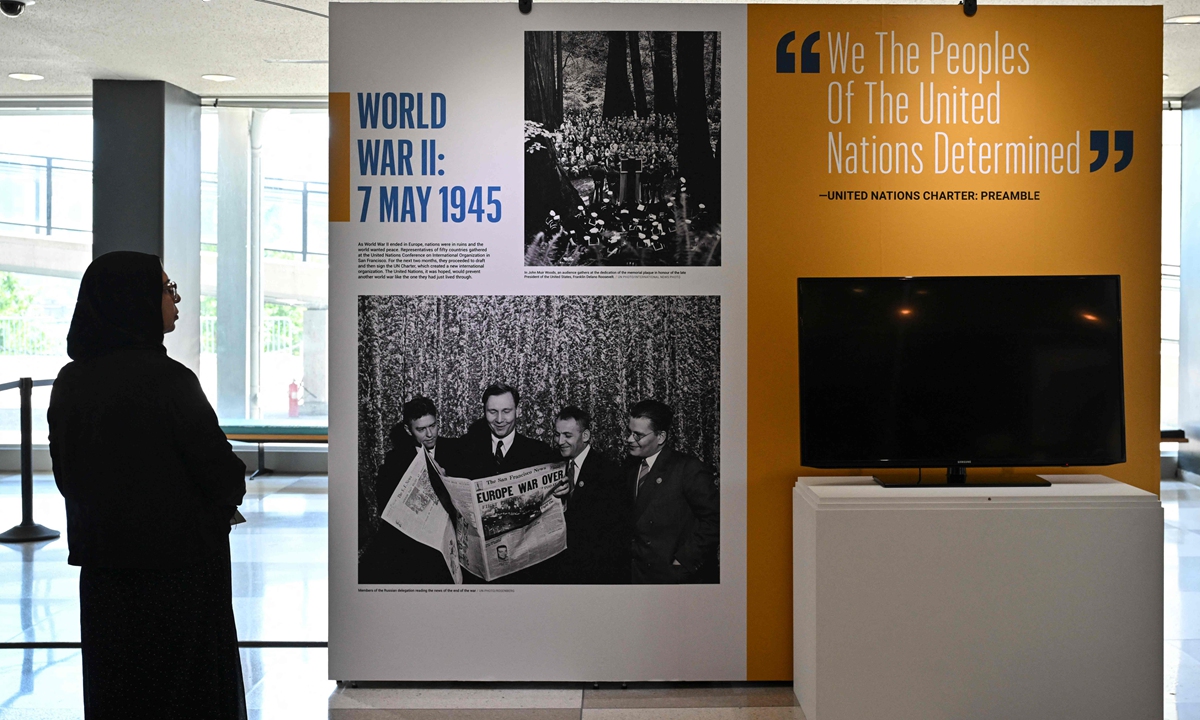
A person looks at the "UN Charter" exhibition ahead of the 80th anniversary of its signing at the United Nations Headquarters on June 20, 2025, in New York. Photo: VCG
Editor's Note:2025 marks the 80th anniversary of the victory in the Chinese People's War of Resistance against Japanese Aggression and the World Anti-Fascist War. Eight decades have passed, yet the world once again finds itself at a crossroads. The rise of unilateralism, ongoing geopolitical turbulence and the distortion of historical truths remind us of the enduring relevance of remembering the past and safeguarding peace. Against this backdrop, the Global Times launches the column "Revisiting WWII, Defending Peace," inviting renowned scholars and peace advocates from around the world to revisit the history of WWII through contemporary lenses. Through diverse perspectives, the series seeks to uphold historical memory, promote shared development and defend fairness and justice. Only by confronting history with honesty and clarity can humanity find the wisdom to shape a more peaceful and sustainable future. This is the fourth installment of this series.
To comprehend the ultimate laws of the world and human society, one must first study history. The year 2025 marks the 80th anniversary of the victory in the Chinese People's War of Resistance Against Japanese Aggression and the World Anti-Fascist War. Only by grounding ourselves in an accurate understanding of World War II (WWII) history can humanity preserve the essential peace amid the growing risks of deglobalization and conflict.
Why should we study and honor the history of WWII today? Because without understanding the war's history and the process behind the creation of the UN Charter, we cannot fully grasp why China emphasizes the idea of a shared future for mankind and insists on the principles of peace and development.
In Volume II of Xi Jinping: The Governance of China, the article that calls to "bear history in mind, honor all those who laid down their lives, cherish peace and open up the future" articulates that "war is like a mirror. Looking at it helps us better appreciate the value of peace."
In an article of Volume III, which is also a keynote speech delivered by Xi, titled "Jointly Charting a Course Toward a Brighter Future" at the APEC CEO Summit in 2018, Xi noted how different choices have steered the world toward divergent trajectories. He highlighted a poignant lesson from human history: "Mankind has learned lessons the hard way. WWII, for instance, plunged mankind into the abyss of calamity in the last century. Not far away from where we are meeting now are the sites of the fierce Battle of the Coral Sea and the Battle of Guadalcanal in World War II. Today, this part of the ocean has long restored its peace and calm, but never should we forget the lessons of history."
Upholding a correct historical perspective on WWII means making a clear distinction between the anti-fascist forces and fascist aggressors, as well as between justice and injustice. WWII was a global anti-fascist war in which fascist powers brazenly challenged the universal values of liberty, equality and fraternity that had been progressively established in the modern era, along with the international community's fundamental respect for national sovereignty and the right to survival. The Kellogg-Briand Pact was signed in 1928. This is an international agreement on peace in which signatory states promised not to use war to resolve "disputes or conflicts of whatever nature or of whatever origin they may be."
Yet signatories like Germany and Japan betrayed this pledge by launching wars of aggression. History demonstrates that all wars of aggression inevitably inflict catastrophic suffering, breed enduring hatred and fracture global unity - with perpetrators invariably facing justice, as conclusively proven by postwar tribunals.
Promoting the correct historical perspective on WWII is essential to upholding the postwar international order. In the wake of the war, the international community's most significant decision was establishing the UN, whose Charter emerged from the painful lessons of history. This global catastrophe made nations profoundly value peace and urgently demand international security mechanisms. Thus the Conference of the UN was called to meet in San Francisco in 1945, for the sole purpose of drafting the charter of a world security organization.
San Francisco was chosen simply because war-ravaged Europe and the Soviet Union had no suitable meeting grounds left standing. Led by the US, UK, Soviet Union, China and France, the UN Charter was signed on June 26, 1945 by the representatives of 50 sovereign countries with a fundamental mission: maintaining world peace. The Charter mandates peaceful dispute resolution, "prohibits the threat or use of force and calls on all Members to respect the sovereignty, territorial integrity and political independence of other States."
Taiwan's return to China is an integral part of the victory of WWII and the post-war international order. The legal basis for reclaiming Taiwan stems from important international documents signed during WWII, including the Cairo Declaration and the Potsdam Declaration. Therefore, the Chinese government's firm opposition to "Taiwan independence" is based on its resolute defense of WWII history and the principles of the UN Charter. Any attempt toward "Taiwan independence" is not only an infringement on China's national sovereignty, but also a blatant disregard for the history of WWII and the achievements of the anti-fascist war.
To uphold the correct historical perspective on WWII is to oppose all forms of hegemony, "Western-centrism," and theories of racial superiority, while defending international fairness and justice. Historically, Nazi expansionist theories and the core ideology of Japanese militarism were cut from the same cloth - both preached the superiority of their own race. Such "racial supremacy" served as their pretext for aggression: seizing foreign lands under the guise of securing "living space." When certain countries today aggressively pursue their own interests through might-makes-right bullying - imposing their will on others - is this not the same old poison in a new bottle? Western-centrism, in its modern form, has become the ideological bedrock for suppressing the rise of developing countries. For decades, the US and its Western allies monopolized the top of the global industrial chain, confining developing countries to low-end manufacturing. Now, China's peaceful rise and its high-quality development strategy are shattering this Western monopoly - precisely what they find hardest to accept.
"The world needs justice, not hegemonism," wrote Xi. This statement gives voice to humanity's shared aspirations - our universal longing for peace and collective prosperity that transcends borders. "Now, the global deficits in peace, development, security and governance continue to widen unabated. To address these deficits, I have proposed to build a community with a shared future for mankind and put forward the Global Development Initiative, the Global Security Initiative, and the Global Civilization Initiative as a way forward to steer the reform of the global governance system toward greater fairness and justice," Xi continued.
China's role is both a guardian of historical memory and a nation that consistently draws wisdom from the past to safeguard peace and development, while advancing the vision of a community with a shared future for mankind. As Xi said, the best inheritance of history is the creation of history, and the greatest tribute to humanity is the creation of a new model for human advancement.
Although the international order established after WWII is not perfect, it has still brought about a relatively peaceful and stable global order, with a peace-driven trend safeguarded by the UN Charter. In the intersection of WWII, international political history and the realities of today's world, people should more clearly recognize that in order to continue maintaining global peace, stability and fairness, we must firmly promote a correct understanding of WWII history, collectively uphold the achievements of its victory and resolutely oppose any actions that deny or distort the historical facts of the war.
The author is a major general, military historian, and retired professor. opinion@globaltimes.com.cn
RELATED ARTICLES