China's Kenli 10-2 oilfield starts production, adding another 100-million-ton giant to Bohai Bay
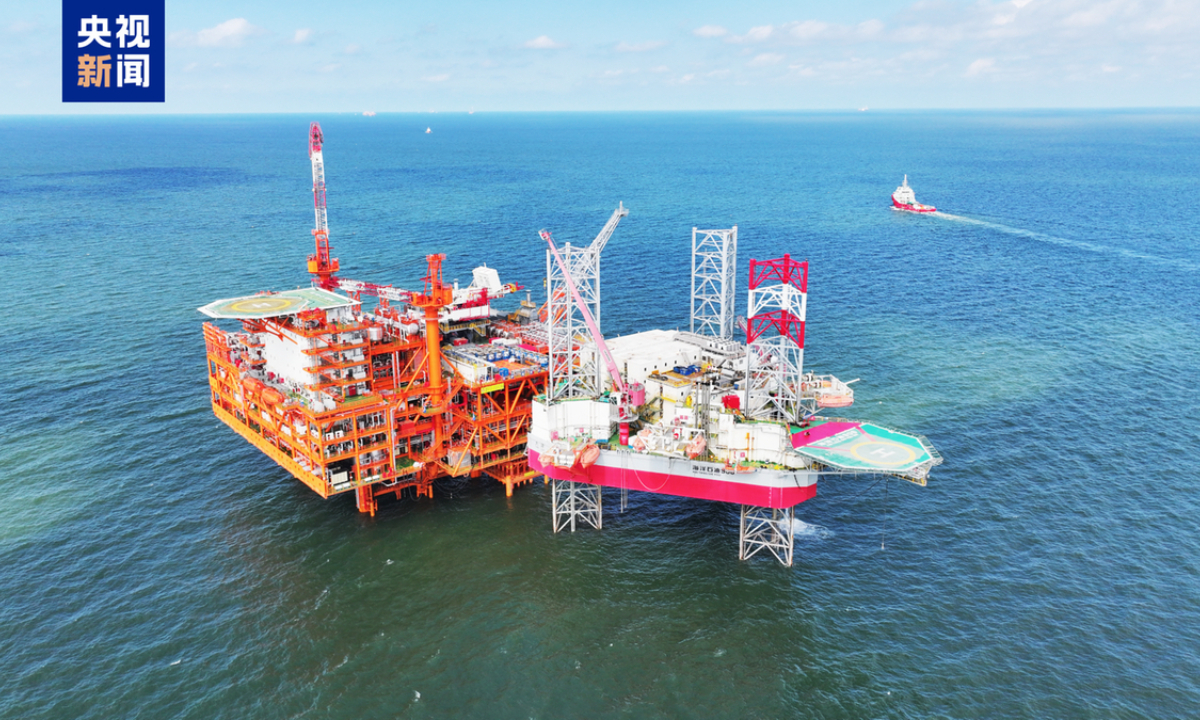
China's Kenli 10-2 oilfield comes online on July 22, 2025. Photo: screenshot of CMG's report
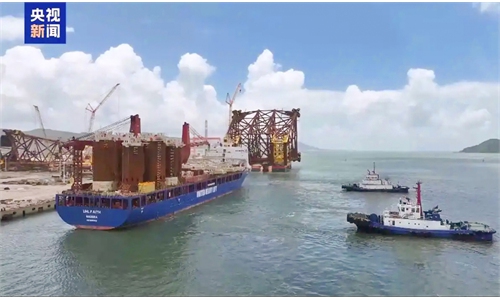
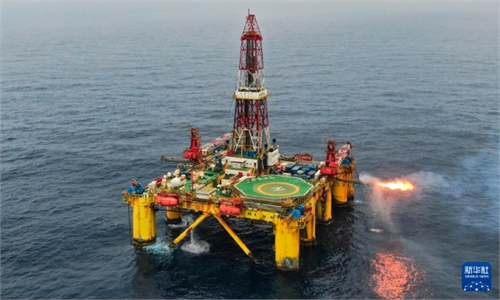
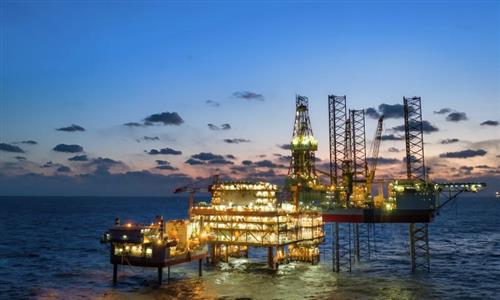
China's Kenli 10-2 oilfield development project in Bohai Bay has officially started production, marking the launch of the country's largest shallow-layer lithologic oilfield at sea, according to China National Offshore Oil Corporation (CNOOC), China Media Group (CMG) reported Tuesday.
Located in the southern waters of Bohai Bay, about 245 kilometers from Tianjin, the Kenli 10-2 oilfield has an average water depth of around 20 meters. With proven geological reserves exceeding 100 million tons, it is the first 100-million-ton-class lithologic oilfield discovered in the shallow zones of the Bohai Bay Basin's depression belt, according to CMG.
Lin Boqiang, director of the China Center for Energy Economics Research at Xiamen University, told the Global Times that the smooth launch of the new offshore oilfield was in line with expectations and marks a long-anticipated milestone, highlighting China's world-class deep-sea exploration capabilities and continued technological progress.
The Kenli 10-2 oilfield significantly boosts China's offshore oil and gas supply capacity, helping to meet the energy demands of the Beijing-Tianjin-Hebei region and the broader Bohai area, while strengthening the foundation of national energy security, Wang Peng, an associate research fellow at the Beijing Academy of Social Sciences, told the Global Times on Tuesday.
Its development drives growth across related sectors such as marine engineering, logistics, and support services, fostering regional economic vitality and contributing to the expansion of China's marine economy and maritime strength, Wang said.
While deep-sea oil and gas is not a direct route to clean energy, it serves as a strategic complement to natural gas and renewables, jointly supporting China's dual-carbon goals by balancing energy security with low-carbon development, he said.
Lin noted that while new onshore reserves are still being found, China's limited land-based resources make offshore development increasingly important. The government has long prioritized upstream oil and gas exploration, with major state-owned oil companies ramping up investment in the sector.
With China relying on imports for about 60-70% of its oil and around 45% of its natural gas, boosting domestic upstream output is key to energy security, Lin said.
"Natural gas, in particular, is a relatively clean energy source. Expanding its use not only strengthens energy security but also supports China's low-carbon transition," Lin added.
Kenli 10-2 is China's first offshore development of a ramified heavy oil reservoir. The underground oil and gas are distributed within narrow, curved sand bodies that intertwine like the shadows of tree branches on the ground, forming a "ramified" pattern. The reservoir is characterized by scattered reserves, complex geological conditions, and a wide range of underground crude oil viscosities, making extraction particularly challenging.
The successful launch of the Kenli 10-2 oilfield development project marks a new stage in China's offshore development of complex heavy oil reservoirs. It sets a valuable precedent for future projects of this kind and is expected to strongly support Bohai Oilfield—the country's largest offshore oilfield—in reaching its annual production target of 40 million tons of oil and gas this year.
In recent years, China's marine economy has seen rapid growth, providing a solid industrial foundation for the advancement of deep-sea technologies. China's 2025 government work report, for the first time, included "deep-sea technology" as a key area under strategic emerging industries. According to data from the Ministry of Natural Resources, the country's gross ocean product surpassed 10 trillion yuan ($1.38 trillion) for the first time in 2024, accounting for 7.8 percent of national GDP. Key drivers include marine tourism, ocean transport, fisheries, and offshore oil and gas.
Global Times
RELATED ARTICLES