Tariffs shadow Marcos’ visit despite US officials underscoring alliance
Subordinate position determines Manila lacks bargaining power in security, trade: experts
By and Zhao Jingru Published: Jul 22, 2025 10:24 PM Updated: Jul 23, 2025 12:24 AM

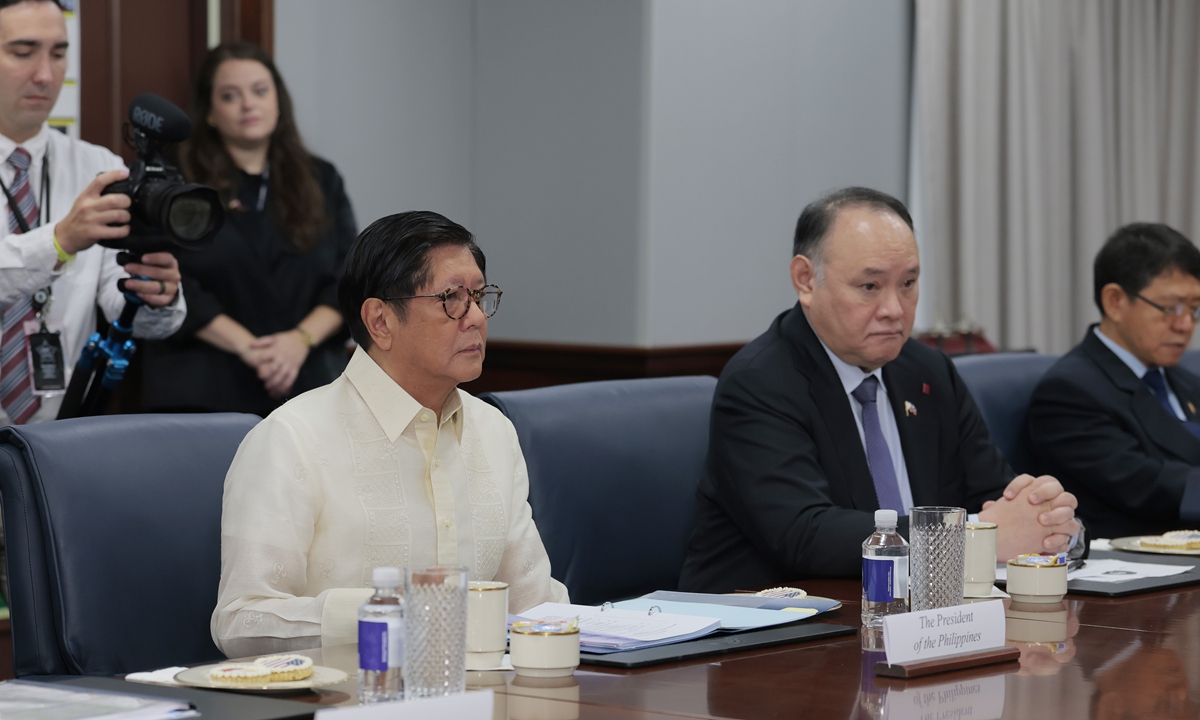
Philippine President Ferdinand Marcos Jr. listens as US Defense Secretary Pete Hegseth delivers remarks to reporters before a meeting at the Pentagon on July 21, 2025 in Arlington, Virginia, US. Photo: VCG
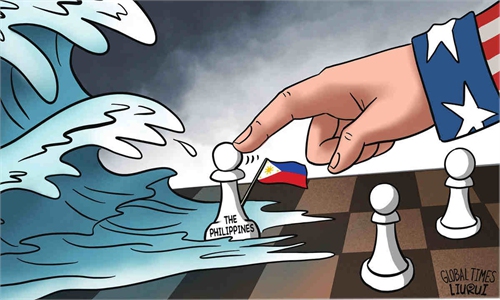
Philippine President Ferdinand Marcos Jr, during his US visit, exchanged views on regional security with senior US officials, which came ahead of the meeting with US President Donald Trump scheduled on Tuesday local time, where tariff issues are reported to take center stage.Analysts said Marcos is leveraging military and security ties with the US as a bargaining chip to secure tariff relief for the Philippines. However, Manila's role as a strategic pawn for the US in the Asia-Pacific region determines that it lacks genuine bargaining power and substantive negotiation leverage in both tariffs and security.
Marcos, who arrived in the US on Sunday, met with US Defense Secretary Pete Hegseth and later met with Secretary of State Marco Rubio on Monday, Reuters reported.
Both Rubio and Hegseth repeated threadbare rhetoric regarding the US-Philippine alliance and defense treaty.
Tammy Bruce, spokesperson of the US State Department, said on Monday that Rubio and Marcos underscored the importance of the "ironclad US-Philippines Alliance" to maintaining peace and stability in the Indo-Pacific region.
According to the transcript released by Pentagon, Marcos called the mutual defense treaty between two sides the "cornerstone" of the relationship and said the alliance was helping preserve stability in the South China Sea.
In response to the US' reiteration of its defense commitment to the Philippines, Chinese Foreign Ministry spokesperson Guo Jiakun said on Tuesday that "whatever cooperation the US and the Philippines have, it should not target or harm any third party, still less incite confrontation and heighten tensions in the region."
Moreover, Philippine media, including the GMA News and Manila Times, mentioned that the talks between Trump and Marcos would focus on US tariffs.
The US had a deficit of nearly $5 billion with the Philippines last year on bilateral goods trade of $23.5 billion, according to media reports. In July, the US administration raised the threatened "reciprocal" tariffs on imports from the Philippines to 20 percent from 17 percent threatened in April, according to media reports.
Citing analysts, the South China Morning Post said that the Philippines could grant the US more access to military facilities under their Enhanced Defense Cooperation Agreement (EDCA) and offer favorable terms on mining concessions, potentially including rare earth minerals, for a lower tariff on his country's exports.
Xu Liping, Director of the Center for Southeast Asian Studies at the Chinese Academy of Social Sciences, told the Global Times that the primary objective of Marcos' visit likely is to bolster the Philippines' alliance with the US in the military and security spheres through some deals, in exchange for tariff reductions.
However, for Trump administration, tariffs remain the top priority, a stance applied consistently to allies like Japan and South Korea, and even more so to the Philippines, Xu said, noting that military and security cooperation between the Philippines and the US is often driven predominantly by American interests.
Xu noted that it seems that the Philippines seeks to position itself as a strategic pawn of the US to gain interests. However, this largely depends on the US government's overall adjustments to its "Indo-Pacific" strategy, rather than Manila's strategic considerations. Consequently, the Philippines' strategy of relying on US for provocative actions lacks long-term viability.
Philippine Senator Imee Marcos on Sunday urged the president, her brother, to protect Philippine interests when he talks with Trump, according to the Manila Times.
Imee Marcos said "as a sovereign country, the tariff agreement with the US should also be reciprocal… The US does not seem to regard us as a sovereign state, nor can we see the value of any so-called treaty allies any longer."
"No president should sign away our sovereignty — not for gold, not for promises, not for alliances," she added, per the Philippine media.
Ma Bo, an associate professor at the School of International Studies at Nanjing University, told the Global Times that the incumbent Philippine government has effectively become a strategic proxy and pawn of the US in the Asia-Pacific region. "This subordinate relationship determines that Manila lacks genuine bargaining power and substantial leverage in negotiations on trade and security issues with US."
The expert said that Philippines accounts for only a minuscule portion of US foreign trade, and its economic weight within ASEAN is relatively limited. From a security standpoint, despite some US officials' efforts to position the Philippines as a frontline pivot in the "Indo-Pacific strategy," Trump may not place significant emphasis on the Philippines' security role.
This dependent relationship means that the Philippines can neither maintain an independent stance on security issues nor secure substantial benefits in trade negotiations, Ma said.
Currently, the US government, particularly President Trump, does not prioritize the "Indo-Pacific," said Ma, "against this backdrop, Marcos' proactive planning of his US visit is, in essence, an attempt to rekindle attention to the South China Sea issue, aiming to draw focus from US public opinion, Congress and even the White House."
This move precisely reflects Manila's anxiety about its strategic position: if it fails to sustain US strategic attention, the Philippines' significance in regional affairs will be greatly diminished.
RELATED ARTICLES