Illustration: Liu Rui/GT
Philippine President Ferdinand Marcos Jr. concluded his three-day official visit to the US on Tuesday. US President Donald Trump described the visit as "beautiful." However, it appears the outcomes for Manila are not so "beautiful," delivering little in terms of substantive gains and leaving the Philippines disappointed.
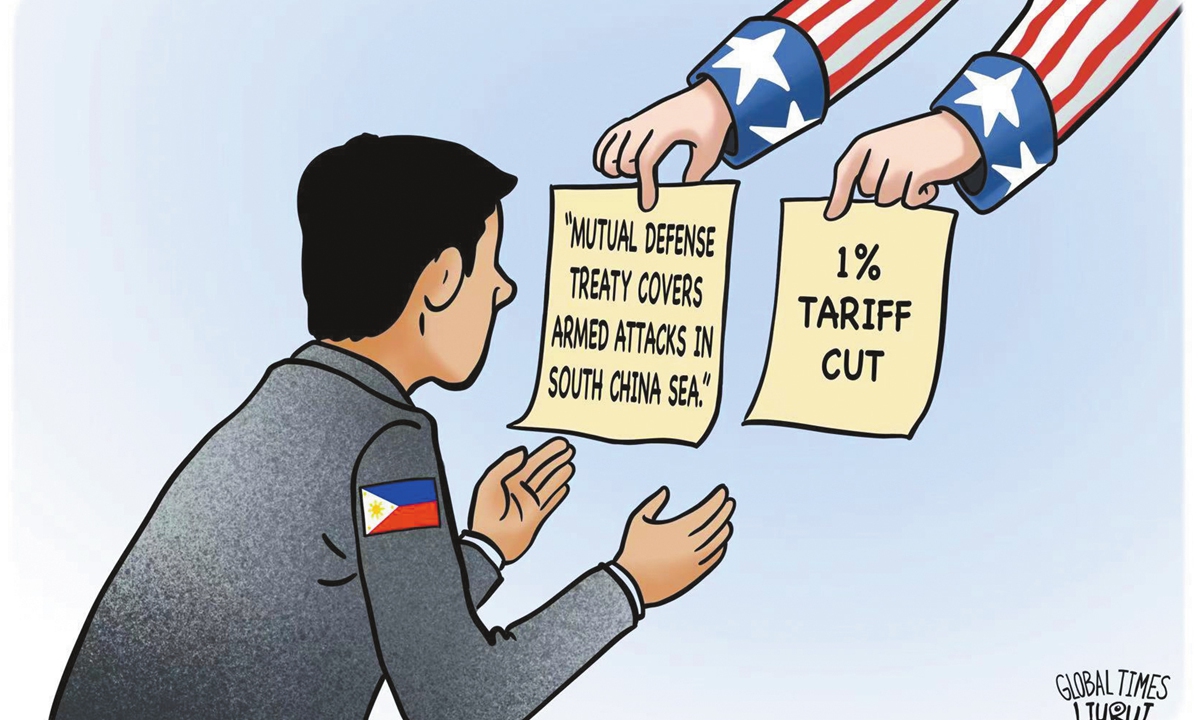
Securing a favorable trade deal to shield Philippine exports from looming economic shocks was one of Marcos' top priorities during the visit. Yet, after hearing numerous statements from US officials, such as "our storied alliance has never been stronger or more essential than it is today," Marcos only received a 1 percent cut in US tariffs on Filipino goods.
On Tuesday, the US announced a trade deal with the Philippines that would put a 19 percent tariff on exports from the Philippines - a slight decrease from the 20 percent it previously threatened but still higher than the 17 percent "reciprocal" rate Washington declared for dozens of countries back in April. This minor reduction has sparked domestic and international skepticism about the real value of the so-called "storied alliance." Aries Arugay, chairperson of the Department of Political Science at the University of the Philippines Diliman, said that this one percent tariff cut is a "not so good deal" for the Philippines.
"Under unilateral US pressure, the Philippines obtained a symbolic 1 percent reduction," Li Haidong, a professor at China Foreign Affairs University, told the Global Times. He noted that given the imbalance in the US-Philippines relationship, Manila lacked real bargaining power. Terms like "negotiation" or "deal" are merely formalities - in essence, the Philippines was forced to accept a lopsided arrangement, unable to control the process, Li emphasized.
On Monday, Marcos met with US Secretary of State Marco Rubio and Defense Secretary Pete Hegseth. Rubio emphasized "the importance of the ironclad US-Philippines Alliance to maintaining peace and stability in the Indo-Pacific region," while Hegseth reiterated that the US-Philippines Mutual Defense Treaty extends to armed attacks in the South China Sea, noting that the two countries are "deploying new cutting-edge missiles and unmanned systems."
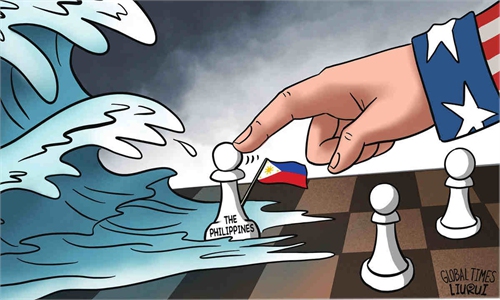
Behind Marcos' "pleasure" with what he called "the modernization of the Philippine military" actually lies a more dangerous reality - the Philippines is being pushed further to the front line and dragged deeper into the regional security tensions. The so-called Mutual Defense Treaty, from the US perspective, is a convenient strategic tool. But the real risks and costs are borne by the Philippines. Far from providing security, this treaty exposes Manila to greater geopolitical danger.
"Washington is using the Philippines to stir up regional tensions for its own strategic ends, while Manila mistakenly believes it can lead the region's security narrative," said Li. Without the ability to shape its own security policy, the Philippines' deepening military ties with the US may only entrench it further in insecurity.
Since the Marcos government took office, it has sought to court the US by constantly provoking China over the South China Sea issue and worsening relations with China. Trump, however, remarked during Marcos' visit that he didn't mind if the Philippines got along with China, because the US has a good relationship with China, too. These remarks were widely seen as sending a "stunning message" to the Philippines. It's unclear whether Trump's reminder will prompt the Philippines to rethink its strategy toward China - assuming there is one to begin with.
It appears that Macros' visit has brought no meaningful benefits and instead highlighted the country's increasingly passive role as a pawn in great power competition. Ultimately, the Philippines' awkwardness stems from its own willingness to play someone else's game. Clinging to the US does not bring national confidence - it only reinforces a narrative of self-diminishment in international affairs.
RELATED ARTICLES