Foshan launches citywide health campaign to curb Chikungunya spread as new cases decline in core areas
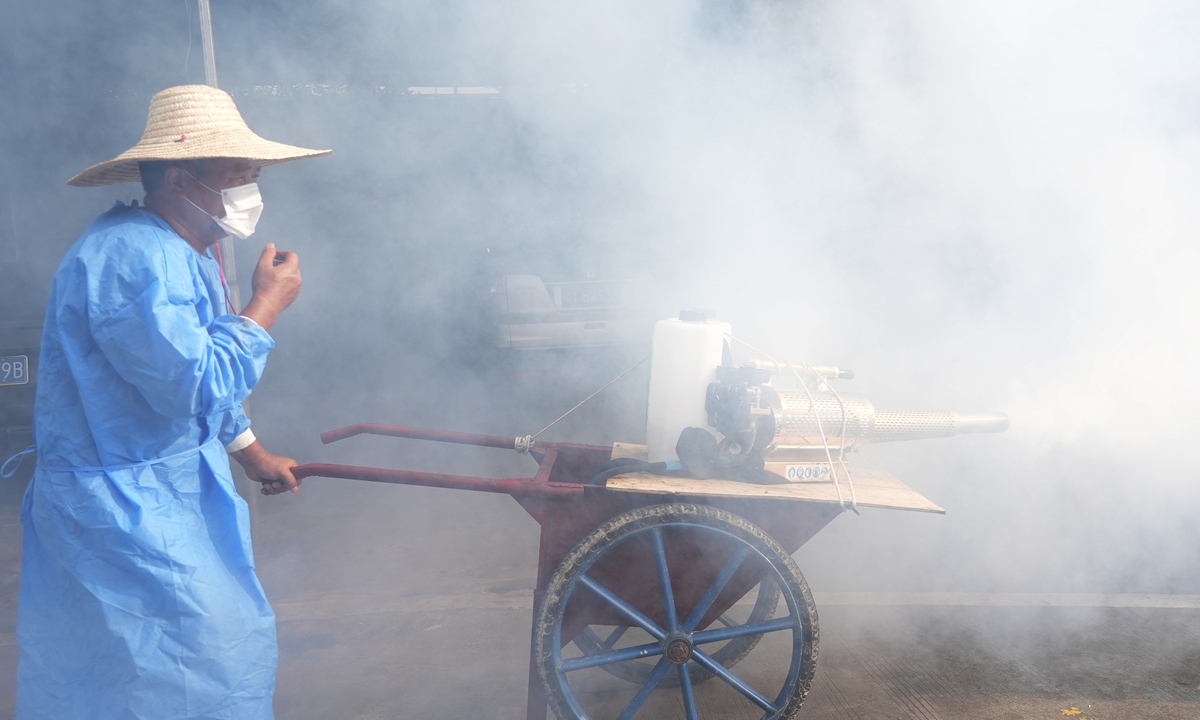
Local authorities in Foshan in South China's Guangdong Province continue mosquito eradication efforts to control the chikungunya outbreak on July 29, 2025. Photo: VCG
Foshan in South China's Guangdong Province launched a health campaign on Thursday to combat the spread of Chikungunya fever, according to an official announcement released via the city government's WeChat account.
As part of the campaign, government departments, enterprises and institutions, village and community organizations, residential compounds, factories, commercial tenants and individuals are urged to take coordinated action to eliminate mosquito breeding grounds. These include environmental cleanups, removal of stagnant water from containers and ensuring comprehensive coverage with no blind spots.
According to the announcement, all government organs and public institutions are required to mobilize staff to carry out thorough internal cleanups. They are also asked to deploy sufficient manpower to support village- and community-level health campaigns.
A local resident told the Global Times on Thursday that the campaign "has had little impact on daily life but is helpful in blocking the spread of Chikungunya."
"As a resident living in Foshan, I support this health campaign. Since Chikungunya is transmitted by mosquitoes, eradicating them will definitely help prevent the virus from spreading. It benefits everyone," the resident said.
The resident also noted that while no large-scale action had yet been observed in their neighborhood, preventive measures were already visible. "Although I haven't seen major operations in my residential compound, mosquito repellent has been placed in elevators and public areas, and the neighborhood committee and property management are promoting mosquito control efforts," the resident added.
Enterprises and factories are urged to actively involve employees in the campaign, fully implement their cleaning responsibilities in front of their premises, and eliminate garbage, abandoned containers, and stagnant water within and around office areas and factory zones.
Communities and residential compounds are required to carry out large-scale sanitation drives. Efforts should focus on clearing garbage and debris from waste collection points, underground parking lots, back alleys, green belts and shrubbery. Pooled rainwater, including that in potholes, must be drained or treated with mosquito larvicides if immediate removal is not possible.
For small businesses and residents, the city urges them to fulfill their responsibilities by removing trash and standing water from business premises, front and back yards, rooftops and terraces. Households are advised to empty water from potted plant trays, unused bottles, and tires, maintain smooth drainage in ditches and sewers, and uphold a clean and tidy living and working environment.
The city also encouraged residents to report mosquito breeding hazards and sanitation black spots in key areas using a hot line.
Some of the disease control efforts have also drawn international attention. The Associated Press reported on Thursday that "Chinese authorities are using nets, spraying insecticide and even deploying drones to fight the mosquito-borne Chikungunya virus." Authorities are using drones to identify standing water, where mosquitoes lay eggs, according to AP.
In Foshan's Shunde district, drones have reportedly conducted scheduled panoramic aerial photography over 170 sites to provide communities with high-resolution images to precisely guide grassroots inspections, according to the China News Service. In the Sanshui district, authorities have deployed multiple vehicle-mounted and fixed drone bases to assist local housing and urban-rural development departments and township governments in inspecting high-risk mosquito breeding sites, including hidden construction waste yards, water pits, and residential building surroundings.
On Wednesday, the health bureau of Shunde district, identified as a core area of the Chikungunya fever in the province, reported 122 new confirmed cases, marking the eighth consecutive day of decline in daily new cases since July 29.
Since August 1, the number of townships and subdistricts primarily affected has also decreased from three to two and has remained stable, according to data from the health bureau of Shunde.
RELATED ARTICLES