Ishiba’s potential speech at war memorial event under spotlight
Experts warn of historical revisionism in Japanese society and politics
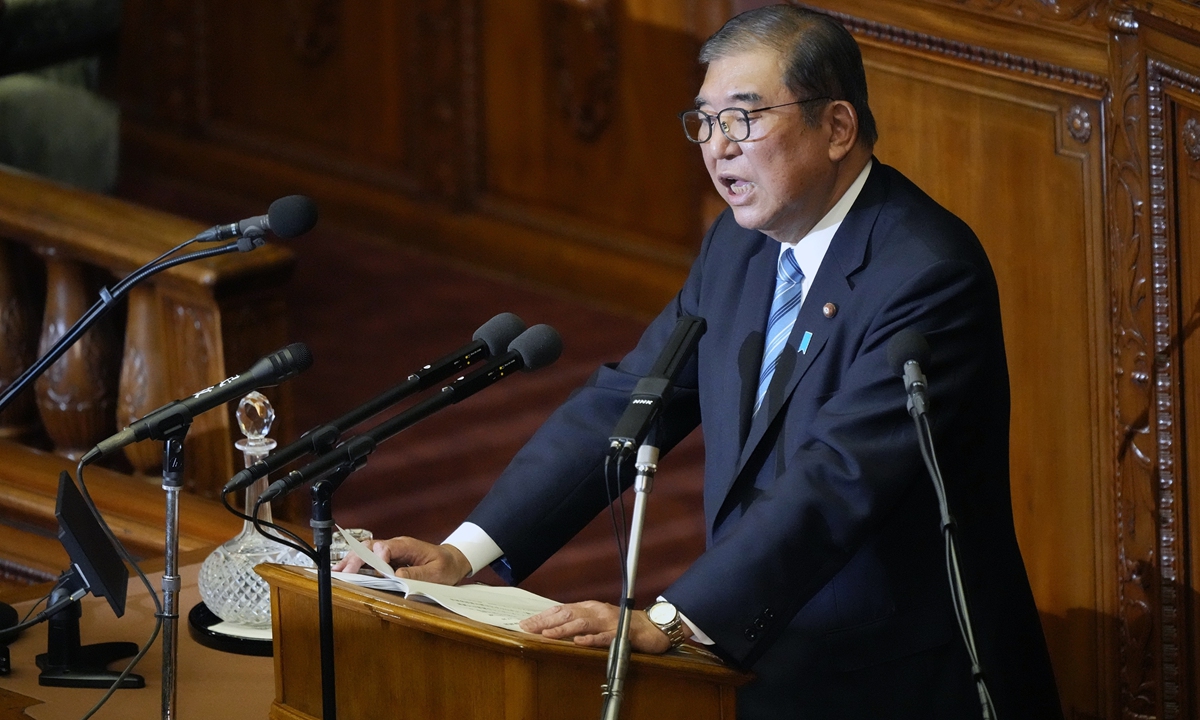
Japanese Prime Minister Shigeru Ishiba delivers his policy speech at the extraordinary session of parliament's lower house Friday, Nov. 29, 2024, in Tokyo. (Photo: VCG)
As Japan prepares to hold a ceremony to commemorate people who lost their lives during World War II on Friday, the anniversary of Japan officially announcing its unconditional surrender, Japanese Prime Minister Shigeru Ishiba's speech is coming under strict scrutiny from the Japanese public as well as neighboring countries that had suffered from Japanese aggression during World War II.
On Friday, the Japanese government will hold a ceremony at the Nippon Budokan Hall in Tokyo to commemorate the people who lost their lives in the war, according to a statement released by the Prime Minister's Office of Japan on Thursday.
According to the ceremony schedule released by the Ministry of Health, Labour and Welfare, Ishiba will deliver a speech.
Japan's Chief Cabinet Secretary Yoshimasa Hayashi issued a statement on Thursday, calling on the public to observe a moment of silence during the ceremony, Jiji News reported.
According to Tokyo Shimbun, regarding the content of the Prime Minister's speech at the ceremony, former Japanese Prime Minister Shinzo Abe had not mentioned Japan's aggression and reflection toward Asian countries in the speech since 2013, and subsequent prime ministers have followed this approach.
Past Japanese prime ministers issued official statements on the 50th, 60th and 70th war anniversaries with a pledge to never again go to war, according to Japan Today. The statements have been scrutinized not only by other nations who suffered under Japan's wartime aggression, but also among the Japanese public.
In consideration of opposition from conservative factions within the ruling Liberal Democratic Party, Ishiba has agreed not to issue an official "postwar statement" that would be accompanied by a Cabinet decision, according to Asahi. Instead, Ishiba expressed his desire to mark 80 years since the end of World War II with a personal message.
During a press conference in Hiroshima on August 6, when asked about the personal message, Ishiba expressed the willingness to consider how to prevent a war.
According to Tokyo Shimbun, the results of a nationwide survey, which was conducted by the Japan Public Opinion Research Association and summarized on Sunday, show that about 80 percent of respondents hope that Ishiba will issue a statement or message.
The timing and format of the message are yet to be decided.
"It is extremely important for the current Prime Minister to reflect on what lessons can be learned from the history of past invasions and colonial rule, and to express those thoughts in his own words," Yoichi Jomaru, a former journalist with Asahi Shimbun, told the Global Times on Thursday.
Jomaru said the content should include words of apology and remembrance for all those who fell victim to Japan's aggression and colonial rule. "Japan has not yet fully achieved reconciliation with Asian countries. I believe that striving for reconciliation will make a significant contribution to the realization of peace in Asia and the world," he noted.
Reflection on history
With the approaching of the 80th anniversary of Japan's unconditional surrender on August 15, discussions surrounding the Japanese government's attitude toward its past aggression are also gaining traction in Japanese public discourse.
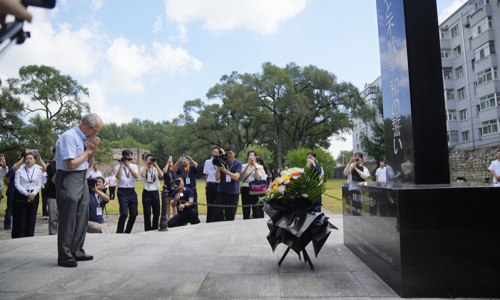
Kanagawa association for advancing memory inheritance, a Japanese civil group, is currently holding its 10th annual exhibition on Japan's war atrocities during WWII in Yokohama, Japan, from August 8 to 15, aiming to help more Japanese people learn about their country's history of perpetration to prevent history from repeating itself. The exhibition covers topics including the "comfort women" system, the Nanjing Massacre, Unit 731, chemical warfare, and the indiscriminate bombing of Chongqing during Japan's aggression against China.
Kenji Takeoka, a representative of the exhibition, told the Global Times on Wednesday that as this year marks the 80th anniversary of the end of WWII, "I hope the public will learn the facts of Japan's wartime perpetration."
In recent years, historical revisionism has taken root in Japanese society and politics, fueling a rollback in both historical reflection and constraints on military growth, Lü Yaodong, deputy director of the Institute of Japanese Studies from the Chinese Academy of Social Sciences, told the Global Times.
Lü said that apart from historical revisionism, Japan has also hyped "China threat" narratives so as to move beyond the constraints of its pacifist constitution, and forged military alliances with countries such as the US, Australia.
RELATED ARTICLES