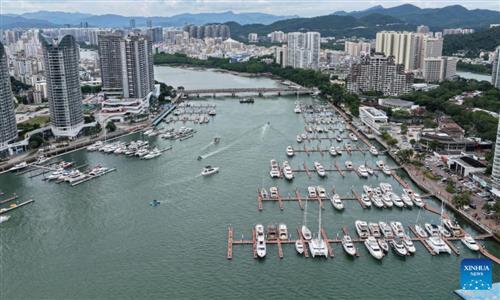
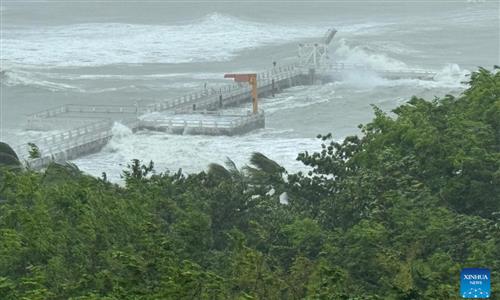
Hainan activates highest alert as Typhoon Kajiki nears
Flood control and disaster relief supplies ready for rainstorms
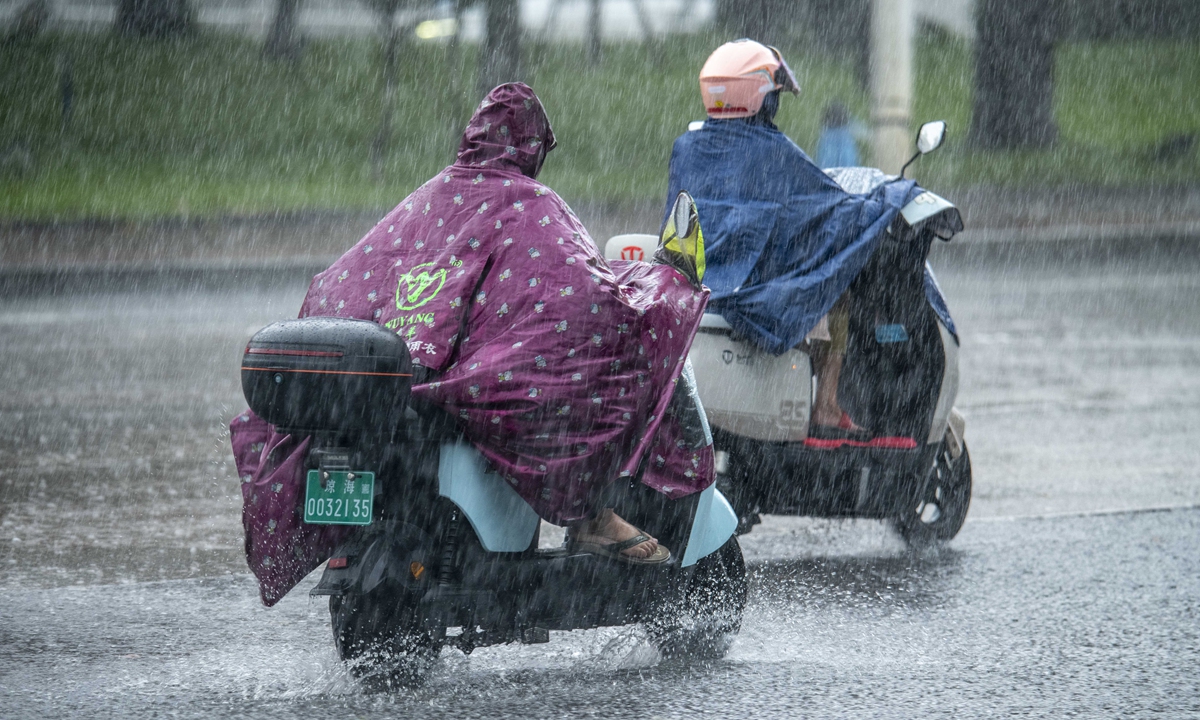
Residents of Qionghai city, Hainan Province, go about their daily business amid torrential rain on August 24, 2025. Under the influence of Typhoon Kajiki, the 13th typhoon of the year, most parts of South China's Hainan Province have been hit by heavy rainfall. Photo: VCG
As Typhoon Kajiki, the 13th typhoon of the year, intensified to a severe typhoon on Sunday afternoon, bringing widespread gales and rainstorms, the coastal city of Sanya in South China's Hainan Province has been placed on high alert to cope with the possible damage brought about by the typhoon.
On Sunday morning, multiple departments including Hainan Meteorological Service and the provincial committee for disaster prevention, mitigation and relief elevated their warnings against typhoon to the highest levels as Kajiki gained strength, CCTV reported. The Sanya Meteorological Observatory raised its typhoon warning from orange to red.
The typhoon is likely to pass close to the southern coast of Hainan around Sunday evening, according to CCTV News.
During a press conference briefing on Sunday morning, Cai Qinbo, a spokesperson from the Hainan Meteorological Service, said that Typhoon Kajiki could be the strongest typhoon to make landfall in Sanya in nearly 40 years.
As of 8 am on Sunday, 20,349 people across Hainan had been relocated from dangerous areas, including 3,190 from dilapidated houses, 14,759 from construction sites, 1,969 from low-lying flood-prone areas, and 431 from areas prone to mountain floods, with efforts made to ensure that everyone who should be relocated was moved promptly and in advance, according to the local authority.
Besides, the province has stockpiled a total of 2.59 million units of flood control and disaster relief supplies, and has pre-deployed 83 rescue teams with 2,821 personnel, 264 vehicles and 3,492 sets of equipment.
In particular, 24 rescue teams with 932 personnel, 188 sets of vehicles and equipment, and two rescue helicopters have been pre-positioned in areas such as Sanya, where the typhoon may make landfall, to ensure a timely response.
In terms of public transportation, the Sanya Phoenix International Airport suspended all flight takeoffs and landings starting from 10 am on Sunday, and canceled the subsequent flights, the Beijing Youth Daily reported on Sunday.
Meanwhile, Hainan has organized the timely evacuation and sheltering of tourists, suspended activities such as surfing, diving, sailing and sea fishing, and closed land-based scenic spots, according to the Beijing Youth Daily.
The Sanya government also issued a notification of the citywide suspension of classes, productions, businesses, transportation, operation of vessels and the closure of scenic spots starting from Sunday.
The meteorological authorities reminded the public that regardless of whether the typhoon makes landfall, the public should take prevention measures, avoid island-related or maritime activities. If people are outdoors, they should not seek shelter near billboards, iron towers, or large trees, instead, they should return as quickly as possible to buildings for safety, according to CCTV.
A resident surnamed Dong in Jiyang district, Sanya, told the Global Times on Sunday that his community has arranged patrolling personnel to check the low-lying areas and the drainage ditches. Large trees at risk of toppling have been cordoned off.
Meteorologists said that based on Kajiki's movement trend, the typhoon with a complete circulation, a compact structure and a relatively clear path is more likely to pass near the southern coast of Hainan Island, but the possibility of making landfall along the coast between Sanya and Ledong cannot be ruled out at present. It may also possibly skirt the southern coastline of the island before heading toward Vietnam. Whether the typhoon makes landfall or skirts past Hainan Island, its intensity is unlikely to weaken significantly and may even further increase.
Ma Jun, director of the Institute of Public and Environmental Affairs, told the Global Times on Sunday that this year's typhoon season started relatively late, but the frequency of occurrences has been higher.
RELATED ARTICLES