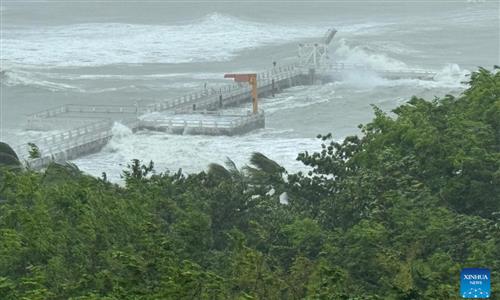
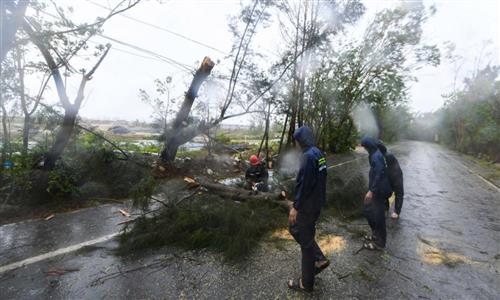
NMC continues to issue yellow typhoon alert and blue rainstorm alert
Efforts underway to repair damaged infrastructure, restore normal production: Hainan government
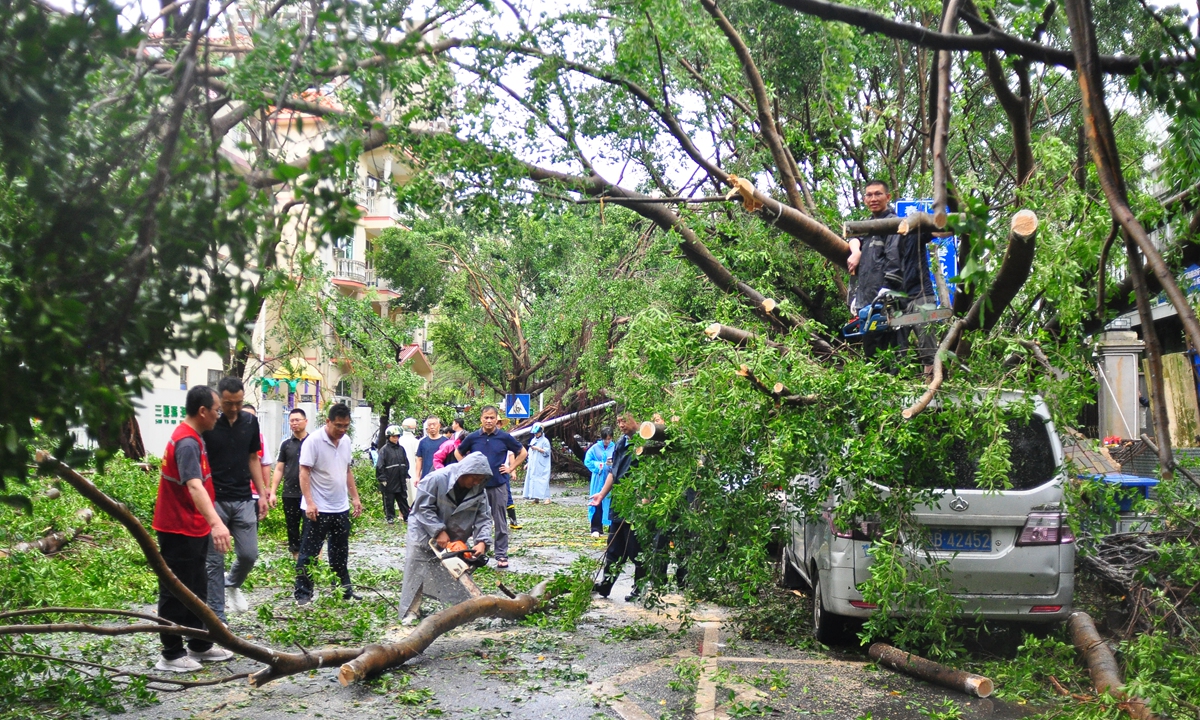
Rescue personnel and local volunteers work together to clear roadblocks caused by Typhoon Kajiki in Sanya, South China's Hainan Province, on August 25, 2025. The passage of Typhoon Kajiki has brought heavy rain to the city, resulting in fallen trees blocking roads. Photo: VCG
Despite Typhoon Kajiki brushing past the offshore waters of South China's Hainan Island on Sunday night before moving toward Vietnam, China's meteorological authority on Monday reminded the public of the typhoon's subsequent impacts on the island and the southern area, and forecast a new round of rainfall across the country's northern area.
China's National Meteorological Center (NMC) on Monday continued to issue a yellow typhoon alert and a blue rainstorm alert to warn about the continuous impact of Kajiki, this year's 13th typhoon, on Hainan Island and across a vast area of the country from the south to the north.
According to the press conference held by the South China's Hainan Province on Monday, no typhoon-related deaths had been reported in the province as of 9 am on Monday, while a total of 102,500 people in the province have reportedly been affected, adding that detailed disaster data is still being compiled, China Central Television reported on Monday.
Areas severely stricken by the typhoon include cities and counties such as Sanya, Ledong and Lingshui, having experienced varying degrees of road, water supply, power, and communication disruptions, as well as toppled trees and localized waterlogging, CCTV reported.
A resident surnamed Wang from Sanya told the Global Times on Monday that the district where she lives doesn't actually experience very strong winds, "but when the wind blows, it feels like the buildings are swaying." The outdoor delivery shelves in the neighborhood have been blown over, and trees have toppled as well, she said, adding that the destructive force of this typhoon was quite significant.
After receiving the work-from-home notice on Sunday afternoon, Wang said she hurried to the nearby supermarket to stock up on daily necessities such as instant food and bottled water, just in case of water and power outages.
"When I got to the supermarket around 3 pm, some shelves were already empty, but the staff said they were doing their best to restock," she recalled.
Wang also mentioned that there were three brief power outages from Sunday evening to Monday noon, but the power company restored electricity promptly each time. "The residential property management taped up the ground-floor windows of every building. Even though the typhoon was fierce, the response from all sides and departments felt effective and timely," she added.
The province has strengthened overall coordination, making every effort to carry out emergency rescue and disaster relief. The Global Times learned from the publicity department of Sanya Municipal People's Government on Monday that Typhoon Kajiki is the strongest to hit Sanya since meteorological records began in the city. Local authorities have mobilized nearly 5,000 personnel to clear roadblocks and repair water, power, and communication facilities since 1 am on Monday, the government said.
More than 770,000 units of emergency supplies have been allocated to support flood control, emergency rescue, and road clearance efforts in severely affected cities and counties such as Sanya, Lingshui and Ledong.
As of 8 am on Monday, a total of 40,772 people were evacuated, with special attention to fishermen, vulnerable groups and the elderly, sick, disabled, or pregnant, according to the government. Safety measures were implemented to prevent evacuees from returning to dangerous areas.
The city will continuously monitor typhoon and rain conditions and adjust risk control measures. Efforts are underway to repair damaged infrastructure to restore normal production and daily life as quickly as possible, the Global Times learned.
A tourist surnamed Zheng from South China's Guangdong Province told the Global Times that by Monday afternoon, the rain had eased, and she already saw soldiers starting to clear the roads of debris along the street. "Rescue teams from the military command arrived, and local volunteers also came to the hotel to deliver emergency food supplies."
Zheng said that her phone kept receiving text alerts about the typhoon, and traffic police officers were out in the heavy rain — blocking roads, stopping vehicles and advising people not to go out. "The typhoon disrupted my travel plans, but I really felt the warmth of Sanya city," she said.
As the impact of Typhoon Kajiki has weakened, relevant ports and airports in Guangdong and Hainan provinces have made corresponding adjustments.
Three ports in Haikou, Hainan, resumed transportation operations at 6 pm on Monday, while the Sanya Phoenix International Airport has also returned to business as usual, according to CCTV.
According to an NMC forecast, in the northern part of the country, moderate to heavy rain will sweep across parts of multiple provinces including Northwest China's Qinghai and Gansu provinces, and the majority of North China from Tuesday to Thursday, with some of these regions experiencing short-term intense rainfall, as well as severe convective weather.
Heavy rain is expected in southeastern parts of Northeast China's Jilin Province, northwestern parts of Sichuan Basin, the coastal area of southern parts of Southwest China's Guangxi Zhuang Autonomous Region, and the southern part of Hainan Island from Monday morning to Tuesday morning, Jiemian News reported on Monday.
The NMC forecast that accumulated rainfall in the affected regions will range from 30 to 60 millimeters, with localized areas reaching 100 to 180 millimeters. Some areas will experience short-term heavy rainfall with the maximum hourly precipitation reaching 20 to 40 millimeters, and even exceeding 60 millimeters in some areas, chinanews.com reported Monday.
RELATED ARTICLES