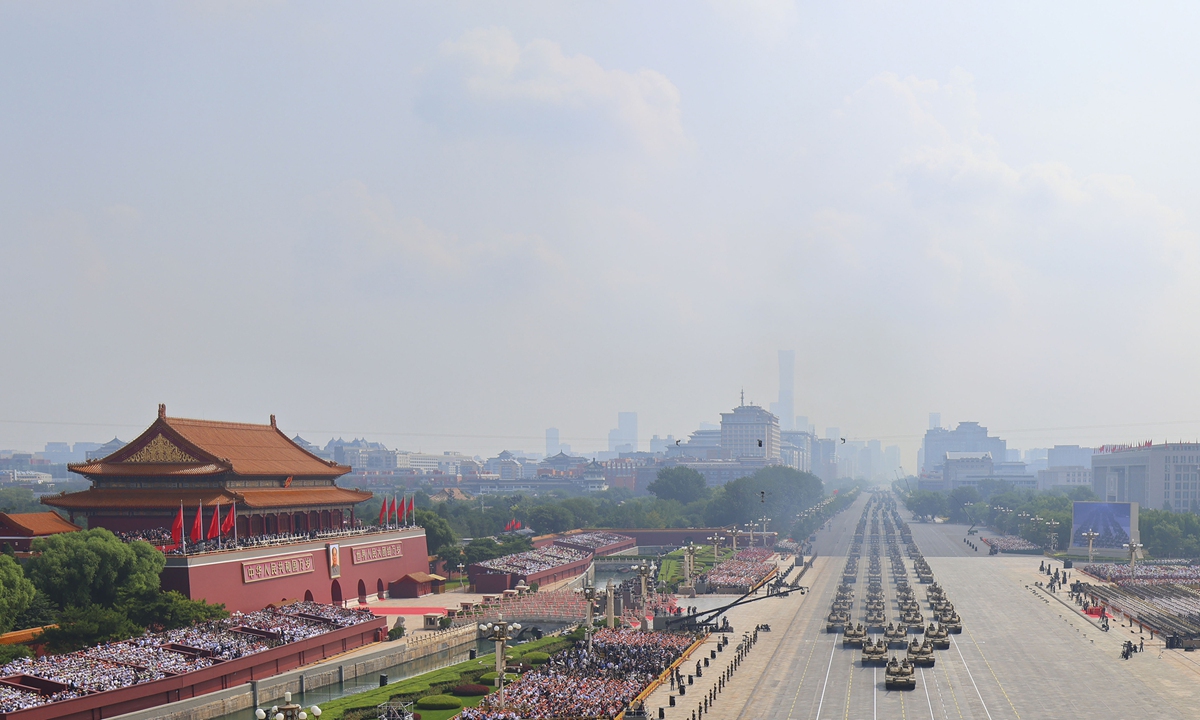
A massive military parade is held in Beijing on September 3, 2025 to mark the 80th anniversary of the victory in the Chinese People's War of Resistance against Japanese Aggression and the World Anti-Fascist War. The armament formation is being reviewed at the event. Photo: Xinhua
On Wednesday, China held a grand military parade in Tiananmen Square to mark the 80th anniversary of the Victory of the Chinese People's War of Resistance Against Japanese Aggression and the World Anti-Fascist War (V-Day).
It is the first large-scale parade of its kind since the 2015 event commemorating the 70th anniversary of the founding of the People's Republic of China.
The international environment today differs markedly from 2015: Strategic rivalry between China and the US has intensified, the Russia-Ukraine conflict has reshaped the global security landscape, and geopolitics has returned to center stage. Against this backdrop, the parade is not only a solemn act of historical remembrance but also a key opportunity for the international community to observe how China presents its military development and strategic outlook. Above all, consistent with the idea of peaceful internationalism, it signals that China's defense posture is intended to safeguard its right to development and help uphold regional and global stability.
Over the past several decades, China's overall national strength has grown substantially. The parade serves as a platform to highlight the progress of Chinese modernization, reflecting advances in industrial capacity, innovation and organizational capability. Rather than focusing on individual pieces of hardware, the significance of the parade lies in the message it has conveyed: China has been working to strengthen the foundations of its defense establishment in a systematic and sustainable way.
Contrary to "muscle-flexing" interpretations, the parade is meant to rebut the assumption that a strong country will inevitably seek hegemony. The international system is in flux: Geopolitical divides are deepening, and economic as well as technological competition is increasingly weaponized - fragmenting the global order and heightening risk. In this context, China is using the parade to reaffirm a commitment to peaceful development. The message is loud and clear: A strong national defense for China is meant to shield modernization from external disruption, not to pursue expansion.
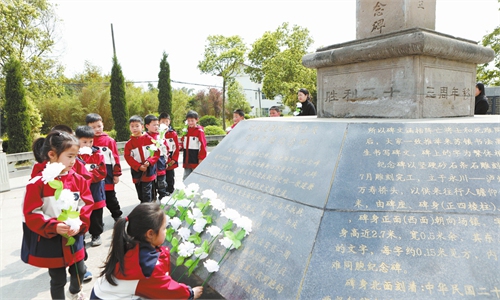
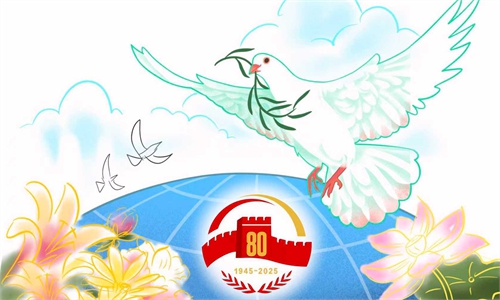
Holding the event on V-Day carries moral significance. It revives the shared memory of WWII and underscores the value of peace while warning against unilateralism and hegemonic behavior. This approach reflects a long-standing strand of Chinese diplomacy often described as peaceful internationalism - drawing on the ethos of "harmony in diversity," shaped by the historical experience of China's "century of humiliation," and reinforced by consistent support for multilateralism since 1949.
As Chinese officials have framed it, the parade is intended not to flaunt force but to demonstrate the resolve to safeguard peace through strength and uphold justice through action - while reaffirming support for the post-war international order and for international fairness and justice.
At the same time, China has sent a clear signal that it will defend its core interests, particularly regarding Taiwan question. For China, the victory in the War of Resistance Against Japanese Aggression marked a historic turning point from national crisis toward rejuvenation, shaping a core state commitment: the uncompromising defense of sovereignty, security and development interests.
If the parade carries a deterrent function, its primary purpose is to discourage separatist moves toward "Taiwan independence" and external interference by demonstrating both determination and resolve. In this sense, the parade is best understood not as saber-rattling but as realist strategic communication: setting clear red lines and using deterrence to preserve stability.
The V-Day military parade offers a reflection on the relationship between strength and peace amid what Chinese discourse calls "profound changes unseen in a century." It conveys a dual message. First, the growth of China's defense posture is intended to provide a firm safeguard for peaceful development, ensuring that modernization is not derailed by external pressure. Second, China does not seek hegemonic expansion. Rather, it aims to help maintain regional and global stability in a constructive way.
By combining confidence with restraint, the parade seeks to show that great-power responsibility lies not in domination but in using strength to safeguard peace and in upholding justice through action.
Ma Bo is an associate professor at the School of International Studies of Nanjing University. Xu Yiyi is a research assistant at the School of International Studies of Nanjing University. opinion@globaltimes.com.cn
RELATED ARTICLES