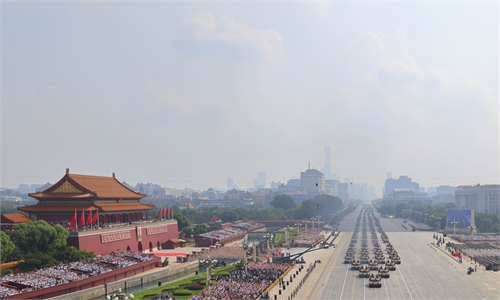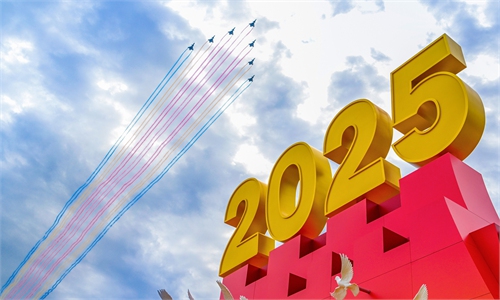
China holds a massive V-Day parade at Tian'anmen Square in Beijing, with aerial formations flying over the anniversary platform displaying the year "2025", on September 3, 2025. Photo: VCG
When China hosted the Shanghai Cooperation Organisation (SCO) Summit and the Victory Day parade commemorating the 80th anniversary of the victory in the Chinese People's War of Resistance Against Japanese Aggression and the World Anti-Fascist War, many Western commentators rushed to frame both events as 'political theatre'. Their narratives suggested China was using these events to challenge the US-led liberal international order and assert its global ambitions. But this interpretation - steeped in Cold War thinking and the ideological residue of centuries of colonial imperialism - is a misstatement that ignores the deeper significance of both gatherings.The SCO, founded in 2001 by China, Russia and four Central Asian countries, was built to address post-Cold War instability and non-traditional security threats. One of its missions centers on combating the "three evils": terrorism, separatism and extremism. Unlike NATO, structured as a military alliance focused on external threats and power projection, the SCO has remained inward-looking - prioritizing regional stability, internal security and cooperative development.
The organization is dynamic, drawing new members, including India and Pakistan in 2017, Iran in 2023, Belarus in 2024, and New Dialogue partners such as Sri Lanka, Turkey and the United Arab Emirates. Today, it spans 42 percent of the world's population and covers 24 percent of the Earth's land mass. Its agenda has grown to encompass economic cooperation, cyber security and cultural exchange, but its core remains the protection and strengthening of its member states from internal destabilization.
The SCO's Regional Anti-Terrorist Structure coordinates intelligence sharing, joint exercises and anti-drug operations. These efforts reflect a pragmatic approach to security - one that recognizes the shared vulnerabilities of Eurasian nations and seeks to build resilience through collaboration rather than confrontation.
The purpose of the SCO is to maintain peace and stability. The West would be wise to remember this, and not dismiss the SCO as a geopolitical challenge to the West. The SCO is not a rival to Western institutions, but a parallel framework for regional governance - one that deserves recognition, not reflexive suspicion.
The Victory Day parade in Tian'anmen Square was more than a display of military might - It was a solemn tribute to the millions who suffered and sacrificed during WWII.
For decades, the dominant narrative of WWII has centered on Western powers, often downplaying the roles of Russia, China and other Asian nations. The V-Day commemoration that China had held sought to restore historical balance and remind the world of the devastating consequences of fascism. In a war that created 100 million casualties, China suffered 35 million and Russia almost 27 million, mostly civilians.
The root causes of WWII stemmed from fascism. In Germany, it followed the Treaty of Versailles; in Japan, it was fueled by resentment toward Western dominance and a desire to emulate colonial expansion. Both regimes weaponized media and myth to dehumanize their targets and mobilize their populations for war and genocide. But, the perpetrators of these crimes were manipulated by those who sought power and dominance. They are the true evil which lurks within our human nature, which the Tian'anmen Square commemoration reminds us to never forget and always resist.
In today's climate - Where populist nostalgia and authoritarian rhetoric are once again gaining traction - remembering the horrors of war is not just symbolic, it is essential. The parade serves as a warning against the seductive simplicity of ideologies that promise strength through division and glory through violence.
The absence of Western leaders from both events - especially the latter - was widely interpreted as a moral stance. But this reading reinforces a binary worldview: Legitimacy belongs only to Western-led initiatives, while others are suspect. Such thinking is outdated and counterproductive. It prevents meaningful engagement and perpetuates mistrust at a time when global cooperation is more urgent than ever.
China's efforts to promote self-reliance, commemorate its past and engage with regional partners should be judged on their merits - not through the lens of ideological rivalry. The SCO Summit and Victory Day parade were not declarations of dominance - they were invitations to rethink how we remember history and how we can shape the future. If the West truly believes in multilateralism and shared values, it must move beyond reflexive skepticism and engage with the world as it is - not as it was.
The SCO Summit and Victory Day parade are not threats to the international order. They are reminders that history is complex, peace is fragile and global leadership must be earned through cooperation, not confrontation.
The author is a senior fellow at the Center for International Governance Innovation based in Canada. opinion@globaltimes.com.cn
RELATED ARTICLES