Illustration: Liu Rui/GT
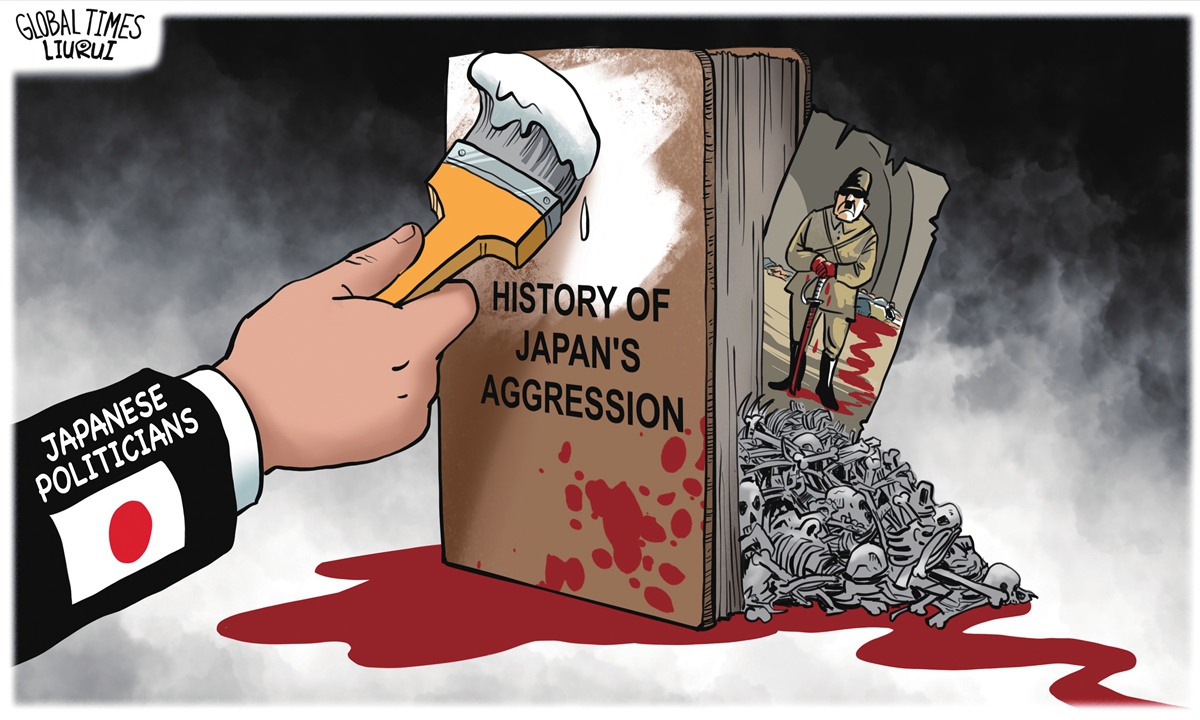
Japan's aggression across Asia during WWII is an undeniable fact. Yet, for eight decades, there have been repeated attempts within Japan to soften, distort or even deny that part of history. Setting the record straight is essential not only to upholding truth, but to preserving humanity's collective memory for realizing enduring peace.
'End of the war' or defeat?
When Emperor Hirohito announced Japan's surrender on August 15, 1945, he delivered an "Imperial Rescript of the Termination of the War" that carefully avoided the word "surrender" and framed Japan's defeat as a voluntary decision to end hostilities. Since then, August 15 has been officially marked in Japan as the "Memorial Day for the End of the War." This narrative, reinforced by conservative media, has profoundly distorted public memory to the point that Prime Minister Shigeru Ishiba was fiercely criticized for merely using the term "defeat" when referencing the war.
This play on words unveils Japan's obstinate reluctance to face historical facts and repent for the atrocities it committed.
But the truth is that Japan was defeated. In his Imperial Rescript, Emperor Hirohito declared Japan's acceptance of the Potsdam Declaration which demanded Japan's unconditional surrender. The formal surrender followed on September 2, 1945, when Japan signed the Instrument of Surrender aboard the USS Missouri.
Notwithstanding this, some in Japan still refuse to acknowledge the defeat. This not only risks blurring history but also raises alarm bells among Japan's neighbors about its unreconciled ambitions.
'Victim' or aggressor?
In recent years, whenever the world commemorates the victory over fascism, certain voices in Japan emerge to emphasize the "damage" Japan suffered — particularly its status as "the only country to have suffered atomic bombings." Some have gone even further to reframe Japan's aggression as self-defense, downplaying its aggression against China as minor skirmishes, and even falsely accusing China of provoking the conflict.
But overwhelming historical evidence tells the truth.
Japan's role in WWII as an aggressor is undeniable. As early as 1927, the Japanese government secretly drafted a comprehensive plan to invade China — known as the Tanaka Memorial — which stated plainly: "In order to take over the world, you need to take over Asia; In order to take over Asia, you need to take over China." The September 18 Incident in 1931 and the July 7 Incident in 1937 were not isolated events, but premeditated acts of aggression.
Japan's war crimes cannot be downplayed. On-site investigation and witness accounts document that over 300,000 Chinese were killed in the Nanjing Massacre alone, at least 200,000 women were subjected to sexual slavery at the "comfort stations" operated by the Japanese military and Japan's Unit 731 conducted biological warfare experiments on human beings in Northeast China - one of the most heinous crimes against humanity.
'Peace commitment' or military buildup?
Article 9 of Japan's postwar constitution explicitly renounced war and prohibited maintaining offensive capabilities. This "Peace Constitution" has served as an anchor of Japan's pacifist course in postwar decades.
Since the 1990s, however, right-wing forces have pushed for constitutional revision, promoting "proactive pacifism" on the pretext of "contributing to peace." Japan has since eased restrictions on weapons exports, greenlighted limited collective self-defense, and announced plans to develop counterstrike capabilities and raise its defense spending to 2 percent of GDP by fiscal year 2027.
It is evident that the "proactive pacifism" is less about peace and more about expanding Japan's military capabilities while circumventing the postwar international limits on Japan's armed forces. More alarmingly, claims that "Taiwan is Japan's business" echo past imperial pretexts for invading China. If unchecked, this risks reviving Japan's militarism under a new guise.
'Shedding burdens' or evading responsibility?
In 2015, then prime minister Shinzo Abe stated that future generations should not be "predestined to apologize," fueling a surge in the rhetoric of "moving beyond" history. Yet, historical responsibility and obligation cannot be written off by a simple statement. International law holds Japan accountable for war crimes indefinitely across governments and generations.
Many Japanese have voiced their opposition to historical amnesia. Former prime minister Tomiichi Murayama urged teaching "the horrors of war" to avoid repeating past mistakes. Another former prime minister, Yukio Hatoyama, stated, "Japan should feel apologetic to wartime victims until they no longer need apologies."
Facing history with honesty is a sign of strength, not weakness. Germany's example shows that confronting the past builds trust and enables genuine reconciliation. True peace begins with acknowledging wrongdoing and preventing its repetition.
The author is a commentator on international affairs, writing regularly for Xinhua News, Global Times, China Daily, CGTN. opinion@globaltimes.com.cn
RELATED ARTICLES