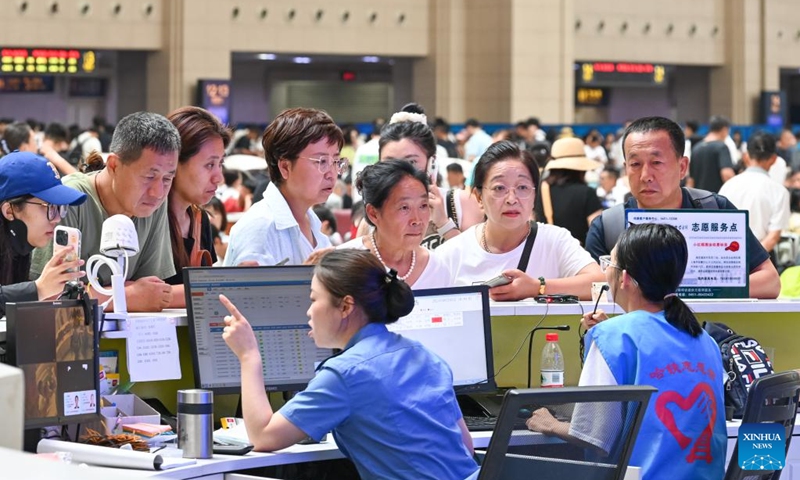
Staff answer passengers' inquiries at Harbin Railway Station in Harbin, northeast China's Heilongjiang Province, Aug. 2, 2025. This year's summer travel rush will last for 62 days from July 1 to Aug. 31. From July 1 to 31, China Railway Harbin Bureau Group had handled 9.775 million passenger trips, and the daily average number of passenger trips reached 315,000. Photo: Xinhua
China's railway passenger transport system will fully adopt the use of electronic invoices starting from the upcoming National Day holidays, with paper reimbursement vouchers no longer available, marking the latest step in the railway sector's broader digital transformation. Expert said the move will streamline operations, improve convenience for passengers, and enhance system security.Earlier, Xinhua News Agency reported that from October 1, paper reimbursement vouchers would no longer be issued in the railway passenger sector nationwide.
To ensure accessibility for elderly passengers, those without internet access, and other groups who may face difficulties operating online platforms, railway authorities have added offline application channels. Passengers can apply for an electronic invoice using a valid ID at station ticket windows or self-service machines. After obtaining a "scan-to-invoice slip," the passenger or an authorized person can scan the QR code through the official 12306 railway app, complete the required information, and verify details before issuing the electronic invoice, according to Xinhua.
Zhu Lijia, a professor of public management at the Chinese Academy of Governance, told the Global Times on Monday that the transition from paper tickets to electronic tickets, and now from paper vouchers to e-invoices, reflects improvements in technological and information management capabilities. "This approach is more environmentally friendly, ensures greater security, and simplifies the process for the public," Zhu noted.
Compared with paper documents, electronic invoices are harder to forge and easier to verify due to their online connectivity, which helps curb fraudulent practices such as falsifying or fabricating vouchers, Zhu added.
A manager from the passenger transport department of China Railway said that since June 2020, the railway sector has phased out paper tickets by fully adopting electronic tickets. On November 1, 2024, the sector began promoting fully digital electronic invoices, with a transition period until September 30, 2025, during which both paper vouchers and e-invoices were accepted, according to Xinhua.
In line with a joint announcement by the State Taxation Administration, the Ministry of Finance, and China Railway in 2024, starting from October 1, 2025, electronic invoices will be fully applied across railway passenger transport nationwide. Passengers can apply for an invoice within 180 days after completing their journey, or after handling refund and ticket-change services, through the 12306 app, station ticket windows, or self-service machines, Xinhua cited the China Railway official as saying.
In addition, ticket purchasers or agents can also apply for electronic invoices for purchased tickets, refund fees, and ticket-change fees. Applications can be made through the 12306 platform or at station ticket windows by presenting the passenger's valid ID or order number.
Once issued, e-invoices can be checked and downloaded via the 12306 app, the personal income tax app, or received by email. If information was incorrectly filled in or if company details have changed, passengers may apply for re-issuance up to three times within the original invoice period. Group tickets for tourism, students, or research trips are not eligible for direct issuance by passengers and must be handled by the purchaser according to relevant procedures. Non-real-name emergency tickets, paper tickets issued for special circumstances, and cross-border railway tickets will continue to follow existing paper voucher policies.
RELATED ARTICLES