S.Korea, US seal 'surprise' investment deal amid doubts
Agreement must still be ratified by S. Korean National Assembly: media
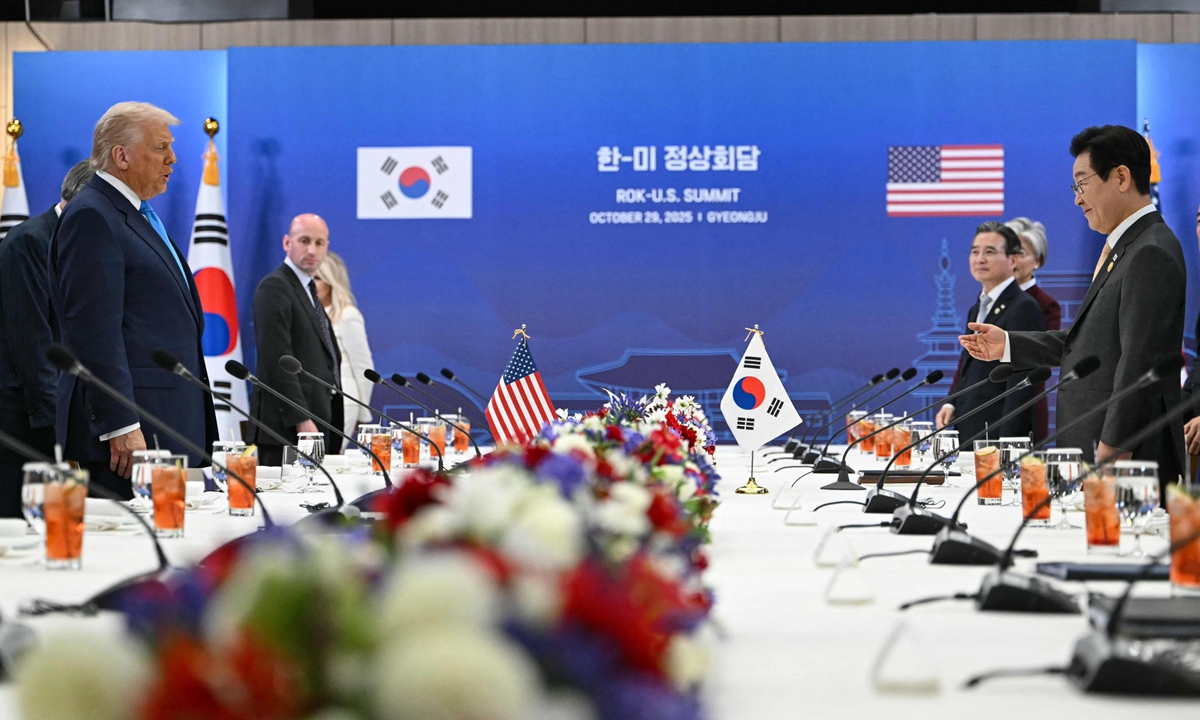
US President Donald Trump and South Korean President Lee Jae-myung attend a bilateral meeting at the Gyeongju National Museum in Gyeongju on October 29, 2025. Photo: VCG
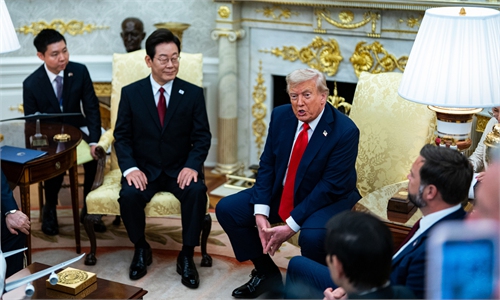
South Korean President Lee Jae-myung and visiting US President Donald Trump held talks on Wednesday on bilateral ties. The two sides have finalized an agreement on the details of Seoul's $350 billion investment pledge that lowered US tariffs on Korean products, according to Yonhap.
The announcement, which was described as "surprise" by South Korean news media the Korea Herald, came hours after an 87-minute meeting between the two leaders, which took place on the margins of the APEC meeting.
The meeting was the second in-person summit between Lee and Trump in about two months after their first meeting at the White House.
During Trump's visit, South Korea rolled out a high-profile welcome. Trump was gifted a replica gold crown, which is a copy of one from the Silla Kingdom, an ancient dynasty that dominated the Korean Peninsula, and awarded the "Grand Order of Mugunghwa," the nation's highest decoration, Reuters reported, citing the presidential office.
Analysts noted that while the trade agreement will likely give Korean companies - particularly automakers - a stronger footing against Japanese competitors in the US market under a more level tariff regime, Washington's push for deeper defense cooperation and nuclear-related capabilities risks heightening tensions on the Korean Peninsula.
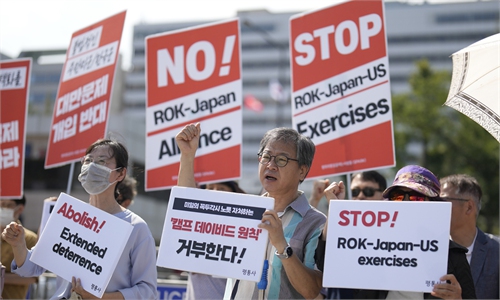
The visit drew fierce backlash from some South Koreans. Activists protesting against US President clashed with police on Wednesday as they attempted to enter the main venue of Trump's summit with President Lee, according to Yonhap.
Trade deals
The US-South Korea agreement includes a major financing component. Kim Yong-beom, South Korea's presidential policy chief, told reporters that the package comprises $200 billion in cash investment and $150 billion in cooperation in the shipbuilding sector. "It is similar in structure to Japan's $550 billion financial package with the US, but we set an annual investment cap of $20 billion," Kim was quoted as saying by Yonhap.
As part of the deal, tariffs on South Korean automobiles in the US will be cut from 25 percent to 15 percent, with the lower tariff already applied since late July, according to Yonhap.
However, Kim confirmed that the agreement must still be ratified by the National Assembly, Reuters reported. The two sides will also set up a special-purpose umbrella company to manage US investment projects, with US Commerce Secretary Howard Lutnick heading an investment committee. Funding will be provided gradually as milestones are met.
Separately, the two countries signed an agreement Wednesday to cooperate in artificial intelligence (AI), space and other areas on the sidelines of the APEC gathering underway in Gyeongju.
Despite the conclusion of the trade agreement, opposition voices have emerged within South Korea. The People Power Party said on Wednesday that while the deal is welcome "in the sense that it removes uncertainty," it is "difficult to view it as a good negotiation compared with Japan's agreement with Washington," the Hankyoreh reported.
The party's spokesperson criticized the outcome in a statement, saying "the negotiations ended exactly as Trump wanted," adding that "it is hard to understand why South Korea, whose GDP is about half that of Japan and whose economy and foreign exchange capabilities are on a different level from a quasi-reserve currency nation like Japan, proceeded with a structure similar to the US-Japan agreement," according to the Hankyoreh.
The Associated Press (AP) also stated that "Although both sides said progress has been made, no agreement has been signed yet," adding that the framework includes gradual investments, cooperation on shipbuilding and the lowering of Trump's tariffs on South Korea's automobile exports, according to Kim Yong-beom, Lee's chief of staff for policy. The White House did not immediately respond to a request for comment.
"These outcomes are the result of intense negotiations under US pressure," Da Zhigang, director of the Institute of Northeast Asian Studies at the Heilongjiang Provincial Academy of Social Sciences, told the Global Times. While lower tariffs will help Korean firms invest and compete in the US, Da warned that the $350 billion commitment could be a heavy burden for South Korea's foreign reserves.
Security tensions linger
On the security front, Trump claimed to seek lasting peace on the Korean Peninsula, which "is legally still in a state of war since the 1953 armistice," he said during his talks with Lee, according to Yonhap. Although a hoped-for "surprise meeting" with North Korean leader Kim Jong-un did not materialize, Trump reiterated his willingness to resume dialogue with Pyongyang, Yonhap added.
Lee said that South Korea will raise its defense budget and develop its defense industry to improve its defense strength so as to ease US defense expenditures in their defense alliance, according to a statement from the South Korean presidential office, according to Xinhua News Agency.
The two leaders also reportedly made agreement regarding South Korea's nuclear-powered submarine capabilities. During the luncheon summit, Lee pledged to increase the country's defense budget while calling on the US to grant permission for Seoul to obtain fuel for nuclear-powered submarines as part of Washington's initiative to "modernize" the alliance, according to the Korea Herald.
"To help ease the US defense burden, I would like to emphasize that South Korea will firmly move forward with increasing its defense budget and supporting its defense industry," Lee told Trump in his opening remarks during the luncheon summit.
But experts cautioned that the renewed focus on nuclear-related cooperation could stoke rather than ease tensions.
RELATED ARTICLES