US Soybean Export Council joins 8th CIIE, eyes long-term cooperation with Chinese clients amid easing trade ties
By , Ma Jingjing and Chen Zishuai in Shanghai Published: Nov 05, 2025 02:46 PM

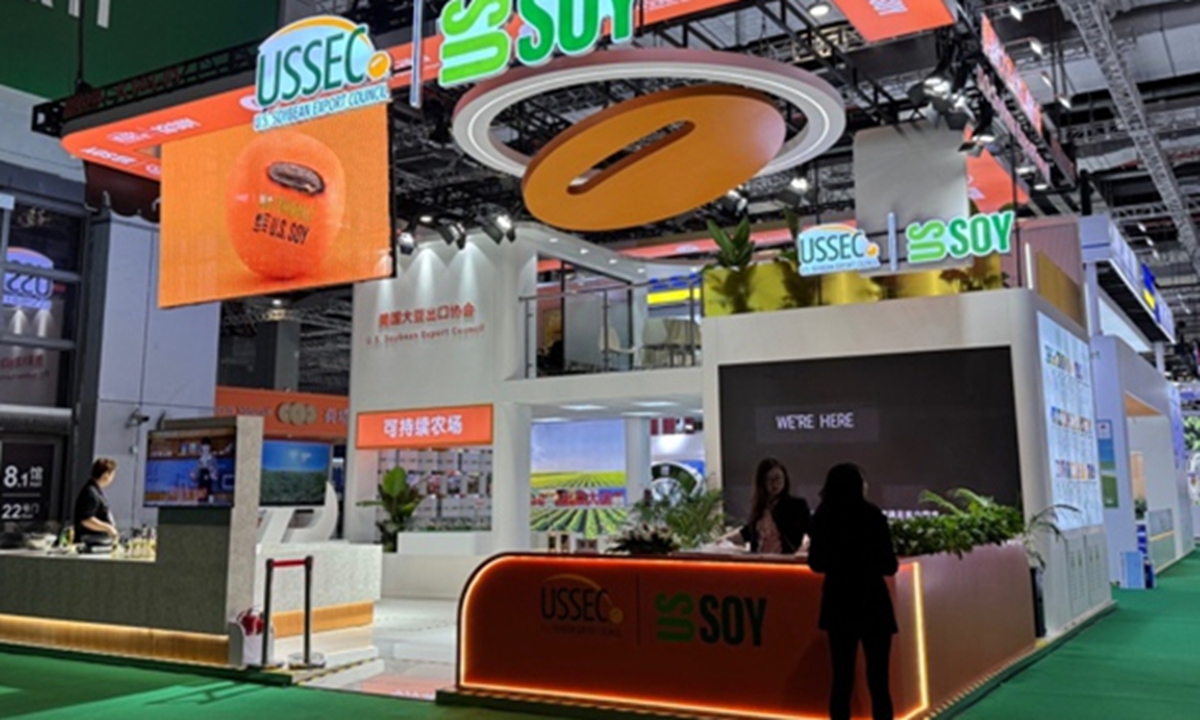
Booth of the US Soybean Export Council at the 8th China International Import Expo in Shanghai on November 5, 2025. Photo: Tu Lei/GT
At the 8th China International Import Expo in Shanghai, which opened on Wednesday, the US Soybean Export Council (USSEC) set up a booth with executives of the council and US soybean farmers. The council told the Global Times that it aims to have its long-term relationship renewed with many customers in China.
"We pay special attention to what we hear from the customers here because many Chinese companies that buy US soybeans will be here. We have a booth at the trade show, so we'll have the opportunity to talk to many of them. It gives us a great opportunity to listen to what's on their minds and also talk to US exporters that are here to hear what they're hearing from their customers [in China]," Jim Sutter, CEO of the USSEC, told the Global Times during the expo in Shanghai on Wednesday.
The meeting between the two heads of state in South Korea gave the council new optimism that it's important to have this long-term relationship, because all of the problems that come along are really short-term problems and there are opportunities for us to work together, Sutter said.
On Tuesday, Li Chenggang, China's international trade representative with the Ministry of Commerce and vice minister of commerce, met the US agricultural trade delegation in Beijing, where they exchanged views on China-US economic and trade relations and agricultural trade, according to a statement on the ministry's website on Wednesday.
Li said that a sound China-US economic and trade relationship benefits both countries and the world. Since May, the economic and trade teams of the two sides, guided by the important consensuses reached between the two heads of state, have held five meetings to stabilize and improve bilateral economic and trade relations. This fully demonstrates that by upholding the spirit of equality, mutual respect, and mutual benefit, China and the US can find solutions to issues through dialogue and cooperation.
China's Ministry of Commerce on October 30 unveiled the outcomes of recent economic and trade talks between the Chinese and US delegations in Kuala Lumpur. A spokesperson for the ministry said that the two sides also reached consensus on expanding agricultural product trade.
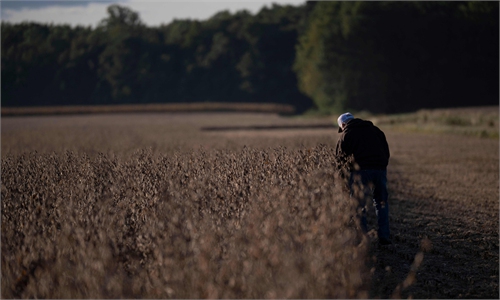
US soybean farmers are committed to the Chinese market for the long term, and I think they are relieved and pleased to see that the trade tensions between China and the US have eased, Sutter said.
The US soy industry has grown along with the Chinese soy industry and the people that use soy here -- for example, the livestock industry and others, Sutter said. "Our farmers feel very good about that. And they're happy that we've made progress. Now they want to be here to tell the customers about the good things to do with US soy, how they grow it on their farms and how they appreciate the business," he said.
"China remains a vital partner for US soybeans," Grant Kimberley, director of market development of the Iowa Soybean Association, told the Global Times in a written interview on Wednesday. He added that "stable relations between the US and China are essential for global food security and the economies of both countries, as well as the world."
In August, the American Soybean Association urged the US government to secure a deal with China to reopen this vital market for US soybeans, stressing that US soybean farmers cannot survive a prolonged trade dispute with their largest customer, according to the association's website.
China has historically imported more than 60 percent of the world's soybean supplies, with the US once serving as its top source. But retaliatory tariffs now make US soybeans 20 percent more expensive than South American supplies, and China has turned to Brazil, which has expanded production to meet demand, according to the association.
In response to a question seeking comments about media reports claiming that China has made its first purchases of soybeans this year from the US, Chinese Foreign Ministry spokesperson Guo Jiakun said at a press conference on October 29 that "China's position on the relevant issue is consistent. I'd refer you to the competent authorities for anything specific."
The series of trade disputes between China and the US, including those over soybeans, were proactively and unilaterally initiated by the US, Dong Shaopeng, a senior research fellow at the Chongyang Institute for Financial Studies at Renmin University of China, told the Global Times on Wednesday.
"The Kuala Lumpur talks have forged a preliminary consensus, a promising start, but the true test lies in whether the US side can genuinely follow through on implementation," Dong said.
RELATED ARTICLES