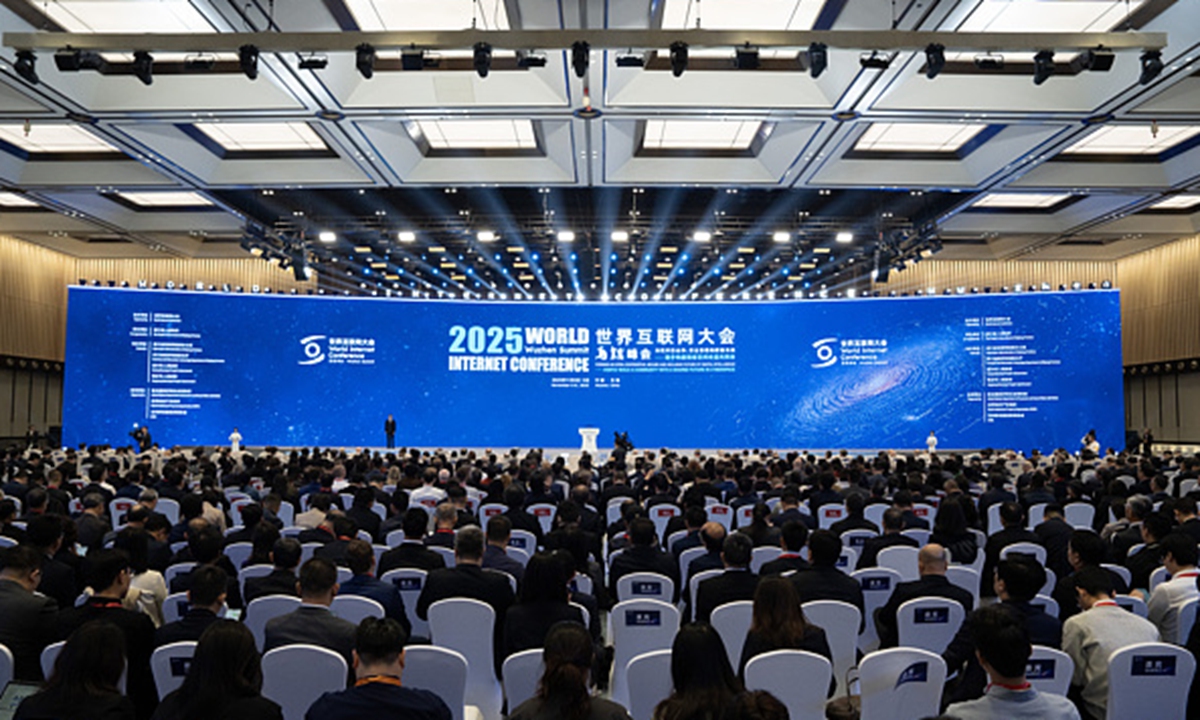
The 2025 World Internet Conference Wuzhen Summit opens on November 7, 2025 in Wuzhen. Photo: VCG
The 2025 World Internet Conference Wuzhen Summit concluded on Sunday. Themed "Forging an Open, Cooperative, Secure and Inclusive Future of Digital Intelligence - Building a Community with a Shared Future in Cyberspace," this year's summit attracted over 1,600 participants from more than 130 countries and regions.A decade ago, Chinese President Xi Jinping proposed the vision of building a community with a shared future in cyberspace. Today, humanity is more connected than ever before, and the human-machine era centered on artificial intelligence (AI) has begun. Humanity faces not only new technological dividends and risks but also entirely new modes of coexistence through human-machine interaction, along with ethical challenges and risk management. The concept of a community with a shared future in cyberspace encompasses the survival situation of countries and humanity as a whole, foreshadowing a new connotation and paradigm of human-machine integration and coexistence.
Since its inception in 2014, the Wuzhen Summit has coincided with the explosive growth of mobile internet and the emerging wave of the intelligent revolution, during which the world has witnessed the evolution of digital civilization in Wuzhen. So far, the Wuzhen Summit has become not only a world internet conference but also a global AI conference. Currently, the internet and high-tech fields are undergoing revolutionary changes worldwide. Without question, the Wuzhen Summit plays a vital role and takes the lead in providing global public goods in the era of intelligence.
The arrival of a new era brings forth not only a series of new technologies, applications and enterprises but also a range of global public goods. Unlike in past technological revolutions, China is no longer merely a follower; it is now running alongside - and in many fields, pioneering - this wave of the AI revolution. The Recommendations of the Central Committee of the Communist Party of China for Formulating the 15th Five-Year Plan for National Economic and Social Development emphasizes achieving greater self-reliance and strength in science and technology and steering the development of new quality productive forces. It states that Chinese modernization must be underpinned by modernization in science and technology. In the past, the Chinese internet and high-tech sector were largely built upon core technologies from the US. After more than 10 years of dedication, China has demonstrated its self-reliance in high technologies with industry-leading sectors like battery technology, electric vehicles and robotics.
If we say that the emergence of ChatGPT in the US marked the beginning of the practicalization of AI, then China's DeepSeek is the horn signaling the mainstream adoption of AI. At the same time, DeepSeek, along with other Chinese models like Qwen, has led a global open-source wave of AI models, helping to bridge the digital divide in the era of intelligence and providing universal intelligent public goods for countries around the world.
The greatest lesson from DeepSeek is that while Silicon Valley regards the AI wave as a capital game, China treats the development of AI models as a public good - promoting disruptive breakthroughs in efficiency and cost, and openly sharing these advancements with the world. Therefore, as a form of global public goods, the Wuzhen Summit cannot be rushed or driven by quick success; instead, it requires patience, persistent effort, and long-term dedication.
Amid the US technological war against China, it is inevitable that the Wuzhen Summit will face various challenges and shocks arising from geopolitics. Nevertheless, it must stand at the forefront of technological innovation and stay true to its original aspiration. China should become a major creator and provider of public goods in the intelligent era - a path essential not only for China's development but also for its contribution to the world.
Innovation in the intelligent era is more than technology and applications; it also depends on the synchronized advancement of governance and institutions. The Wuzhen Summit, as a model for global public goods in the intelligent age, still has a long way to go.
However, its significance and influence continue to enlighten and inspire further Chinese efforts. The Wuzhen Summit itself must also explore its long-term path through continuous innovation.
The author is executive dean of the College of Media and International Culture at Zhejiang University and president of the Wuzhen Institute for Digital Civilization. opinion@globaltimes.com.cn
RELATED ARTICLES