Spanish King kicks off state visit to China with economic, cultural ties expected to be strengthened
Pragmatic cooperation to inject momentum into China-EU relationship: expert
By and Bai Yunyi Published: Nov 10, 2025 10:46 PM

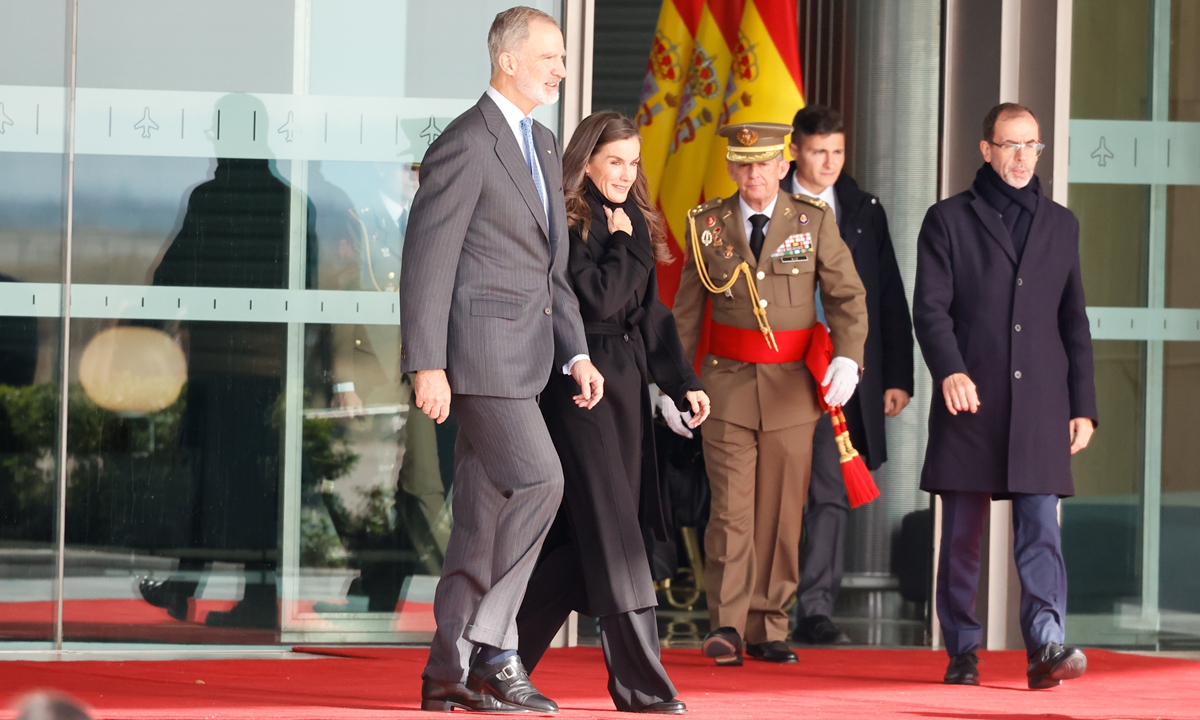
King Felipe VI of Spain and his wife Queen Letizia during the farewell ceremony at the State Pavilion of Terminal T-4, at Adolfo Suárez Madrid-Barajas Airport, on November 9, 2025, in Madrid, Spain. Photo: VCG
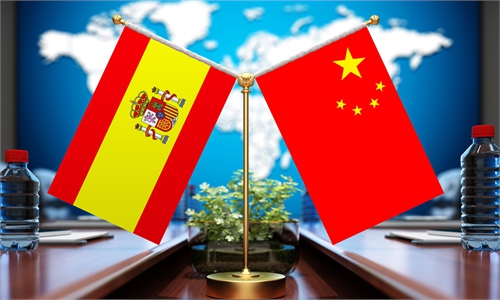
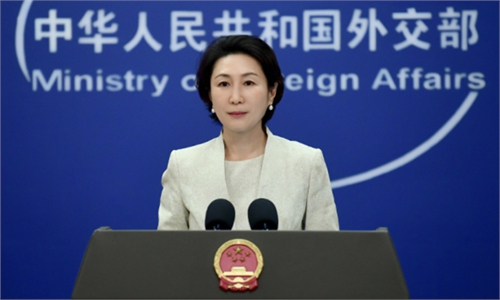
King Felipe VI of Spain and his wife Queen Letizia arrived in Chengdu, Southwest China's Sichuan Province on Monday, kicking off a state visit to China from November 10 to 13, media reported, with experts expecting the visit to not only propel the China-Spain ties to a new height, but also to inject momentum into the broader China-EU relationship.According to the Chinese Foreign Ministry, the visit marks King Felipe VI's first state visit to China after his enthronement and another visit by a Spanish king to China in 18 years. Foreign ministry spokesperson Mao Ning described the visit as carrying "great significance."
Through King Felipe VI's visit, China stands ready to work with Spain to cement their traditional friendship, expand mutually beneficial cooperation, have closer people-to-people and cultural exchanges, strengthen coordination on multilateral affairs, and achieve more progress in the comprehensive strategic partnership so as to deliver more tangibly for the two peoples and inject more stability and positive energy into a turbulent international landscape, Mao added.
Spanish news outlet El Pais reported that King Felipe VI is scheduled to attend an economic and trade themed forum in Chengdu, a cultural event related to poetry will be attended by Queen Letizia on November 11.
Spanish news outlet La Vanguardia said that during the visit, the King and Queen will be accompanied by Spain's Minister for Foreign Affairs, European Union and Cooperation José Manuel Albares Bueno, and the Minister of Economy, Trade and Industry, Carlos Cuerpo.
Spain's Ministry of Foreign Affairs said the state visit is an "opportunity" to continue strengthening "the deep political, economic, and cultural ties between both countries," per La Vanguardia's report.
Spain, a key member of the European Union, is one of China's most important strategic partners in Europe. The King's visit coincides with the 20th anniversary of the China-Spain comprehensive strategic partnership.
Cui Hongjian, a professor at the Academy of Regional and Global Governance at Beijing Foreign Studies University, told the Global Times that unlike heads of government, a king stands above party politics and embodies the entire nation and its people in international engagements.
King Felipe VI's visit signals that Spain, as a whole, is willing to deepen exchanges and mutual understanding with China, and the consensus goes far beyond just governmental level; and it reflects a broad national and societal mindset of mutual appreciation and seeking to enhance mutual understanding, Cui added.
Placing economic, trade, cultural, and people-to-people exchanges at the forefront serves as a powerful counterbalance to those European politicians who obsessively amplify political and diplomatic differences between China and Europe, Cui said.
Since the establishment of diplomatic relations, China-Spain relations have enjoyed a stable overall development, Zhao Junjie, a senior research fellow at the Institute of European Studies at the Chinese Academy of Social Sciences, told the Global Times on Monday.
Among countries that are both EU and NATO members, Spain has consistently maintained close cooperation with China and rarely engaged in ideological confrontations against China, Zhao added.
The expert noted that in the fields of culture, tourism, automobile manufacturing, electronic equipment, green energy, infrastructure construction, and agricultural exports, China and Spain share vast space for cooperation and highly aligned common interests.
According to the Chinese Foreign Ministry, China is Spain's largest trading partner outside the EU, while Spain is China's fifth-largest trading partner within the EU. In 2024, the bilateral trade volume reached $50.1 billion, representing a year-on-year growth of 3.2 percent.
On October 9, the Ministry of Commerce of China and Spain's Ministry of Economy, Trade and Enterprise co-hosted the China-Spain Trade and Investment Matchmaking Event in Madrid, with deals worth about $300 million signed covering sectors including agri-food, new-energy vehicles, batteries, machinery, cross-border e-commerce, finance and tourism, according to Xinhua.
In addition, the implementation of several Chinese investment projects in Spain has also been confirmed, including the battery factory of CATL and the renewable energy project of Envision Energy.
China-Spain ties carry great significance for how other European countries perceive their approach to getting along with China, Zhao said, noting that the mature, pragmatic cooperation between China and Spain can serve as a role model for the entire China-EU relationship.
King Felipe VI's state visit will not only propel the China-Spain comprehensive strategic partnership to unprecedented heights, but also inject momentum into broader China-EU relations, said Pan Deng, a professor with China University of Political Science and Law.
"The visit proves that the essence of China-EU relations is cooperation, not confrontation—and areas of consensus far outweigh differences," Pan said, "Even under external geopolitical pressure, European countries can safeguard their own strategic interests while steering China-EU relations toward healthy, stable development through pragmatic cooperation with China."
RELATED ARTICLES