From scratch to success
Exploring China's beautiful, harmonious countryside along Xi's footsteps
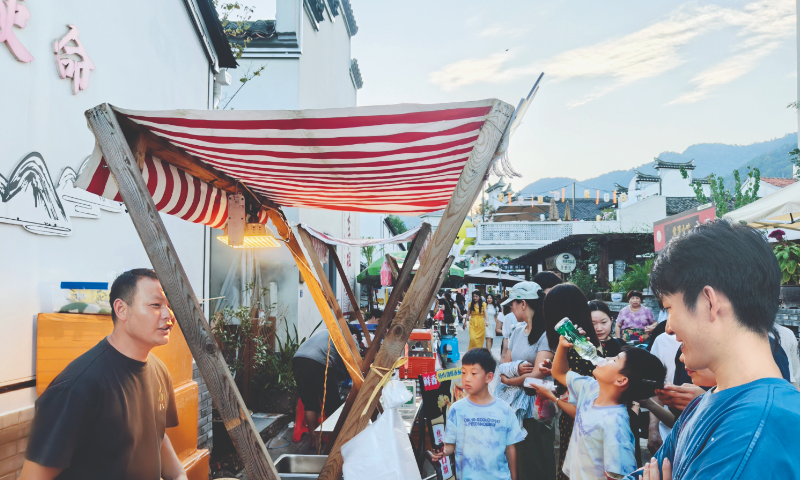
The agricultural makers' market attracts tourists to stop by and taste the local products in Lizu village, East China's Zhejiang Province, during the National Day holidays in 2025. Photo: Courtesy of China Rural Revitalization magazine
Editor's Note:
China Rural Revitalization magazine has published a series of articles on the rapid development and transformation of rural China. The articles reflect the arduous efforts of rural revitalization across the country, which is an important and genuine solution to China's rural economic development. In the future, articles selected from this series will be published.

A music drama attracts audience during the National Day holidays in 2025, in Lizu village, East China's Zhejiang Province. Photo: Courtesy of China Rural Revitalization magazine
How much change can a village witness in just two years? Lizu village in Yiwu, East China's Zhejiang Province, offers a vivid answer. The number of shops in the village increased from 58 to 73, agricultural entrepreneurs from 220 to 271, annual visitor trips from 650,000 to 1 million, and village collective income up from 3.56 million yuan ($500,183) to 4.64 million yuan.
President Xi Jinping inspected Lizu village on September 20, 2023. Lizu village has achieved solid progress in promoting common prosperity, Xi noted, expressing hopes that the village will make further efforts and achieve more results in advancing rural revitalization, according to the Xinhua News Agency.
His visit boosted confidence across Lizu villagers in pursuing further development. Since pioneering the village-wide operation model overseen by village CEOs in July 2020, this once-remote and resource-scarce village - lacking scenic resources, celebrities, and industrial foundations - has undergone a profound metamorphosis triggered by the return of young talent. Today, Lizu shows many faces: vibrant growth, close-knit community bonds, and an outward-looking drive for progress.
Vibrant growth
"No girl could leave here empty-handed." This bold slogan splashed across the wall of Pipi grocery store in Lizu village. Yet, visitors, especially young women, agree it's true.
Founder Ye Lupin (Pipi), Lizu's first post-2000 female college-educated entrepreneur, has packed the 30-square-meter space with creative goods: fish-skin jewelry, crocheted toys, and more. "Most items come from indie designers nationwide," Ye said. Each marker gets a dedicated cubby, turning the tiny store into a meeting point for creators and customers.
Since July 2023, the store has generated 3.7 million online searches and attracted over 100,000 visitor trips to Lizu, according to the village's operation data.
Ye's business scaled quickly. In late 2023, she leased an idle kitchen and turned it into a rustic pizza restaurant named "Sangu Pizza." In April 2025, she partnered with a young mixologist to launch a hybrid space for drinks and food.
This vitality aligns with village operation chief Jin Jing's "ground-up" philosophy. "Rural startups are like farming - plant in spring, harvest in autumn. It needs time," Jin said. Her target: young, sticky founders building multi-format ventures that stay rooted.
To attract talent to a resource-scarce village, Jin built a rainforest-like ecosystem to support the development and growth of village CEOs. The initial Lizu village CEOs park introduced service businesses, such as e-commerce, photography and packaging, that support fellow makers. The first-year survival rate of the youth entrepreneurship project in Lizu village exceeded 95 percent.
"Makers are seeds - they attract more entrepreneurs and tourists," Jin said. Lizu's 1-million-visitor trips target for 2028 was reached in 2024. More footfall meant more income: about one-third of homes now were rented by makers, adding 20,000 yuan per household.
Warm community ties
"I love the village," said Bao Liping, founder of a linen studio. "Lizu feels like home - warm and welcoming."
"When customers get lost, I tell them to ask any elder for directions," Bao said. "Villagers would happily guide them, and visitors adore the warmth."
Before coming to Lizu, Bao ran a high-pressure business in downtown Yiwu, rarely returning home before 10 pm. Now, she hosts tea fireside chats, knitting meetups, and small salons with locals and customers. The village healed her, resulting in her stay.
"Rural startups need warmth, not cold contracts," Jin said. Warm details connect everyone: makers, customers and villagers.
Such rapport is designed, not accidental. From day one, the village committee and operation team practiced "preemptive operations" and clear rules, open channels, and complementary business planning to prevent conflicts and encourage collaboration.
Recently, "dog parking" spots were added to make the village pet-friendly, after a smooth coordination between Jin's team and locals. Proactive management and fast dialogue help keep Lizu a harmonious, welcoming community.
Outward-looking expansion
Many call Lizu a mini Yiwu International Trade City - people hustle to startup, scale up, and go global. Beneath its warm details, the village is also eyeing outward-looking push.
"Our earlier problem was variety without volume, and low standardization," Jin said. The team pushed makers to build brands and standard operating procedures (SOPs) for rapid expansion.
Peixian incense hall, founded by young village returnee Fang Tianning, shows the model in action: it now has five franchisees and 32 dealers, leaping from a solo startup to scaled operation.
To professionalize e-commerce, Lizu village launched a multichannel network (MCN) this year. MCN project lead Ding Xinyu is optimistic: "During the National Day and Mid-Autumn holidays, our Xiaohongshu (RedNote) livestreaming once hit No.13 on the gourmet sales chart nationwide."
"We're linking with funds and cultural investors, serving not just Lizu village but 'greater Lizu,' even Yiwu and beyond," Jin said. "Greater Lizu" is a prosperity zone with Lizu village as the core, covering nine villages, 15,000 people, and 18.76 square kilometers since 2014.
The zone formed a 1.5-million-yuan JV to run 19 shared projects. By August 2025, collective operating income reached 11.46 million yuan, up 43.5 percent year-on-year, every village cleared the 1-million-yuan annual target ahead of schedule.
To replicate the model, young village committee members train on-site in Lizu. So far, 26 cadres from eight villages have completed four cohorts of hands-on learning.
"This training platform spreads Lizu's experience quickly, and will expand citywide," said an official from Houzhai Subdistrict, where Lizu is located.
From branding and shared prosperity to grassroots talent pipelines, Lizu's rural revitalization story is scaling, from one small village to the wider world.
Yi Zhenglin is a reporter for China Rural Revitalization magazine.
RELATED ARTICLES