Takaichi’s Taiwan-related claims continue to draw criticism from political figures, media
Japanese PM questioned about whether she understands gravity of such remarks
By and Shen Sheng Published: Nov 11, 2025 10:46 PM

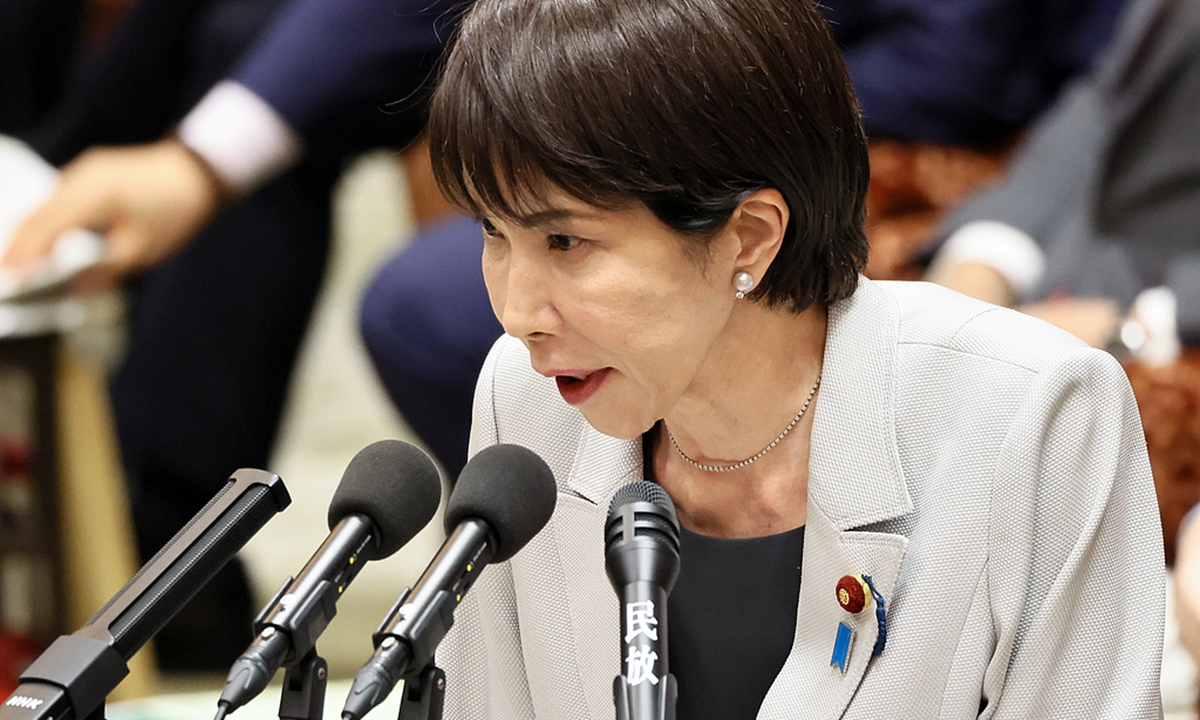
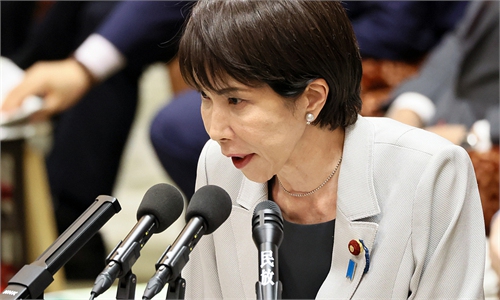
Japanese Prime Minister Sanae Takaichi attends the House of Representatives Budget Committee and responds to questions at the Diet building in Tokyo on November 10, 2025. Photo: VCG
The repercussions of Japanese Prime Minister Sanae Takaichi's recent wrongful remarks that implied the possibility of armed intervention in the Taiwan Straits are still resonating in Japan, drawing criticism from some senior Japanese political figures and media, according to multiple Japanese media reports.
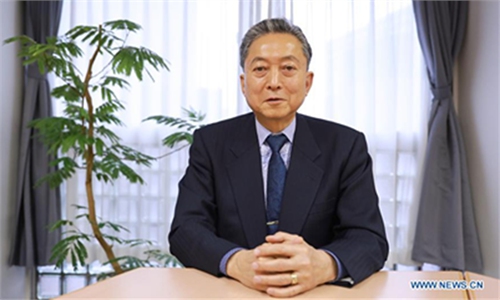
Former Japanese prime minister Yukio Hatoyama responded again on social media platform X on Tuesday to Takaichi's wrongful remarks on the Taiwan question, stating that Japan should not interfere in China's internal affairs.
Hatoyama posted on Saturday on X expressing a similar view the day after Takaichi made the claims. He criticized her remarks for clearly stoking a crisis to justify military buildup. "Japan should respect the fact that Taiwan is part of China," he added.
During a hearing in the Diet, Japan's legislature, on Friday, Takaichi claimed that a Taiwan emergency involving the use of military vessels and military force from the Chinese mainland could constitute a "survival-threatening situation" for Japan. According to legislation, Japan's Self-Defense Forces could exercise the right of collective self-defense if such a situation is recognized as "survival-threatening."
Jiji Press reported on Tuesday that Hiroshi Ogushi of the Constitutional Democratic Party of Japan had demanded Takaichi revoke the remarks on Monday at a Lower House Budget Committee. "If a 'survival-threatening situation' is recognized, it would lead to a defense mobilization. This is a judgment equivalent to entering a war, and past cabinets have been cautious in making such statements," Ogushi said.
In response, Takaichi appeared to step back from her previous remarks. While maintaining that her position "aligns with the government's longstanding view and I have no intention of retracting or rescinding it," she characterized the statement as "a response based on a worst-case scenario" and pledged to "reflect on specific scenarios moving forward and exercise greater caution in future remarks," the Mainichi Shimbun reported on Monday.
Shimbun Akahata, the newspaper of the Japanese Communist Party (JCP), reported on Tuesday that JCP Chief of Secretariat Akira Koike has criticized Takaichi's claims on Taiwan as "an extremely dangerous statement."
Tokyo Shimbun published an editorial on Tuesday, questioning whether Takaichi understands the gravity of such a statement coming from a prime minister, condemning this as "extremely reckless and imprudent" remarks.
The Okinawa Times reported on Tuesday that Takaichi's claims on Taiwan have sparked controversy. Quoting a Japanese government source, the report added that "this should not have been stated from the position of prime minister."
Liu Jiangyong, vice dean of the Institute of Modern International Relations at Tsinghua University, told the Global Times on Tuesday that the Japanese politicians and media who expressed opposition against Takaichi's wrongful remarks "have stepped forward at this critical moment to voice a just stance." Liu noted that "In the eyes of the peace-loving people of Japan, Takaichi's claims are dangerous and unacceptable."
"That a so-called 'Taiwan emergency is a Japanese emergency' is, in essence, creating a problem where none exists for Japan," Liu remarked. This position was a blatant claim first raised by former Japanese Prime Minister Shinzo Abe and echoed by some conservative Japanese politicians. Liu noted that it serves as a pretext to break through the constraints of Japan's postwar pacifist constitution and to justify further military expansion. "Such actions are destined to lose the support of the Japanese people and are bound to fail," Liu said.
China has expressed firm opposition and strong protest against Takaichi's wrongful remarks.
"It constitutes a gross interference in China's internal affairs and violates the one-China principle, the principles set forth in the four political documents between China and Japan, and basic norms in international relations," Chinese Foreign Ministry spokesperson Lin Jian stated on Monday. Lin said that "China deplores and opposes that and has made serious démarches and protests to Japan."
Late on Monday, a spokesperson from the Chinese Embassy in Japan stated that Japan's reference to a "survival-threatening situation" and its attempt to associate itself with forces seeking to split China raises the question of whether Japan is attempting to repeat its past mistakes.
The incident of Takaichi's wrongful remarks have crossed the Pacific Ocean to reach the US as well.
US President Donald Trump appeared to "defend China," as described by the Daily Mail, during a Monday night interview with Fox News, when the host raised Takaichi's recent claims about Japan potentially interfering in the Taiwan Straits and asked whether China was "not our friend." Trump pushed back, saying, "A lot of our allies are not friends either."
Apparently challenged by the strong backlash regarding Takaichi's remarks, Japanese Chief Cabinet Secretary Minoru Kihara told a news conference on Tuesday that Japan has conveyed the intent behind Takaichi's remarks as well as Tokyo's official position, the Asahi Shimbun reported.
"Peace and stability in the Taiwan Straits are crucial for Japan's security and for the stability of the international community," Kihara claimed, Asahi Shimbun reported. According to Asahi Shimbun, Kihara said Japan intends to "further strengthen communications across a wide range of fields and deepen mutual understanding and cooperation with China."
Kihara's remarks during the press conference were an attempt to quell the controversy through "damage control," but in fact served to defend Takaichi, Xiang Haoyu, a distinguished research fellow at the Department for Asia-Pacific Studies of the China Institute of International Studies, told the Global Times on Tuesday.
"This equivocal response not only fails to dispel the controversy but instead exposes the Japanese government's contradictions in wanting to blur the red lines on the Taiwan question while avoiding any consequences and doing little to dispel international and domestic doubts about its attempt of intervention in the Taiwan Straits," Xiang commented.
"While this year marks the 80th anniversary of victory in the Chinese People's War of Resistance Against Japanese Aggression and the World Anti-Fascist War, if populism continues to rise and right-wing forces in Japan persist in making trouble and meddling in the Taiwan question, Japan risks falling into a trap of its own making - a self-inflicted crisis," Liu warned.
RELATED ARTICLES