Chinese market vital to Brazilian farmers, offering growing export and cooperation opportunities: chamber head
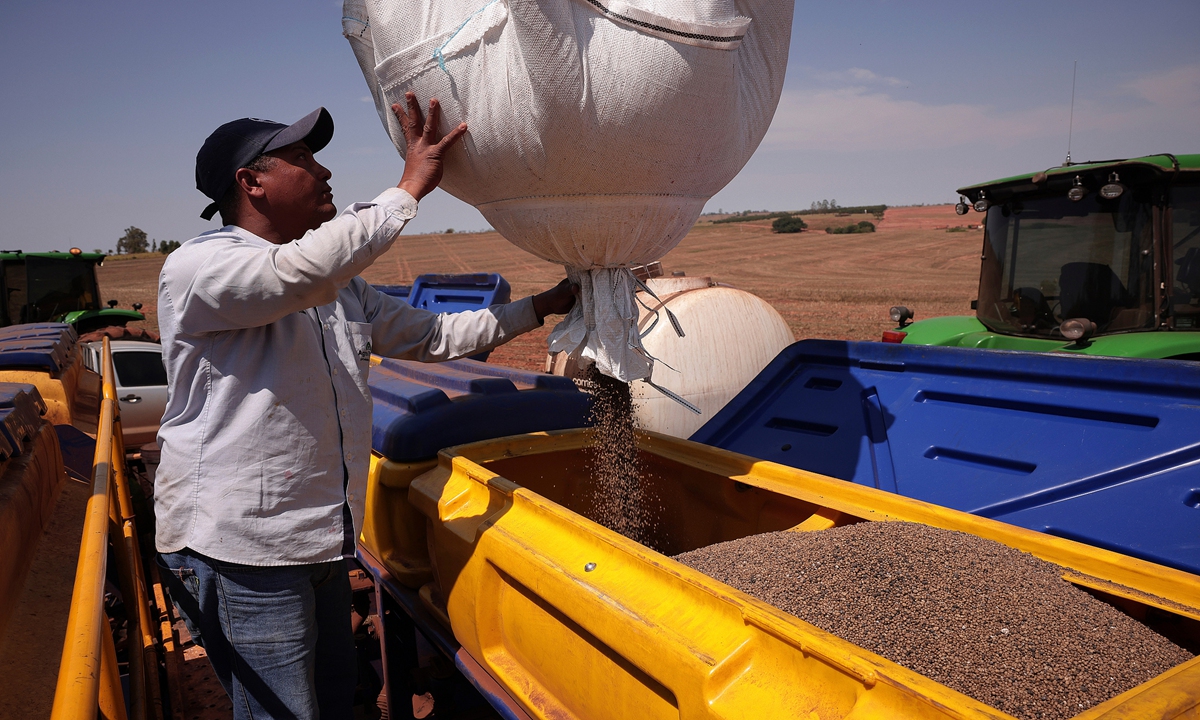
A farm worker loads a seeder with soy seeds for planting at the Morada do Sol farm in Santa Cruz do Rio Pardo, Sao Paulo state, Brazil on October 15, 2025. Photo: VCG
The Chinese market is vital to Brazilian farmers and exporters, and the continuous demand for Brazilian soybeans provides great opportunities for Brazil, Henry Osvald, president of the Brazilian Association for Industry, Commerce and Innovation in China, said in an interview with the Global Times on Monday.The Brazilian National Association of Grain Exporters (ANEC) recently predicted a strong soybean export trend, saying that in November and December alone, Brazil will export 8 million tons, bringing total soybean exports for the calendar year to 110 million tons. At the same time, Brazilian farmers are benefiting from strong demand from China.
About 79 percent of the country's soybeans go to China, according to the ANEC.
Osvald said that strong demand from China will not only help Brazil to increase its exports, but may also involve potential investments from China to increase the cost efficiency for Brazil, mainly involving logistics.
"Chinese consumers are demanding, with great purchasing power," the chamber head said, noting that in addition to soybeans, other products such as quality beef have gained a foothold in the Chinese market. According the Ministry of Agriculture and Rural Affairs, more than 40 percent of China's beef imports come from Brazil, the Xinhua News Agency reported.
Osvald said that the Chinese market is extremely important as agriculture generates many jobs in Brazil and brings foreign currency to help the country's trade balance. "It also reinforces the close relationship between Brazil and China and mutual trust," he said.
China's 15th Five-Year Plan (2026-30), which charts the nation's course for development in the next five years, serves as a source of certainty and confidence in a world that is undergoing unprecedented changes and that stands at a pivotal crossroads, he said, adding that the plan will bring new opportunities for cooperation for Brazilian businesses and beyond.
"We are going through global political instability and we should all learn from China to think strategically about the long term," he said, expressing his hope for the protectionism trend in the world to end soon, "as such polarization and extremes create great economic and social disruption."
Osvald's comments again reflect how China's continued openness and cooperation have created a valuable window of opportunity for its trading partners, Wang Youming, director of the Institute of Developing Countries at the China Institute of International Studies in Beijing, told the Global Times on Monday.
"With trade protectionism on the rise, Latin American countries such as Brazil, which is also a major agricultural exporter, are seeking to diversify their export markets, while China, as a vast and reliable market with a stable economy and predictable trade relations, is naturally becoming an increasingly important destination for Brazilian exports and investment," Wang said.
China remains the second-largest trading partner in Latin America and is the largest trading partner for countries such as Brazil, Chile, and Peru, Xinhua reported.
RELATED ARTICLES