HK to launch first lunar probe around 2028, to fill gap in dedicated circumlunar observation: media reports
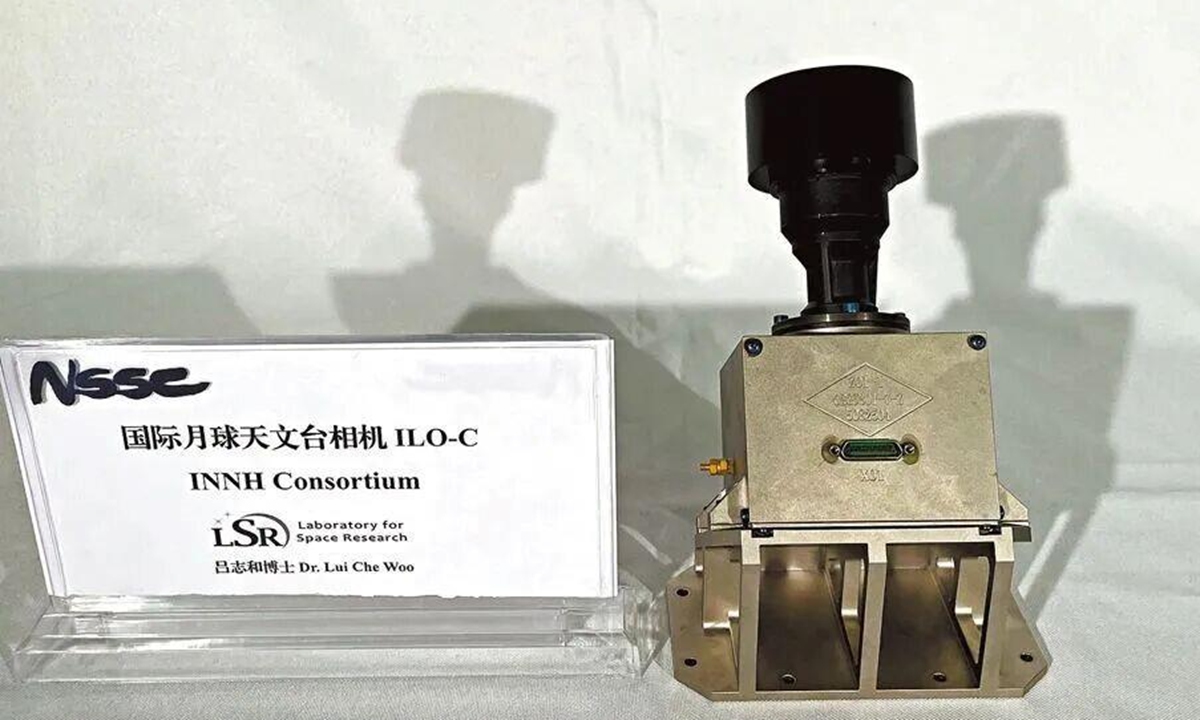
The Laboratory for Space Research at The University of Hong Kong collaborates with the International Lunar Observatory Association (ILOA) to jointly develop the ILO-C small wide-angle optical telescope camera for Chang'e-7, which is scheduled for launch in 2026 to capture images of the Milky Way from the lunar surface. Photo: from web
Hong Kong is set to embark on a lunar mission by launching its first lunar probe around 2028 to observe lunar meteor impacts, Su Meng, deputy director of the Laboratory for Space Research at The University of Hong Kong (HKU), said on Monday, according to media reports. He added that during the 15th Five-Year Plan (2026-30), Hong Kong will continue to participate more deeply in major national aerospace projects such as Chang'e-7, Chang'e-8, and Tianwen-3.
The 15th Five-Year Plan period marks a new phase for China's aerospace industry. Against this backdrop of national strategy, Hong Kong is participating in major national space missions with unprecedented depth and breadth, demonstrating strong scientific research capabilities and strategic value, Su said, according to Science and Technology Daily .
Expanding on HKU Laboratory for Space Research's involvement in China's lunar and Martian exploration programs, Su said that the laboratory is collaborating with the International Lunar Observatory Association (ILOA) to jointly develop the ILO-C small wide-angle optical telescope camera for Chang'e-7, which is scheduled for launch in 2026 to capture images of the Milky Way from the lunar surface.
The laboratory is also partnering with Shenzhen University and the Committee on Space Research (COSPAR) to advance the development of payloads for Tianwen-3 - China's first Mars sample-return mission, Su said.
He added that over the next five years, the laboratory will launch a master's program in "New Space Economy," strengthen cooperation with space centers in the Chinese mainland and abroad, and may take on deeper roles in research and development of observation equipment and data analysis related to the Lunar Research Station.
Notably, the HKU space research laboratory plans to launch Hong Kong's first lunar orbiter, Yueshan, meaning "lunar flash," around 2028.
Su explained that the probe is designed to observe lunar impact flashes. "The 'lunar flash' refers to the transient optical phenomenon caused by micrometeoroid impacts on the lunar surface," he said.
Because the moon lacks an atmosphere, such observations are essential for assessing the Earth-moon space environment and ensuring the safety of future human activities on the lunar surface.
Currently, there are no dedicated circumlunar observation instruments worldwide, and Hong Kong's lunar mission is expected to fill this gap, significantly enhancing the city's influence in the international deep-space exploration field.
According to Su, the Yueshan mission will be a joint effort between Hong Kong and the Chinese mainland. The probe's telescope will be built locally in Hong Kong, and the spacecraft design is also being carried out there, while specific manufacturing and testing will be completed in partnership with multiple mainland institutions.
As for the rocket to transport the Yueshan probe to lunar orbit, several aerospace agencies in the mainland have expressed interest, Su said. Furthermore, HKU is conducting in-depth feasibility studies on using the moon's far side for very-low-frequency (VLF) radio astronomical observations, which could fill the last "missing piece of the cosmic electromagnetic spectrum" for humanity.
Global Times
RELATED ARTICLES