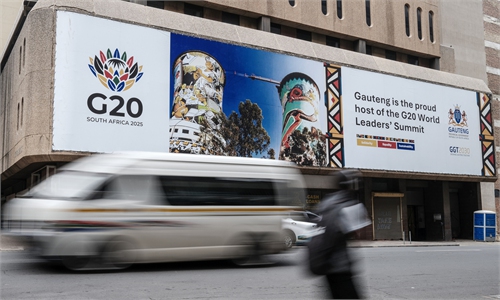
Media professionals enter the media center for the Group of 20 (G20) Leaders' Summit in Johannesburg, South Africa, November 22, 2025. The summit is held here from November 22 to 23. Photo: Xinhua
The 20th G20 Leaders' Summit concluded on November 23 in Johannesburg, South Africa. As the first G20 summit ever held on the African continent, it was convened under the theme of "Solidarity, Equality, Sustainability," and successfully released the "G20 South Africa Summit: Leaders' Declaration." The declaration reflects a growing trend: At the decision-making table of major global issues, the voices of Africa and the development demands of Global South countries are increasingly being respected and translated into action.The fiscal crisis facing low-income countries has become one of the main drivers of global health insecurity. In many countries, spending on external debt repayment now far exceeds their healthcare budgets. This leaves their health systems exceedingly vulnerable when confronted with natural disasters and disease risks exacerbated by climate change, lacking the resilience needed to withstand external shocks. After years of disruption caused by pandemics and natural disasters, global health security has become a systemic development and financial challenge - and a key measure of whether the G20 can meaningfully deliver. The declaration signals a shared understanding among all parties: The G20 must move beyond outdated aid-based thinking, build collective strength, and place development and equity at the heart of global health governance.
Therefore, the G20 needs to take more pragmatic and effective steps to address the debt problems of low-income countries. For example, G20 members should adhere to the principle of "common but differentiated responsibilities" and encourage international financial institutions and major creditor nations, especially developed economies, to shoulder greater financial and moral responsibility.
More importantly, the G20 should promote the establishment of a practical mechanism that links debt restructuring with health investments. Such a mechanism should ensure that any debt relief or savings are strictly earmarked for strengthening primary health care and improving disease prevention capacity. This approach would not only ease the debt burdens of developing countries, but also ensure the transparent and efficient use of funds, turning fiscal relief into tangible health benefits for their populations.
Health cooperation is an important part of China-Africa friendship and cooperation, and South-South cooperation is a key pathway to enhancing Africa's health capacity. Under this framework, platforms such as China's "Health Silk Road" offer African countries practical support, moving from "giving fish" to "teaching how to fish."
The G20 should support this development model and help African countries in three key ways. First, it should strengthen disaster-resilient infrastructure by promoting the construction of medical facilities with earthquake and flood resistant capabilities, and by using renewable energy such as solar power to ensure hospitals can continue operating during natural disasters or public-health emergencies. Second, it should enhance digital early warning capabilities by leveraging the experiences of countries like China in digitalization and big data monitoring. Third, resource development should be directed toward improving community health. The G20 should encourage governments of resource-rich countries and investors to explore the creation of a revenue-sharing mechanism for resource development. This mechanism should allocate a portion of the revenues from key minerals to community health funds, addressing issues such as drinking water safety and occupational health for communities surrounding mining areas, ensuring that the benefits of inclusive growth are directly reflected in the health of the population.
The G20 should take the response to global health challenges as a historical opportunity to promote reform of the global financial system and innovation in development models. As a responsible major power, China has always advocated for prioritizing development under the banner of "development first," urging G20 member countries to collaborate in transforming the commitments made in declarations into concrete actions. We look forward to joint efforts from all parties to advance global health governance into a new stage that is fairer, more resilient, and more development-oriented.
Li Zhuo is a PhD candidate at Peking University, and Zhai Kun is a professor and deputy director of the Institute of Area Studies at Peking University. opinion@globaltimes.com.cn
RELATED ARTICLES