Illustration: Liu Rui/GT
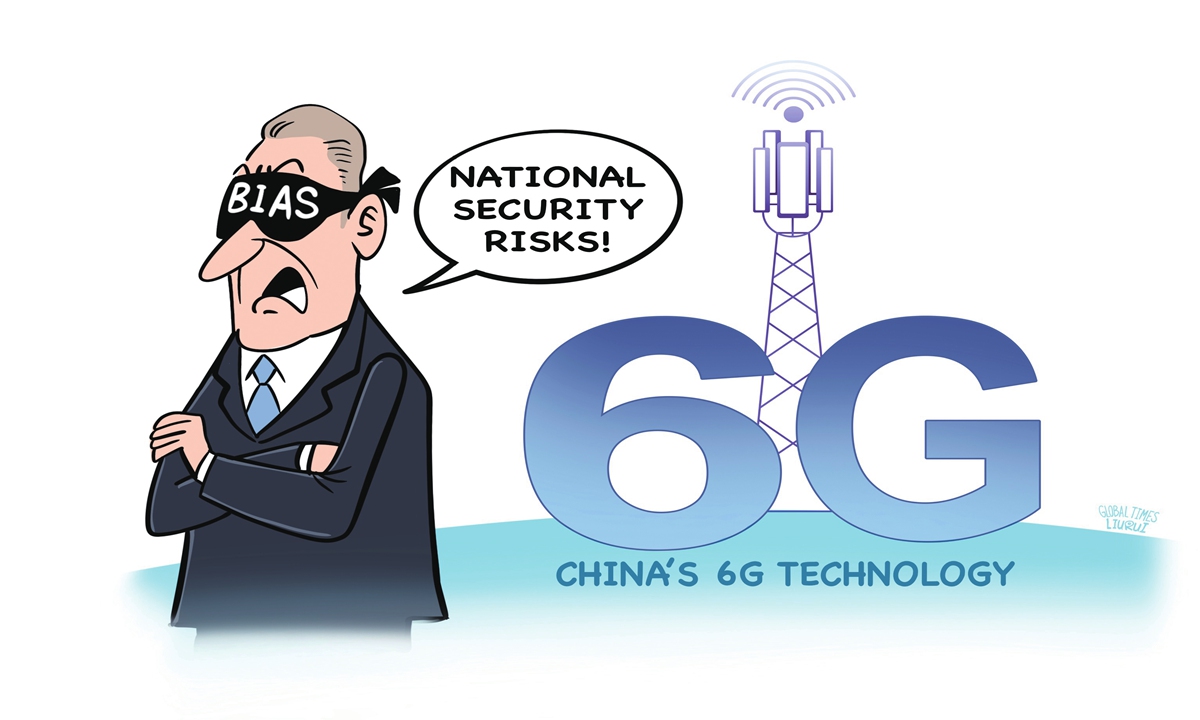
At a critical juncture when countries worldwide are developing and planning for the next generation of communications - 6G, some voices in Australia, which has unfortunately missed key opportunities in the 5G era, are once again promoting stigmatizing narratives about China and amplifying "national security risks" in the context of 6G cooperation.
On Wednesday, the Australian Financial Review quoted a so-called "cybersecurity strategist" who claimed that "Australia must not be seduced by the promises of advancements in 6G and quantum computing technology promised by China," and even went so far as to warn that "any collaboration with China would invite extraordinary and irreversible national security risks into Australia's economy." Such stigmatizing accusations against China have neither technical grounding nor scientific evidence and are merely a habitual recycling of politicized narratives.
The stigmatization of China's telecommunications technology by certain forces in Australia is nothing new, and this approach has already come at a high cost to the country. In 2018, the Australian government, citing vague "national security" concerns, excluded Chinese companies Huawei and ZTE from its 5G network rollout. At the time, the Chinese side questioned: "Does shutting out globally advanced technology companies truly benefit a country?" The facts have since provided a clear answer: Australia is now visibly lagging in the 5G field.
A report by the Australian Mobile Telecommunications Association in 2024 shows that Australia now lags behind other developed nations in take-up and usage of the 5G technology. Further analysis by the journal Independent Australia recently noted that internationally, Australia no longer belongs to the top cohort. Countries across Asia, the Middle East and Europe have already moved beyond the first wave of 5G deployment.
Chen Hong, director of the Australian Studies Centre of East China Normal University, told the Global Times that based on his own experiences, Australia's current network quality is worrying, with limited 5G coverage and frequent public complaints about poor mobile and internet service. Over the past decade, Australia's technology policymaking has been excessively politicized, leaving the country passive and disadvantaged in the field of communications technology. If Australia continues to view China through a prejudiced lens in the development of 6G, its digital divide risks further widening, and the gap in infrastructure between urban and rural areas will likely continue to grow.
For years, some Australian media outlets and commentators have repeatedly amplified stigmatizing narratives about China, hyping up so-called national security risks posed by the country. This has pushed Australia's telecommunications policymaking into a vicious cycle of over-securitization. As one Australian netizen bluntly put it: "Network problems have been used as a political football for nearly a decade, and we could have had some of the best infrastructure in the world. Much of the world is still moving faster, and we are going to struggle to keep up."
Chen further pointed out that narratives such as "surveillance" and "security risks" have become a fixed template for anti-China forces in Australia, automatically invoked whenever an issue involves China. In reality, hyping alleged 6G risks from China will not make Australia any safer. The real risks currently facing the development of Australia's communications technology do not stem from external factors, but from its own narrow ideological mind-set and increasingly self-imposed policy isolation.
Chinese Ambassador to Australia Xiao Qian recently wrote in the Australian media that China's 15th Five-Year Plan charts the course for practical cooperation across various sectors between China and Australia. The plan emphasizes the pivotal role of scientific and technological innovation and calls for fostering new drivers of economic growth, including quantum technology, bio-manufacturing, hydrogen and nuclear fusion power, brain-computer interfaces, embodied artificial intelligence, and 6G mobile communications.
Facts have shown that China's 5G technology has not only driven high-quality development domestically but has also delivered tangible progress for partner countries. Looking ahead to 6G research and development, China is already positioned in the world's leading tier. Australia should learn lessons from its 5G decision-making blunder: Smearing China's 6G based on security biases is both unfounded and detrimental to its own interests.
RELATED ARTICLES