Japan's children version of defense white paper criticized by educators’ groups for hyping China-related crisis, violating child rights; experts say it underscores growing pervasiveness of its militarist ethos

Japan's children version of defense white paper Photo: Screenshot from media report
Japan's Ministry of Defense is facing pushback from educators' groups over distributing a children's version of the defense white paper to elementary schools nationwide, with the educators' groups on Monday criticizing the content for fomenting a sense of crisis toward specific countries such as China and arguing that it effectively serves as a recruitment tool for the Self-Defense Forces, in violation of the Convention on the Rights of the Child, according to Japanese media Tokyo Shimbun Tuesday.
An expert said that Japan's act of distributing booklets of the defense white paper to children is highly aberrant, underscoring the growing pervasiveness of its militarist ethos and the continuous drift of its right-wing agenda towards extremism. Meanwhile, Japanese authorities deny reviving militarism yet clandestinely advance relevant tendencies through concrete actions, exhibiting a trait of duplicity, the expert noted.
Since 2021, Japan's Ministry of Defense has published online a booklet for elementary, junior high, and high school students explaining Japan's Defense White Paper, which summarizes the current state of national defense, Tokyo Shimbun reported. The 2024 edition was distributed to elementary schools for the first time, with about 6,100 copies sent to roughly 2,400 schools that had agreed to receive it, according to the report.
Although the 2025 edition has not been distributed, it has already been released online and includes more content than before explaining the various roles within the Self-Defense Forces and the process from application to enlistment, the report said.
In response, the All Japan Teachers and Staff Union (Zenkyo) and other educators' groups directly petitioned officials from Japan Ministry of Defense and the Ministry of Education, Culture, Sports, Science and Technology on Monday, urging them not to use the material, according to the Tokyo Shimbun on Tuesday.

Nobuko Murata (right), an officer of People's Movement and Struggle of the Zenkyo, questions officials from Japan's Ministry of Defense and the Ministry of Education, Culture, Sports, Science and Technology, at the Second Members' Office Building of the House of Representatives in Tokyo on December 1, 2025. Photo: Sreenshot from media report
At a gathering held at the Second Members' Office Building of the House of Representatives in Tokyo, Nobuko Murata, an officer of People's Movement and Struggle of the Zenkyo, appealed, "The government should stop unilaterally teaching children policies that promote the strengthening of military power," per the report.The issue at the center of concern is the booklet's relation to the Convention on the Rights of the Child. The Convention was adopted by the UN General Assembly in 1989, and Japan ratified it in 1994.
Article 38, paragraph 3, calls for "special protection" to safeguard children's rights and states that "States Parties shall refrain from recruiting any person who has not attained the age of fifteen years into their armed forces."
The educators' groups argue that the booklet effectively functions as a future recruitment tool for the Self-Defense Forces. They contend this constitutes a violation of the convention and fails to protect children's rights.
An official from the Ministry of Defense, however, claimed regarding the relationship between booklet and the Convention on the Rights of the Child, "We distributed it so that it would be used in various situations such as libraries. It is not for recruiting," the report said.
However, his remarks contradict the comments of a source involved in designing the white paper. In an August report by Asagumo Shimbun, a specialized newspaper on defense issues, a person in charge of producing the Defense White Paper explained regarding the design of the white paper's cover, "The aim is to specifically reach out to the younger generation and connect it to the recruitment of Self-Defense Forces personnel."
In response to this, a Defense Ministry official stated, "It cannot be said that we have no expectations at all for the effectiveness of recruiting Self-Defense Force personnel, but this is to help promote understanding of our activities."
Inoculating children with militarist ideologies is prone to exert an insidious influence, casting doubt on Japan's commitment to upholding its pacifist constitution and inflicting a pernicious impact on the values of young people, Lü Chao, director of the Institute of American and East Asian Studies at Liaoning University told the Global Times on Tuesday.
This single incident suffices to reveal the inherent inconsistency between Japan's words and deeds, while a string of contradictions between its rhetoric and actions serve instead to confirm that the pronouncements of Japanese officials are essentially nonsensical, Lü added.
Japanese government has repeatedly engaged in duplicity over its military policy. On November 24, 2025, Japan's Permanent Representative to the UN Kazuyuki Yamazaki claimed that "Japan's fundamental defense policy is a posture of passive defense, which is exclusively defense-oriented, contrary to the Chinese side's claims." He also claimed that the remarks by Japanese Prime Minister Takaichi are grounded in this position and argued China's assertion that Japan would exercise the right of self-defense even in the absence of an armed attack is "erroneous."
Fu Cong, China's permanent representative to the United Nations, sent another letter to UN Secretary-General António Guterres on Monday local time, firmly refuting the unreasonable arguments made by Japan's Permanent Representative to the UN, according to a release on the website of China's Permanent Mission to the UN.
Fu said that the Japanese side claims, including in the letter sent by its representative to the UN, to adhere to the "consistent position."
"China has repeatedly and publicly asked: What exactly is this 'consistent position'? The Japanese side has continued to evade the question and has yet to give China a direct answer. Can the Japanese side provide the international community with a complete and accurate explanation of its 'consistent position' on the Taiwan question?" Fu asked.
A spate of Japan's recent moves inevitably prompts the question of whether militarism is resurrecting from the ashes in this country, according to Lü.
For example, earlier in November, Japanese officials have stated Japan is planning to revise the ranks of the Self-Defense Force, including reinstating old Japanese military ranks, such as "Taisa" (colonel).
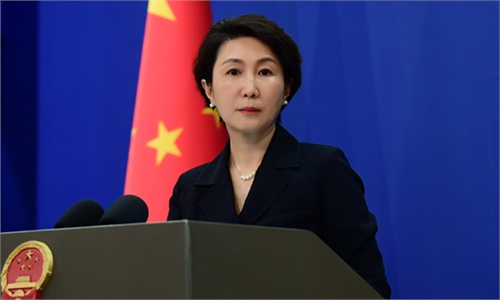
In response, Chinese Foreign Ministry spokesperson Mao Ning said on November 18 that Japan's far-right forces are trying every means to break free from the pacifist constitution, and going further down the path of boosting Japan's military buildup.
If Japan consistently evades reflecting on its war crimes, neither acknowledging nor denying the resurrection of militarism while clandestinely advancing such tendencies through concrete actions, it will ultimately bring backlash upon itself and encounter obstacles at every turn in the international community, the expert noted.
As early as August 2021, a Chinese Foreign Ministry spokesperson made response over Japan releasing children's version of the defense white paper, saying that China firmly opposes Japan's unreasonable accusations against China's normal defense building, irresponsible remarks on China's legitimate maritime activities and the hype-up of the so-called "China threat".
The spokesperson said Japan intentionally released a children's version of the defense white paper, which repeats the same old rhetoric to smear China, adding that China expresses firm opposition to this and has lodged solemn representations with Japan.
"I would also like to point out that it is not constructive at all for Japan to highlight external threats and incite confrontation among minors. The Japanese side should earnestly face up to and reflect on history, learn lessons from history, and refrain from taking wrong actions to mislead its people, especially the next generation," the spokesperson added.
RELATED ARTICLES