China’s foreign, defense ministries rebut Japan’s hype of ‘radar illumination’ by Liaoning carrier-based jets against JSDF aircraft; China lodges counter-protests in Beijing, Tokyo
By , Liang Rui and Fan Wei Published: Dec 08, 2025 12:16 AM

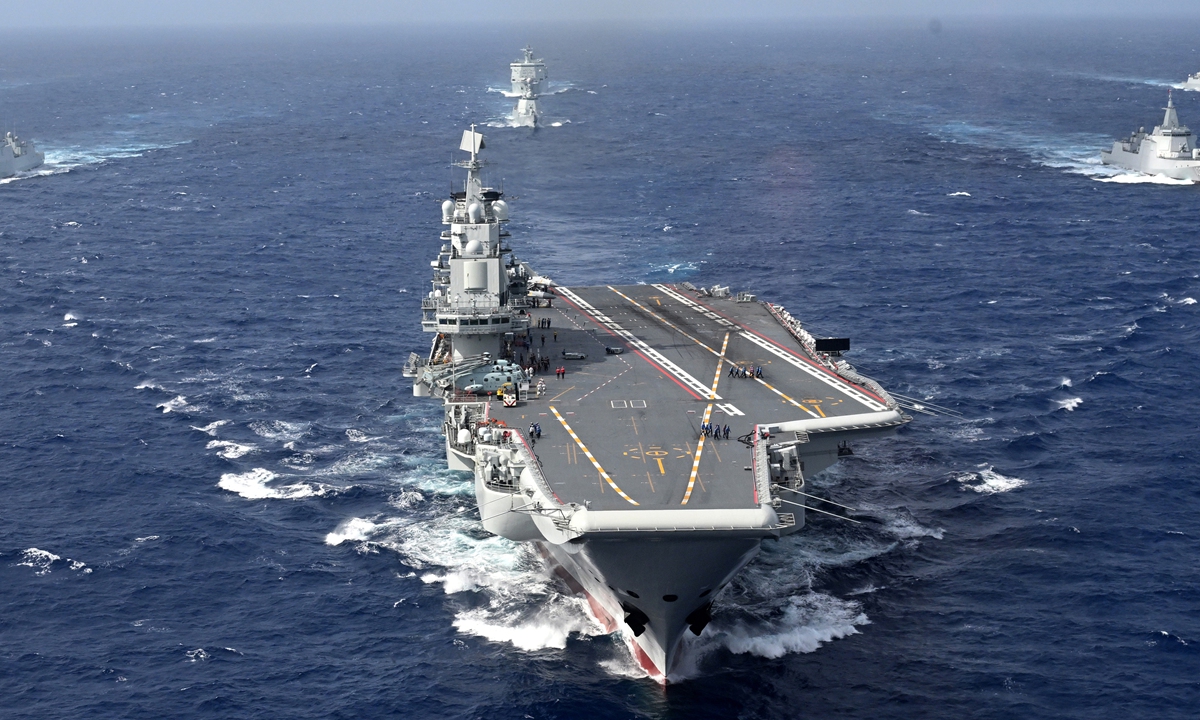
The Liaoning aircraft carrier participates in a dual-aircraft-carrier formation drill on October 21, 2024. Photo: VCG
The Liaoning aircraft carrier formation was approached and harassed by Japanese warplanes during a recent regular training in the far seas, Chinese military spokespersons revealed on Sunday. As the Japanese side hyped the incident and reportedly lodged a "strong protest" with the Chinese side, the Chinese foreign ministry said on late Sunday that China does not accept the so-called protest from the Japanese side and has rejected it on the spot and lodged counter-protests in Beijing and in Tokyo.
Chinese experts said that Japan is the perpetrator blaming the victim and a thief crying "stop thief," with the Japanese warplanes having dangerously approached the Chinese aircraft carrier formation in open waters first. They also warned that Japan is hyping the "China threat" rhetoric in an attempt to justify its dangerous ambitions of military expansion that break away from its pacifist constitution and post-war restrictions.
The Chinese side's responses came amid consecutive hypes by Japanese Defense Minister Shinjiro Koizumi and Prime Minister Sanae Takaichi on Sunday that the carrier-based aircraft of China's Liaoning formation directed radar at Japan Air Self-Defense Force fighter jets in open waters southeast of Okinawa Island. According to an Asahi Shimbun report that cited the Japanese defense ministry, two Japanese warplanes conducted "countermeasures for airspace violations." However, the Asahi Shimbun report then admitted that no Chinese aircraft actually violated Japanese airspace in the incident.
A Chinese Foreign Ministry spokesperson said in a statement released on late Sunday night that it is the frequent close-in reconnaissance and disruptions conducted by Japan's fighter jets on China's normal military activities that have caused the biggest maritime and air security risk and that China does not accept the so-called protest from the Japanese side and has rejected it on the spot and lodged counter-protests in Beijing and in Tokyo.
The spokesperson made the remarks when asked to comment on reports that on the early morning of December 7, Shinjiro Koizumi claimed at an emergency press conference that the J-15 fighter jet from the Chinese naval aircraft carrier Liaoning intermittently targeted its radar at Japanese Air Self Defense Force F-15 fighter jets on two occasions over international waters southeast of the Okinawa Prefecture on the afternoon of December 6. The Defense Minister reportedly called it "a dangerous act that exceeded the scope necessary for safe aircraft operations," and said the Japanese side has lodged a "strong protest" with the Chinese side.
Under the current circumstance, the Japanese side, by hyping up the so-called issue of "radar illumination," is deliberately making a false accusation against China to build up tension and mislead the international community. It is purely ill-intentioned, the spokesperson stated.
China's Liaoning aircraft carrier formation conducted far seas training in the waters east of the Miyako Strait, which is in line with international law and international practices. However, Japan maliciously tracked and harassed Chinese activities, repeatedly dispatched aircraft to intrude into the training area designated and announced by the Chinese side, and afterward smeared China's normal operations. This is purely a case of the thief crying "stop thief" and falsely accusing others of one's own misdeeds, Chinese Defense Ministry spokesperson Zhang Xiaogang said on Sunday.
"We urge Japan to earnestly recognize the situation, sincerely reflect on and correct its mistakes, completely abandon any malicious intentions, and refrain from going further down the path of opposing the Chinese people and the international community," Zhang stated.
The Chinese People's Liberation Army (PLA) Navy's Liaoning aircraft carrier formation conducted normal flight training for carrier-based fighter jets in the sea area east of the Miyako Strait and had made public the training sea and airspace in advance, the PLA Navy spokesperson, Senior Captain Wang Xuemeng, said in a statement on Sunday.
During the training exercise, Japanese Self-Defense Force aircraft repeatedly approached the PLA Navy's training sea and airspace and made harassment, seriously interfering with China's normal training activities and posing a severe threat to flight safety. The Japanese hype is completely inconsistent with the facts, Wang said.
Chinese Ambassador to Japan Wu Jianghao on Sunday lodged a solemn representation and strong protest with Japanese Vice Minister for Foreign Affairs Funakoshi Takehiro over the harassment by Japanese Self-Defense Force (JSDF) aircraft against training by Chinese Navy's aircraft carrier formation, according to a release by the Chinese Embassy to Japan WeChat account.
Song Zhongping, a Chinese military affairs expert, told the Global Times on Sunday that the Japanese side is the perpetrator playing the victim and shifting blame to the real victim.
The Japanese hype on the activities by the carrier Liaoning came after a Thursday Reuters report claimed that China had deployed a large number of naval and coast guard vessels across East Asian waters, at one point numbering more than 100.
In response to a Reuters reporter's question about this alleged deployment, and the Japanese defense minister's claim that "China has been expanding and stepping up its military activities in the area surrounding Japan," Chinese Foreign Ministry spokesperson Lin Jian said at a regular press conference on Friday "I'd refer you to competent authorities for what you mentioned. Let me stress that China is committed to a national defense policy that is defensive in nature. The Chinese navy and China Coast Guard carry out activities in relevant waters in strict accordance with China's domestic laws and international law."
There is no need for relevant parties to overreact and overinterpret, still less should they make groundless accusations, Lin said.
Zhang Junshe, a Chinese military affairs expert, told the Global Times that during the training, the unauthorized intrusion of Japanese warplanes into the PLA Navy's training area objectively made them targets of the Chinese side's radar pointing and simulated targeting. This is entirely a result of the Japanese side's active provocation. The relevant measures taken by China constitute legitimate defense and are entirely justifiable. Japan must have a clear understanding of this and refrain from reckless actions.
If Japanese military aircraft once again ignore China's warnings and notifications and insist on intruding into the training area to conduct harassment, they will bear full responsibility for the consequences, Zhang Junshe said.
PLA warships' far seas exercises conform to international law and common practices, and the Japanese side should not hype such legitimate activities, Zhang Junshe said. "Why wouldn't Japan hype US military activities in the region?" he asked.
In June, Japan also claimed it had spotted the aircraft carrier Liaoning sailing in the Pacific near Japan. In response to a related question, Lin, the Chinese Foreign Ministry spokesperson, said at a regular press conference on June 9 that China's military vessels' activities in relevant waters are fully consistent with international law and international practices.
"China pursues a national defense policy that is defensive in nature. We hope Japan will view those activities objectively and rationally," the spokesperson said.
Military ambitions
Japan's recent military moves, including plans to export weapons and deploying aggressive weapons that violate its pacifist constitution and post-war restrictions, have raised alarms over Japan's military ambitions, experts said.
In late November, Japan's Kyodo News reported that the Japanese government was holding informal consultations with the Philippines regarding the export of the Japan Self-Defense Forces' Type 03 medium-range surface-to-air missile. Earlier in August, the Australian Defense Ministry announced in a press release that the Japanese Mogami-class frigate had been selected for the Australian Navy's new general purpose frigates.
Japan is not only developing weaponry and equipment for export, it is already deploying or planning to deploy them domestically. The same Type 03 medium-range surface-to-air missile that Japan is planning to export to the Philippines is also planned to be deployed on Yonaguni Island, according to a report by Japan's Asahi Shimbun on November 23. Asahi Shimbun reported that Yonaguni Island is located in the westernmost point of Japan, only about 111 kilometers away from Taiwan Island.
Exclusive satellite images recently obtained by the Global Times show that Japan is rapidly advancing military construction on Mageshima Island, a key strategic location in the southwestern region. Multiple military facilities have taken shape on this uninhabited island in just one year, with the outline of a full-scale base already emerging.
Amid Takaichi's erroneous remarks on Taiwan and Japan's consecutive military expansion gestures, Japan's right-wing forces are trying to find every excuse to hype the so-called "China threat" in an attempt to justify its breaking away from the pacifist constitution, so it can develop more weapons that were previously restricted, Song said.
The Japanese right-wing forces' hype regarding normal, legitimate and professional Chinese military activities only exposes their own militaristic schemes, Song said. He noted that Japan's development of aggressive weapons including long-range missiles, aircraft carriers and submarines should be considered as attempts to break away from the post-war international order, which should raise high alert by the international community.
RELATED ARTICLES