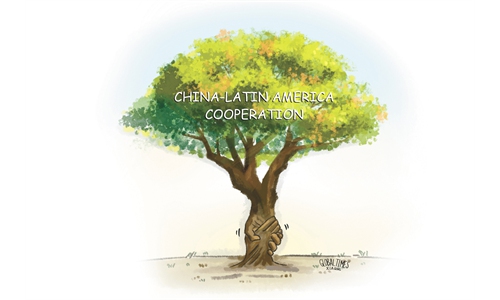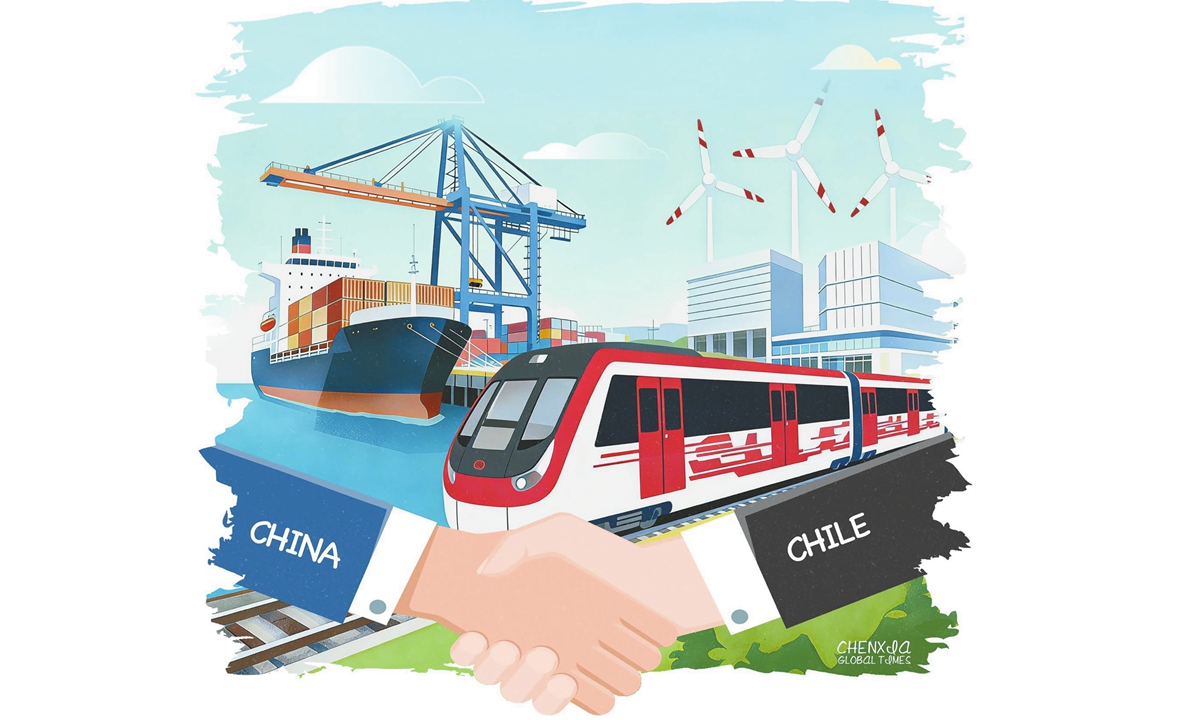
Illustration: Chen Xia/GT
On December 15, 55 years ago, Chile and China established diplomatic relations. The decision made in 1970 was truly pioneering. Chile was the first South American country to recognize the People's Republic of China in a highly polarized international context. Despite profound internal political changes in Chile, both countries decided to keep diplomatic channels open. This consistency sent a clear signal to the region: Latin American states with very different political systems could build long-term, pragmatic partnerships with China based on mutual respect, non-interference and economic complementarity. It anticipated the diversification of Latin America's external ties and helped normalize China's presence as a legitimate partner in the region.
In fact, Chile has often played the role of regional pioneer in enhancing its relationship with China. Chile was the first in the region to support China's entry into the WTO and the first Latin American country to sign a bilateral free trade agreement (FTA) with China. As the bilateral ties deepened, the two countries agreed in 2016 to upgrade their relationship to a comprehensive strategic partnership.
Over the past 55 years, trade has become the backbone of the relationship. After the signing of the China-Chile FTA in 2005 and its upgrading in 2019, tariffs were eliminated on most tariff lines and, by the mid-2010s, most agricultural goods traded at zero tariffs. As a result, China is now Chile's main trading partner, absorbing close to 40 percent of our exports, especially copper, lithium, pulp and fresh fruit.
The challenge for the next phase is to diversify and move up the value chain. The upgraded FTA can promote services, digital trade and green technologies, and encourage joint ventures that process Chilean critical minerals and agricultural products in a more sophisticated way, creating quality jobs in Chile and a stable, sustainable supply for China.
Chile was also one of the first Latin American countries to join the Belt and Road Initiative (BRI). The BRI has opened a new chapter for connectivity between China and the Southern Cone. In Chile, Chinese companies have invested in electricity distribution, ports and urban transport, including the extension of San Antonio, the country's largest port, and the construction of part of Santiago's future metro line. At the same time, the full potential of the BRI is still ahead. To unlock it, we need better project preparation and stronger administrative capacity on the Latin American side, so that more high-quality, green projects can be implemented.
Today, the center of gravity of the China-Chile relationship should be the global green transition. China has developed the concept of "ecological civilization" and is a global leader in renewable energies, electric vehicles and battery technologies. Chile is rich in critical minerals such as copper and lithium, has excellent conditions for solar and wind power, and has launched a National Lithium Strategy that links foreign investment to technological upgrading and ecosystem protection. This creates a natural space for cooperation. We are already working together on solar energy, electromobility and green hydrogen pilots.
In the 2000s and 2010s, Chile actively promoted itself as a hub for Chinese firms in South America. Renewing that agenda, in the context of the green transition, could allow Santiago to become a place where Chinese and Latin American actors meet, test cooperation schemes and design projects that can later be replicated elsewhere.
Looking ahead, I see three broad areas in China-Chile cooperation. First, the global green transition: copper, lithium and other critical minerals; renewable energy; and green hydrogen and its derivatives. Here, the priority should be to combine Chinese technology and finance with Chilean resources and institutions, not only to export raw materials but also to build local value chains. Futhermore, the two countries should deepen dialogue on environmental standards, create joint innovation funds and use existing frameworks, such as the FTA and the China-CELAC Forum, to promote value-added, low-carbon exports from Chile. The key is to ensure that investments support both climate goals and local communities.
Second, infrastructure and logistics: ports, railways and digital connectivity that link Chile more efficiently to Asia and to its neighbors, taking advantage of projects such as Chancay megaport in Peru and Chile's own port system. Third, knowledge, innovation and people-to-people exchanges: joint research centers on climate and mining, academic cooperation, and increased tourism and cultural dialogue.
Connecting these three dimensions would allow Chile to remain a reliable, rules-based partner for China's green transition, while China supports a more sustainable and diversified development model in Chile.
The author is an assistant professor at the Institute of International Studies at the University of Chile. opinion@globaltimes.com.cn
RELATED ARTICLES