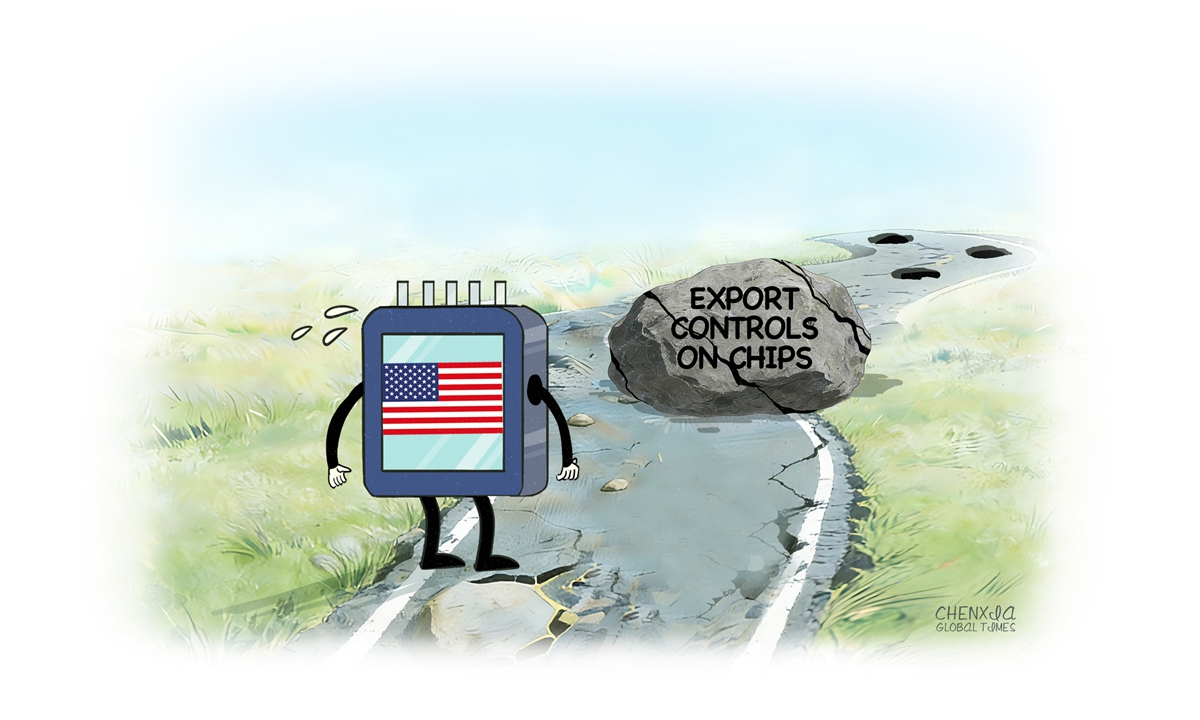
Illustration: Chen Xia/GT
According to Bloomberg, David Sacks, the White House AI czar, recently noted that he was uncertain about whether the Trump administration's approach - allowing Nvidia's H200 exports to China as part of an effort to challenge Chinese tech champions like Huawei by bringing American competition to their home market - would work. It has been reported in recent days that the US will allow Nvidia's H200 processors to be exported to China. China's actual procurement decisions and volumes for the H200 remain to be seen. However, the news itself reveals a more fundamental shift: In the critical domain of advanced chips and computing power, the strategic initiative is undergoing a structural transfer.
The core of this transfer lies not in the purchase volume of any particular chip, but in who sets the rules of the game and who moves at their own pace.
For decades, the US has been accustomed to shaping other nations' technological trajectories through export controls: deciding "what to sell, what not to sell, to whom and under what conditions." This logic rested on a single premise: Target countries maintained structural dependence on US supply, making both "threats of cutoff" and "limited opening" effective strategic instruments.
That premise is now crumbling. When China explicitly defines advanced chips and computing power as core capabilities that must be indigenized, and commits national resources to sustained investment, the impact of whether the US "sells or doesn't sell, what it sells and how much" on China's long-term trajectory diminishes significantly. At most, it can affect pace and cost, but it cannot alter direction or objectives.
This transformation is no accident. Before the US adjusted its chip strategy toward China, China had already charted an independent innovation course. Afterward, rather than wavering, this course has only intensified.
The bigger change is that China no longer waits for external conditions to improve; it treats external uncertainty as a given constraint to optimize around. As long as Chinese companies believe "we can buy today but might be cut off tomorrow," they will treat imported advanced chips as short-term gap-fillers and transitions while positioning domestic alternatives as the long-term main track.
Sacks' puzzlement comes as no surprise. The strategic thinking he represents still rests on the premise that "US supply is a scarce resource and therefore can be used to shape others' behavior." The downgrade of "sell or don't sell" from a decisive variable to a disruptive variable is not China's choice but the consequence of the US strategy itself.
When export controls evolved from "precision targeting" to "comprehensive containment," they not only slowed the adversary's pace but also accelerated their determination and action toward self-reliance.
When a state treats something as a long-term security and development objective and can sustain investment and organizational mobilization, the logic of technological breakthroughs shifts from "optimization dependent on external supply" to "accumulation and iteration of indigenous capabilities." What China now pursues is breakthrough after breakthrough, advancement after advancement.
China no longer needs to adjust its strategic goals in response to US supply policies. The core of this competition lies in building national capabilities and strategic resilience. Whoever can consistently invest over the long term, organize effectively, create closed-loop systems, continuously iterate and, based on this, persist in open cooperation, will grasp true strategic initiative.
RELATED ARTICLES