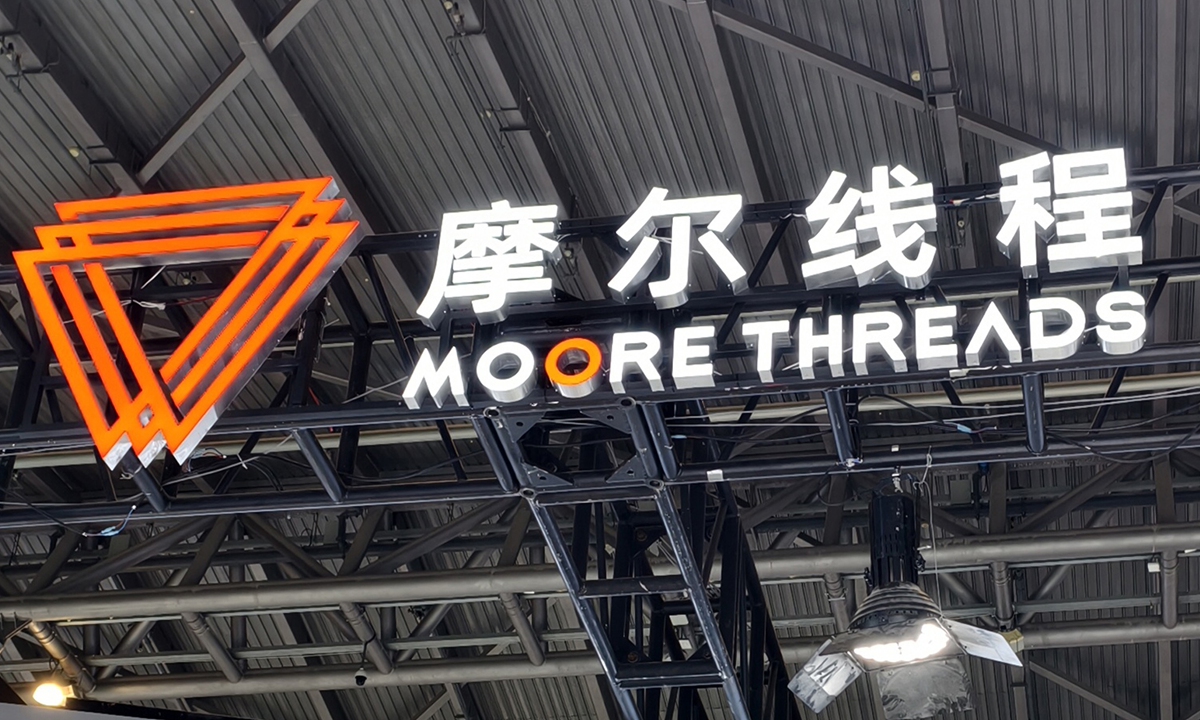
A logo of Moore Threads at the 2025 World Artificial Intelligence Conference in Shanghai on July 28, 2025 Photo: VCG
Chinese technology company Moore Threads unveiled its next-generation graphics processing unit (GPU) architecture on Saturday, supporting artificial intelligence (AI) clusters with more than 100,000 chips.
during its first "MUSA Developer Conference" (MDC 2025) held in Beijing on Saturday and Sunday.
During the conference, the company's founder, chairman, and CEO Zhang Jianzhong announced on Saturday the launch of the fifth-generation GPU architecture "Huagang," along with the AI training and inference chip "Huashan" and the graphics computing chip "Lushan" based on the new architecture, which will be mass-produced and launched next year, according to the Paper.
According to media reports, the "Huagang" architecture features a next-generation instruction set, with a 50 percent increase in computing density and a tenfold improvement in energy efficiency. It also integrates full-precision end-to-end acceleration technology and a next-generation asynchronous programming model, supporting AI clusters with more than 100,000 cards. The architecture also brings breakthroughs in graphics, with a new first-generation AI Generative Rendering (AGR) architecture and a second-generation ray-tracing hardware acceleration engine.
Zhang emphasized that the ecosystem is the core moat and value proposition of the GPU industry. Leveraging the advantages of the MUSA (Moore Threads Computing Platform) architecture, the company continues to increase research and development investment, focusing on overcoming core technical challenges across both hardware and software.
Through open innovation, Moore Threads aims to strengthen collaboration with ecosystem partners, working together to build a self-reliant and resilient domestic computing industry ecosystem, he said.
Building on this foundation, the performance of the AI chip "Huashan" has also been significantly enhanced. The "Huashan" chip integrates the new generation of asynchronous programming and full-precision tensor computing units, providing stable and efficient computing power support for AI clusters with tens of thousands of cards.
Meanwhile, as an AI-powered graphics rendering chip, the "Lushan" chip outperforms the company's previous-generation S80 in 3A gaming performance by 15 times, AI performance by 64 times, ray tracing performance by 50 times, and geometry processing performance by 16 times. It also shows improvements in texture filling performance, atomic memory access, and video memory capacity.
Ma Jihua, a veteran industry insider, told the Global Times that Moore Threads' GPUs stand out for their "full-function" design. Built on the company's self-developed MUSA architecture, the chips support multiple workloads on a single processor, unlike many rivals that are focused mainly on AI computing. This enables broader application scenarios. On the software side, Moore Threads follows a dual strategy combining compatibility with mainstream ecosystems and its own platform, with solutions already deployed in large AI models and several key industries.
Ma said that the company's next-generation GPU architecture addresses two main bottlenecks: stronger support for clusters with tens of thousands of GPUs, significantly enhancing scalability, and improved bandwidth performance, boosting efficiency in large-scale parallel computing.
Based on current technical benchmarks, Ma said that domestic GPUs are steadily narrowing the gap with Nvidia and may soon catch up across hardware, software and ecosystems. He added that multiple Chinese firms are advancing along different technological paths, covering high-, mid- and low-end products. With capacity rising rapidly, they are increasingly meeting domestic demand and moving toward global markets, helping advance more accessible AI.
Experts said that domestic GPUs in China have accelerated significantly in the past two years.
Biren Tech, Moore Threads, Metax Tech, and Enflame Tech—dubbed China's "Four Little Dragons" of GPUs—have drawn strong market attention. On December 17, Metax Tech debuted on the STAR Market, surging 568.83 percent at the opening to 700 yuan ($99) per share, giving it a market value of 280.1 billion yuan.
Moore Threads was listed on the STAR Market on December 5.
Driven by the AI era, demand for GPUs is expanding rapidly. According to Frost & Sullivan, the global GPU market is expected to expand at a compound annual growth rate (CAGR) of 24.5 percent from 2025 to 2029. The Chinese market is growing even faster, with its size projected to exceed 1.3 trillion yuan by 2029 and a CAGR of more than 50 percent during the same period. China's share of the global GPU market is expected to rise from 15.6 percent in 2024 to 37.8 percent, the Securities Times reported.