ARTS / CULTURE & LEISURE
Drone-augmented Liuyang fireworks: mutual enhancement of high tech and traditional feats
Seeing the spectacle
By and Dong Feng Published: Dec 22, 2025 10:43 PM

Editor's Note:
Among the many descriptions of China seen from the outside, the country has gained an increasingly prominent image for itself in 2025 as a "cool" place to visit and live, as reflected in multiple global surveys and in foreign vloggers' videos and comments.
As the year draws to a close, we turn our gaze to the vibrant tapestry of China's new cultural forces - stories that have sparked surprises and pleasant experiences for both people living in the country and staying for a short visit, and even those who are only starting to get to know the true face of the country through online means and explore why China has, seemingly in a short while, taken on a cool shape. To capture this dynamism, the Global Times is launching the "Cool China" series to approach the most iconic events and phenomena of the year through the five senses.
In this second installment, let's gaze upon the dazzling spectrum where technology empowers tradition, and witness how ancient heritages are being rekindled into a globally resonant, visually stunning language of "cool."

This stunning drone fireworks show, seen as Liuyang's "love letter of light" to the world, set two Guinness World Records that day: the most fireworks carried by a drone formation in flight, and the most drones simultaneously launched and controlled by a single computer.
Taking the theme "one flower, one tree, one world," it carried quiet yet profound goodwill: China's reimagining of its ancient gunpowder craft through the contemporary innovation of drone technology offered the world a glimpse of a "Cool China," a nation rooted in tradition yet still modern, a place where progress is measured in shared wonder.
The footage, shared on TikTok and YouTube, racked up over 10 million views in just a few days.
When Elon Musk retweeted the Guinness World Record-breaking performance, the internet erupted, showing that the 1,400-year-old craft that can be traced back to the Tang Dynasty (618-907), amplified by technology, had become a global visual spectacle.
"It's a shining example of how innovation can transform our celebrations, making them not just memorable, but truly extraordinary," read one viral comment on TikTok. For many, the spectacle was more than a feast for the eyes, it was also a demonstration of the core qualities embedded in Chinese culture: harmony, inclusivity and innovation.
Tobias Isler, a Swiss fireworks industry insider who has traveled the globe chasing the world's best fireworks shows, captured the sentiment in words.
"I am amazed about the progress in terms of quality of the effects used. It probably reflects a lot of what's going on in China. The shows in Liuyang always feel like they have a story behind them. This makes them special and unique," Isler told the Global Times.
For Lü Suwei, a tourist from Wuhan, Central China's Hubei Province, the magic was personal. Lured by the "last show of the year" promotion, she traveled by high-speed rail to Changsha city in Hunan, then took an hour ride to Liuyang.
"The moment drones formed the Chinese poem 'As if the Silver River fell from the azure sky' (like the Milky Way pouring down from the heavens), and fireworks exploded in harmony, I felt pure joy and awe… It reminded me of the Spring Festival, that warm, nostalgic feeling," Lü told the Global Times.
Liuyang's Guinness records were more than just a milestone. It was the climax of a banner year for China's cultural tourism sector, the moment tradition stopped being a static relic and evolved into a universal language, amplified by technology.
Liuyang's success was not built in a day. It was the result of eight years of relentless experimentation, during which gunpowder and code evolved from competitors to collaborators.
"In 2017, we saw drone shows and realized this technology could complement, not replace, fireworks," Ye Changzheng, a fourth-generation inheritor of the intangible cultural heritage (ICH) of Liuyang fireworks, told the Global Times.
"Drones excel at concrete imagery; fireworks at abstract emotion. Together, they create something extraordinary," Ye added.
The fusion posed daunting technical challenges. Performance drones were never designed to carry loads, and firework attachments reduced battery life by 20 percent.
Ye's team upgraded battery density, modified drones with custom brackets to stabilize fireworks, and developed programming that syncs ignition to within one-thousandth of a second.
"We tested in deserts, plateaus, coastal areas, and adapted to wind, temperature, and pressure changes," Ye explained.
Anti-interference technology was critical. "With thousands of drones flying, electromagnetic interference could disrupt ignition. We collaborated with drone companies to integrate fireworks control into their systems, eliminating manual triggers," said Ye.
Product innovation was equally vital. Engineers reduced firework weight by 30 percent using lighter materials and optimized formulas to maintain brightness while cutting smoke and sulfur. "Green technology isn't just a trend, it's survival," Ye emphasized. "Traditional fireworks faced strict environmental and safety restrictions. By combining with drones, we turned pressure into momentum."
This symbiosis transformed Liuyang's industry. From selling standalone fireworks, the city now offers integrated "technology plus culture plus communication" solutions.
According to Ye, the team's structure evolved too: from relying on craftsmen and graphic designers to hiring 3D animators, programmers, and previsualization specialists.
"A single computer controlling 15,000 plus drones isn't just tech, it's art," noted Ye, referencing the October show that caught Musk's eye. "Young talent brings fresh ideas, while veteran craftsmen ensure the essence of our ICH remains intact."
Jiang Yiyi, dean of the School of Sports Leisure and Tourism at Beijing Sport University, noted that Liuyang's model conforms to the cultural and tourism industry's trend of integration, diversification and technological transformation.
"It's about technology empowering tradition," she told the Global Times. "Liuyang cracked the code: uphold core cultural values, embrace technological change, and prioritize emotional resonance. This triple helix is the future of cultural tourism."
Tang Xiaoyun, vice president of the China Tourism Academy, echoed that as an example of phenomenal innovation in technology-cultural tourism integration, Liuyang demonstrates the strong driving force of technology empowerment and the innovation logic of "creating new demand with new supply," playing a unique role in the creation of content and experiences.
Tang told the Global Times that such initiatives have evolved into a diversified format combining performances with study tours, food, the night economy, intangible cultural heritage, and homestays and which has gained market popularity and significantly boosted local influence and consumption.
Liuyang is just one star in China's 2025 cultural tech firmament. Across the country, different distinct fusion models emerged over the year, transforming tourism from passive sightseeing to active experiences.
Extending this trend, in Wuxi, East China's Jiangsu Province, the Nianhua Bay Scenic Area has created a smart, immersive night-time experience, using light projections and sound installations to build a Zen-inspired digital dreamscape. This has successfully extended visitor dwelling time and boosted occupancy rates in nearby homestays.
Additionally, the Mount Emei Scenic Area has deployed exoskeleton hiking-assistance robots, which attracted over 1,000 paid users within just two months of their launch.
The "virtual-real immersive interaction" model uses VR/AR to blur past and present.
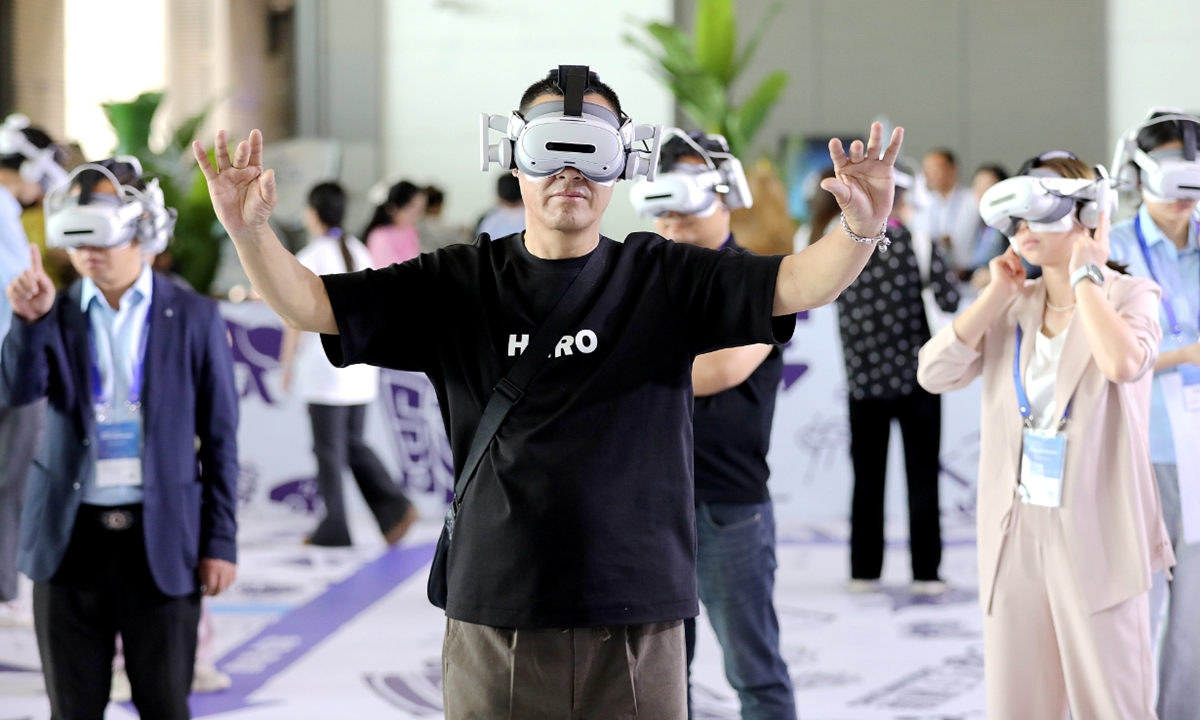
At the Palace Museum, the "digital twin Forbidden City" project has brought relics to life as visitors wearing VR headsets can use gesture controls to open and read virtual memorials. At the Sanxingdui Ruins, 2025 saw the launch of an upgraded VR archaeology experience that allows visitors to "dig" for bronze artifacts and "restore" ancient masks using haptic technology.
The "IP plus tech" model extended cultural influence beyond physical sites. Sichuan's giant panda IP spawned digital souvenirs, metaverse experiences, and AI-generated panda avatars that interact with visitors at the Chengdu Research Base of Giant Panda Breeding. Dunhuang's "Digital Library Cave" VR project, updated in 2025, allowed global audiences to explore 29 newly digitized Buddhist manuscripts in 4K resolution. The project partnered with international museums, reaching 12 million users overseas and generating media coverage by news outlets in both China and abroad.
These models share a common thread: They turn static culture into dynamic experiences. "Tourism is no longer about 'checking in,' it's about creating emotional memories that last a lifetime," Jiang noted.
Jiang told the Global Times that this shift has redefined the industry's value chain: from the ticket-driven economy to the experience economy, and ultimately to the emotional economy.
Global wonder
This wave of innovation is reshaping China's tourism landscape and boosting its appeal to inbound visitors. Celebrities, including Katie Perry and streamer IshowSpeed, have embarked on high-profile China tours.
Data from the National Immigration Administration (NIA) underscores the trend: Foreigners made a total of 38.053 million trips in the first half of 2025, up 30.2 percent year-on-year, with visa-free entries reaching 13.64 million, up 53.9 percent year-on-year. What makes these cultural tech spectacles such powerful global communicators?
Both Tang and Jiang explained that visual storytelling transcends language: A foreign audience may not understand the Chinese poem "As if the Silver River fell from the azure sky," but they feel the grandeur of fireworks and drones. "Authentic cultural elements paired with universal visual appeal create a bridge," Tang explained.
This spread has reshaped China's cultural image. "For decades, international perceptions focused on ancient relics like the Great Wall or the Palace Museum," Jiang noted. "Now, they're seeing a dynamic China, one that honors tradition while leading in innovation. It's a more holistic, modern narrative."
Yet challenges remain. Jiang warns of homogenization: "Without patent protection, good ideas are copied quickly, diluting quality." Talent shortages persist, and investment bubbles risk wasting resources on trend-chasing rather than meaningful innovation.
To avoid "tech dizziness," which is the sense of emptiness from over-reliance on gadgets, Jiang advocates anchoring technology in culture and balancing virtual and real experiences. Liuyang's success, she argues, stems from this balance: "The drones and fireworks are tools, but the heart of the show is human emotion: joy, nostalgia, wonder."
As 2025 draws to a close, Liuyang's glowing "Sky Tree" stands as a role model for China's cultural tech revolution. It's a tree rooted in tradition that was watered by centuries of craftsmanship, cultural heritage, and human emotion, yet branching out into the future via innovation.
In the year-end spectacle of 2025, China showcased a compelling new kind of cool: one built on the inclusive and innovative dialogue between its past and its future.
Among the many descriptions of China seen from the outside, the country has gained an increasingly prominent image for itself in 2025 as a "cool" place to visit and live, as reflected in multiple global surveys and in foreign vloggers' videos and comments.
As the year draws to a close, we turn our gaze to the vibrant tapestry of China's new cultural forces - stories that have sparked surprises and pleasant experiences for both people living in the country and staying for a short visit, and even those who are only starting to get to know the true face of the country through online means and explore why China has, seemingly in a short while, taken on a cool shape. To capture this dynamism, the Global Times is launching the "Cool China" series to approach the most iconic events and phenomena of the year through the five senses.
In this second installment, let's gaze upon the dazzling spectrum where technology empowers tradition, and witness how ancient heritages are being rekindled into a globally resonant, visually stunning language of "cool."
A fireworks show featuring drones lights up the night sky in Liuyang, Hunan Province. Photo VCG
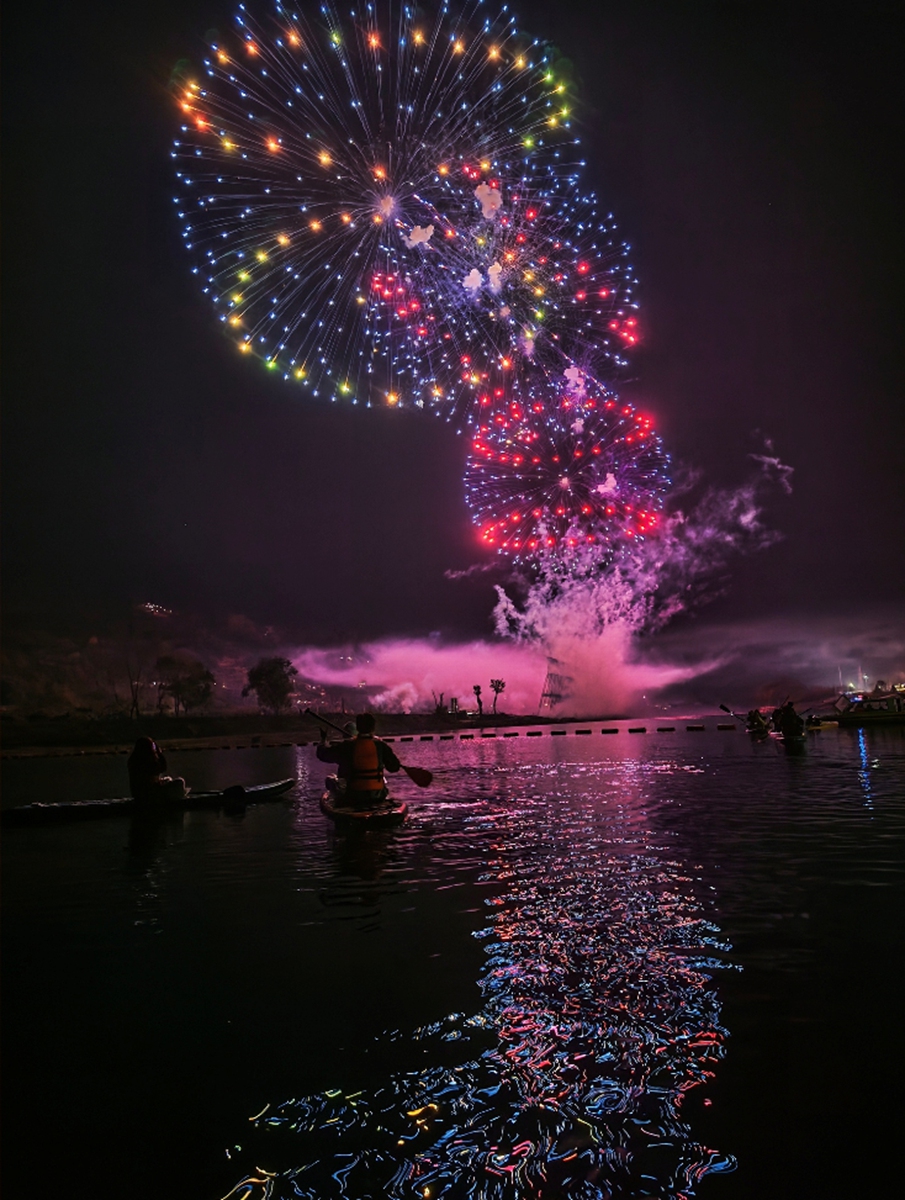
As night descended on October 17 in Liuyang, "the fireworks capital of the country" in Central China's Hunan Province, purple and crimson fireworks burst across the sky, painting ephemeral arcs against the darkness. Below, nearly 16,000 drones hummed in perfect unison, morphing into a giant flower and then, a towering tree whose branches drip with fiery tassels.This stunning drone fireworks show, seen as Liuyang's "love letter of light" to the world, set two Guinness World Records that day: the most fireworks carried by a drone formation in flight, and the most drones simultaneously launched and controlled by a single computer.
Taking the theme "one flower, one tree, one world," it carried quiet yet profound goodwill: China's reimagining of its ancient gunpowder craft through the contemporary innovation of drone technology offered the world a glimpse of a "Cool China," a nation rooted in tradition yet still modern, a place where progress is measured in shared wonder.
The footage, shared on TikTok and YouTube, racked up over 10 million views in just a few days.
When Elon Musk retweeted the Guinness World Record-breaking performance, the internet erupted, showing that the 1,400-year-old craft that can be traced back to the Tang Dynasty (618-907), amplified by technology, had become a global visual spectacle.
"It's a shining example of how innovation can transform our celebrations, making them not just memorable, but truly extraordinary," read one viral comment on TikTok. For many, the spectacle was more than a feast for the eyes, it was also a demonstration of the core qualities embedded in Chinese culture: harmony, inclusivity and innovation.
Tobias Isler, a Swiss fireworks industry insider who has traveled the globe chasing the world's best fireworks shows, captured the sentiment in words.
"I am amazed about the progress in terms of quality of the effects used. It probably reflects a lot of what's going on in China. The shows in Liuyang always feel like they have a story behind them. This makes them special and unique," Isler told the Global Times.
For Lü Suwei, a tourist from Wuhan, Central China's Hubei Province, the magic was personal. Lured by the "last show of the year" promotion, she traveled by high-speed rail to Changsha city in Hunan, then took an hour ride to Liuyang.
"The moment drones formed the Chinese poem 'As if the Silver River fell from the azure sky' (like the Milky Way pouring down from the heavens), and fireworks exploded in harmony, I felt pure joy and awe… It reminded me of the Spring Festival, that warm, nostalgic feeling," Lü told the Global Times.
Liuyang's Guinness records were more than just a milestone. It was the climax of a banner year for China's cultural tourism sector, the moment tradition stopped being a static relic and evolved into a universal language, amplified by technology.
A show blending splendid fireworks with drones lights up the night sky in Liuyang, Central China's Hunan Province. Photo VCG
Symbiotic innovationLiuyang's success was not built in a day. It was the result of eight years of relentless experimentation, during which gunpowder and code evolved from competitors to collaborators.
"In 2017, we saw drone shows and realized this technology could complement, not replace, fireworks," Ye Changzheng, a fourth-generation inheritor of the intangible cultural heritage (ICH) of Liuyang fireworks, told the Global Times.
"Drones excel at concrete imagery; fireworks at abstract emotion. Together, they create something extraordinary," Ye added.
The fusion posed daunting technical challenges. Performance drones were never designed to carry loads, and firework attachments reduced battery life by 20 percent.
Ye's team upgraded battery density, modified drones with custom brackets to stabilize fireworks, and developed programming that syncs ignition to within one-thousandth of a second.
"We tested in deserts, plateaus, coastal areas, and adapted to wind, temperature, and pressure changes," Ye explained.
Anti-interference technology was critical. "With thousands of drones flying, electromagnetic interference could disrupt ignition. We collaborated with drone companies to integrate fireworks control into their systems, eliminating manual triggers," said Ye.
Product innovation was equally vital. Engineers reduced firework weight by 30 percent using lighter materials and optimized formulas to maintain brightness while cutting smoke and sulfur. "Green technology isn't just a trend, it's survival," Ye emphasized. "Traditional fireworks faced strict environmental and safety restrictions. By combining with drones, we turned pressure into momentum."
This symbiosis transformed Liuyang's industry. From selling standalone fireworks, the city now offers integrated "technology plus culture plus communication" solutions.
According to Ye, the team's structure evolved too: from relying on craftsmen and graphic designers to hiring 3D animators, programmers, and previsualization specialists.
"A single computer controlling 15,000 plus drones isn't just tech, it's art," noted Ye, referencing the October show that caught Musk's eye. "Young talent brings fresh ideas, while veteran craftsmen ensure the essence of our ICH remains intact."
Jiang Yiyi, dean of the School of Sports Leisure and Tourism at Beijing Sport University, noted that Liuyang's model conforms to the cultural and tourism industry's trend of integration, diversification and technological transformation.
"It's about technology empowering tradition," she told the Global Times. "Liuyang cracked the code: uphold core cultural values, embrace technological change, and prioritize emotional resonance. This triple helix is the future of cultural tourism."
Tang Xiaoyun, vice president of the China Tourism Academy, echoed that as an example of phenomenal innovation in technology-cultural tourism integration, Liuyang demonstrates the strong driving force of technology empowerment and the innovation logic of "creating new demand with new supply," playing a unique role in the creation of content and experiences.
Tang told the Global Times that such initiatives have evolved into a diversified format combining performances with study tours, food, the night economy, intangible cultural heritage, and homestays and which has gained market popularity and significantly boosted local influence and consumption.
Visitors experience immersive VR tourism in Xi'an, Northwest China's Shaanxi Province. Photo VCG
National transformationLiuyang is just one star in China's 2025 cultural tech firmament. Across the country, different distinct fusion models emerged over the year, transforming tourism from passive sightseeing to active experiences.
Extending this trend, in Wuxi, East China's Jiangsu Province, the Nianhua Bay Scenic Area has created a smart, immersive night-time experience, using light projections and sound installations to build a Zen-inspired digital dreamscape. This has successfully extended visitor dwelling time and boosted occupancy rates in nearby homestays.
Additionally, the Mount Emei Scenic Area has deployed exoskeleton hiking-assistance robots, which attracted over 1,000 paid users within just two months of their launch.
The "virtual-real immersive interaction" model uses VR/AR to blur past and present.
At the Palace Museum, the "digital twin Forbidden City" project has brought relics to life as visitors wearing VR headsets can use gesture controls to open and read virtual memorials. At the Sanxingdui Ruins, 2025 saw the launch of an upgraded VR archaeology experience that allows visitors to "dig" for bronze artifacts and "restore" ancient masks using haptic technology.
The "IP plus tech" model extended cultural influence beyond physical sites. Sichuan's giant panda IP spawned digital souvenirs, metaverse experiences, and AI-generated panda avatars that interact with visitors at the Chengdu Research Base of Giant Panda Breeding. Dunhuang's "Digital Library Cave" VR project, updated in 2025, allowed global audiences to explore 29 newly digitized Buddhist manuscripts in 4K resolution. The project partnered with international museums, reaching 12 million users overseas and generating media coverage by news outlets in both China and abroad.
These models share a common thread: They turn static culture into dynamic experiences. "Tourism is no longer about 'checking in,' it's about creating emotional memories that last a lifetime," Jiang noted.
Jiang told the Global Times that this shift has redefined the industry's value chain: from the ticket-driven economy to the experience economy, and ultimately to the emotional economy.
Global wonder
This wave of innovation is reshaping China's tourism landscape and boosting its appeal to inbound visitors. Celebrities, including Katie Perry and streamer IshowSpeed, have embarked on high-profile China tours.
Data from the National Immigration Administration (NIA) underscores the trend: Foreigners made a total of 38.053 million trips in the first half of 2025, up 30.2 percent year-on-year, with visa-free entries reaching 13.64 million, up 53.9 percent year-on-year. What makes these cultural tech spectacles such powerful global communicators?
Both Tang and Jiang explained that visual storytelling transcends language: A foreign audience may not understand the Chinese poem "As if the Silver River fell from the azure sky," but they feel the grandeur of fireworks and drones. "Authentic cultural elements paired with universal visual appeal create a bridge," Tang explained.
This spread has reshaped China's cultural image. "For decades, international perceptions focused on ancient relics like the Great Wall or the Palace Museum," Jiang noted. "Now, they're seeing a dynamic China, one that honors tradition while leading in innovation. It's a more holistic, modern narrative."
Yet challenges remain. Jiang warns of homogenization: "Without patent protection, good ideas are copied quickly, diluting quality." Talent shortages persist, and investment bubbles risk wasting resources on trend-chasing rather than meaningful innovation.
To avoid "tech dizziness," which is the sense of emptiness from over-reliance on gadgets, Jiang advocates anchoring technology in culture and balancing virtual and real experiences. Liuyang's success, she argues, stems from this balance: "The drones and fireworks are tools, but the heart of the show is human emotion: joy, nostalgia, wonder."
As 2025 draws to a close, Liuyang's glowing "Sky Tree" stands as a role model for China's cultural tech revolution. It's a tree rooted in tradition that was watered by centuries of craftsmanship, cultural heritage, and human emotion, yet branching out into the future via innovation.
In the year-end spectacle of 2025, China showcased a compelling new kind of cool: one built on the inclusive and innovative dialogue between its past and its future.
RELATED ARTICLES