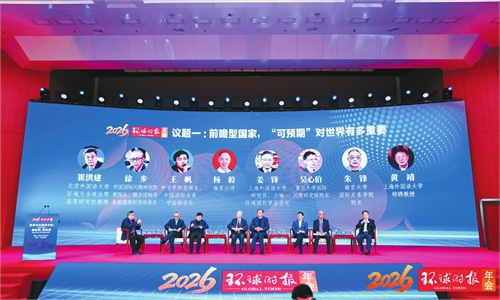
The Global Times Annual Conference 2026 is held in Beijing on December 20, 2025. Photo: GT
Editor's Note:
The Global Times Annual Conference 2026 took place in Beijing on Saturday, under the theme "Trust in China: New Journey, New Opportunities." This year's conference brought together more than 100 authoritative experts and scholars from political, academic and business circles, both domestically and internationally, to decode the logic of China's development and explain why "trust in China" is increasingly becoming an international consensus. This page highlights key points from the experts' speeches and discussions during the third panel of the conference, titled "A civilizational country: Why the Chinese approach is the most implementable."
Four global initiatives are China's response to gravity of crisis of global order
Fu Xiaoqiang, president of China Institutes of Contemporary International Relations
The Global Governance Initiative (GGI) embodies China's wisdom, concepts and solutions. It provides clear guidance for addressing challenges in global governance: how to ensure that the global governance system fulfills humanity's shared aspirations for peace and development and effectively resolves issues related to development and security.
The current global governance system faces three major challenges: imbalanced representation, outdated rules and ineffective action.
In many international institutions, the voting power of Global South countries does not match their evolving influence. This structural imbalance renders the existing system inadequate for tackling global challenges such as climate change and the digital divide. As the largest country in the Global South, China has put forward the GGI, enabling Global South countries to become the main force reshaping the global governance landscape rather than remaining bystanders.
Martin Jacques, British scholar and senior fellow at the China Institute, Fudan University
The four global initiatives - Global Development Initiative (2021), Global Security Initiative (2022), Global Civilization Initiative (2023) and GGI (2025) - are an articulate summary and statement of China's foreign policy as it has evolved.
The four global initiatives are part of China's response to the gravity of the crisis of the global order that is becoming ever more evident. They are China's response to increasingly widely asked questions: What is China's position on the global order? How should it be reformed? How does China see the future of the international system? These are the subjects of the GGI.
Above all, the four global initiatives are directed to the Global South. China has seen itself as an integral part of the developing world ever since 1949. And with the passage of time and the growing importance of the Global South, this has become the case increasingly. China regards the relationship with the Global South as the primary relationship in its present and future foreign policy.
Success of Chinese modernization will profoundly influence the direction of human civilization's progress
Ma Xiaojun, a senior research fellow at the Institute of Global Governance and Development at Renmin University of China
A breakdown in shared values is emerging between the US and Europe, its traditional ally, revealing a vast ideological divide. The "clash of civilizations" articulated by US scholar Samuel Huntington is now manifesting within Western civilization itself. At the same time, Chinese modernization is progressing steadily, and the rise of the Global South is in full swing, creating a magnificent landscape of human civilization in the 21st century.
Looking ahead to 2026, profound changes in the international landscape will undoubtedly impact China's development; conversely, China's development will also more profoundly influence and drive changes in the international landscape. The success of Chinese modernization will influence the direction of human civilization's progress.
Ahmed Moustafa, director and founder of the Asia Center for Studies & Translation in Egypt
The philosophical bedrock in win-win cooperation and shared future of China's four global initiatives provides a compelling, inspirational alternative to zero-sum geopolitics.
This vision of inclusive globalization, where progress is not a privileged commodity but a shared pursuit, resonates deeply with the Global South, offering a collaborative model of engagement that stands in stark contrast to historical paradigms of dominance and conditionality.
Ultimately, the secret behind the resilience and successful implementation of the four Chinese global initiatives is their alignment with an undeniable global trend: multipolarity.
Why China resonates with Global South nations on development
Li Xiaoyun, distinguished chair professor of humanities at China Agricultural University
China's development solutions can influence Global South nations. I summarize this as "parallel experience." First, China and most other Global South nations share a parallel history of having experienced or currently facing poverty. China's modernization process has made our experiences and insights referential to most countries in the Global South. Second, China and most countries in the Global South have experienced or are currently facing common challenges such as poverty and development. Third, we thus have mutually learning solutions to address these common challenges.
These three elements have enabled China to resonate with Global South nations on development issues, which largely explains why China holds such significance for the Global South.
Yang Xuedong, director of the Department of Political Science at Tsinghua University
Discussing why China's approach is the most implementable cannot be separated from the focus on execution. First, China possesses practice-based thinking. For a solution to be executed, a certain material foundation must first exist. Only when this foundation is established can collective action emerge, followed by shared ideals. Second, when translating China's national governance approach into global governance, three dimensions are crucial: First, emotionally, we share significant similarities and empathy with developing nations. Second, developmentally, China's practical experience provides a direct reference for other countries in the Global South. Third, China's governance system prioritizes mechanisms designed for unification rather than division to achieve its objectives.
Jiang Shixue, distinguished professor at Shanghai University
The proposal and implementation of the four global initiatives represent important wisdom contributed by China in the new era to address global challenges and promote the building of a community with a shared future for humanity. Turning the four global initiatives into reality requires the participation of every country. Only through joint efforts and solidarity can they be truly implemented.
Sharing China's experiences means making available to the world the practices and achievements China has accumulated in reform and opening-up, poverty alleviation, economic development and social governance. In essence, this is a form of international exchange rather than coercion, and certainly not the export of any model. Countries are free to decide, based on their own conditions and needs, whether to draw on these experiences and how to do so. Such sharing is rooted in China's own development practice and responds to the common aspiration of countries to explore development paths suited to their national realities.
RELATED ARTICLES