Dozens of HK study tours to Japan reportedly canceled; Chinese mainland cities viewed as preferred destinations, insiders tell GT
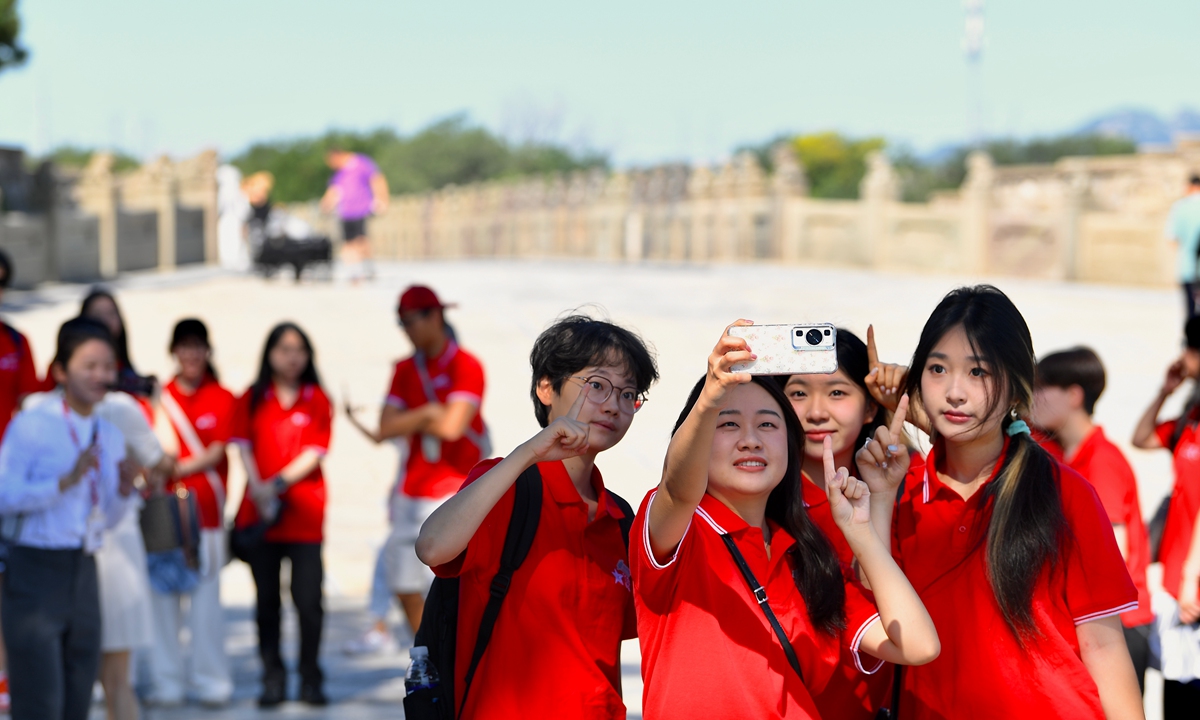
University students from Hong Kong take a selfie together while participating in a summer exchange program in Beijing on July 30, 2025. Photo: VCG
Amid strained China-Japan relations triggered by Japanese Prime Minister Sanae Takaichi's erroneous remarks on Taiwan and dangerous moves, some Hong Kong media outlets reported that many Hong Kong study tour agencies have received a large number of requests from schools to cancel trips to Japan. The number of cancelled Japan tour groups has currently reached double digits, the report said.
Institutions specializing in study tours said after cancelling trips to Japan, they have switched destinations to South Korea and Singapore, with Chinese mainland cities under consideration, according to a local Hong Kong media outlet.
Another Hong Kong media outlet HKET also covered the report of Hong Kong study tour agencies canceling student trips to Japan. The report cited Hong Kong-based Victoria Educational Organization as an example, saying that it has changed the destination of its upcoming parent-child overseas exchange tour from Tokyo to Chengdu, Southwest China's Sichuan Province, to protect safety of parents and their children.
Poon Ka Wa Ken, general manager of A-Team Travel, a Hong Kong-based study tour organization partnering with multiple local primary and secondary schools and universities, told the Global Times on Wednesday that since last month, when Takaichi's erroneous remarks led to a sharp deterioration in China-Japan relations, 99 percent of his company's study tours to Japan have been canceled.
Study tour institutions also noted that the wave of cancellation has also extended to study tour groups scheduled to depart for Japan in March next year, the report said.
Regarding the sudden and large-scale cancellation, Poon noted that although the company would incur some losses and face an increased workload, he still considers this is "the right and necessary thing to do."
He said that the primary duty of educational institutions is to impart proper values to students. "What we must do is to make students aware of the erroneous stance of the Japanese government and understand the non-negotiable red lines of our nation, rather than blindly pursuing exchanges," Poon said.
Poon also noted that "Chinese mainland cities are a preferred destination for the future" as Hong Kong students show great interest in mainland cities, culture, and the hobbies of young people there.
The highly inappropriate remarks from Japan have seriously worsened the atmosphere for China-Japan personnel exchanges and cast doubt on the effectiveness of many exchanges, the Hong Kong Special Administrative Region (HKSAR) Chief Executive John Lee said at the press conference held on November 24.
He added that the HKSAR government will closely monitor developments, and any related arrangements must safeguard national dignity and the interests of Hong Kong residents.
Poon expressed his hope that Japanese government will correct its stance at an early date, retract the erroneous remarks and allow people-to-people exchanges, which should not have been implicated, to return to the right track.
"What ordinary people hope for is nothing more than normal and friendly heart-to-heart bilateral exchanges," Poon said, adding that "we hope the Japanese government can demonstrate sincerity and prevent more cultural exchanges from becoming casualties of certain Japanese officials' actions."
The Hong Kong Security Bureau updated the outbound travel information on November 15 on its website regarding Japan, noting a rising trend of attacks against Chinese nationals in the country since mid-year, along with several other earthquake and typhoon alerts during the year.
The bureau urged Hong Kong residents who are planning to travel to Japan — or are already there — to stay vigilant, pay attention to personal safety, monitor local announcements on the latest developments, and follow information issued by Chinese embassy and consulates in Japan.
RELATED ARTICLES