Takaichi’s claim ‘Japan is back’ is a warning bell; China will absolutely not allow history to repeat itself: experts at GT Global Minds Roundtable
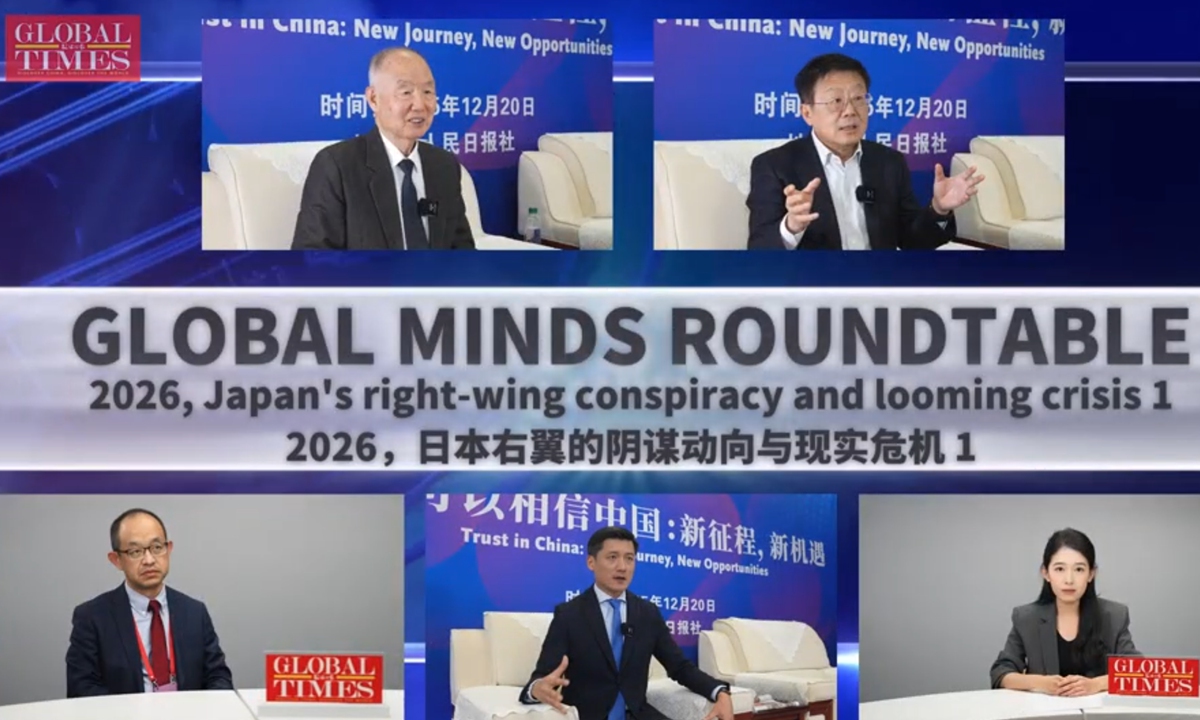
Clockwise from top left: Yang Yi, Huang Jing, Li Aixin, Xiang Haoyu and Wang Qiang Photo: screenshot
Editor's Note:
From Japanese Prime Minister Sanae Takaichi's erroneous remarks on the Taiwan question to Japanese government official's claims that Japan should possess nuclear weapons, the ambitions of Japan's right-wing forces to steer the country toward becoming a "war-capable state" are now out in the open, louder and clearer than ever. Can Japan's strength support its right-wing ambitions? Trapped by challenges near and far, how many grim truths does Japan still confront? In the latest episode of the Global Times (GT) Global Minds Roundtable, Yang Yi (Yang), Chinese People's Liberation Army Navy rear admiral, Huang Jing (Huang), a distinguished professor at Shanghai International Studies University, Xiang Haoyu (Xiang), a distinguished research fellow at the China Institute of International Studies, and Wang Qiang (Wang), a Chinese scholar of national security strategy studies, share their insights with GT reporters Li Aixin and Pang Yue.
GT: How do you analyze the conspiracy - or overt scheme - exposed by Japan's right-wing forces, starting with Takaichi's erroneous remarks?
Xiang: Throughout the development of postwar Japanese politics, there has always been a core policy ideology: to free Japan from its status as a defeated nation and turn it into a so-called normal country. A "normal country," in their view, means giving Japan political and military power that matches its economic strength, thereby breaking free from the constraints of the Pacifist Constitution.
Yang: Japan's militarism was never thoroughly eradicated after WWII. In the past, right-wing forces exercised some restraint, but now they are seizing on turbulence in the geopolitical landscape to seek new openings for expansion. Their current strategy essentially relies on seeking the US' support to counterbalance China, while their fundamental goal is to loosen the restraints on themselves.
Huang: The right-wing forces are now facing a difficult predicament. On one hand, China is growing ever stronger. On the other, the US is demanding more from Japan while offering less support. In my view, Takaichi's remarks represent a risky probe by Japan's right-wing forces in an international environment that is highly unfavorable to Tokyo. It is an act of provocation toward China, while simultaneously testing the US and trying to drag it into the tension.
Wang: Be it a covert conspiracy or an overt scheme, it amounts to the same thing. The outcome of the war left Japanese right-wing forces deeply resentful to this day - Japan is not a so-called normal country, it has no right to wage war, and the Self-Defense Forces (SDF) is not a Japanese military. To put it bluntly, given the current momentum of Japan's right wing, the level of public support they enjoy and changes in the broader international environment, they hope the SDF could become a Japanese military and that Article 9 of the Constitution could be abolished. This is their ultimate objective - and it has never changed since the end of WWII.
GT: Within China's multifaceted response - spanning diplomatic, economic and military domains - which specific measures have, in your assessment, imposed noticeable pressure on Japan's right-wing forces? And does China still hold major cards yet to be played?
Xiang: China issued a travel advisory to Chinese citizens regarding trips to Japan. Chinese tourists account for a quarter of all inbound foreign visitors to Japan, and they spend generously on average. As a result, the decline in Chinese tourists has had a noticeable impact on tourism-related sectors - retail, dining, accommodation, transportation, logistics, and more. Recently, it was reported that chairman of Japan-China Economic Association asked the Chinese side to accept a previously planned economic delegation visit to Beijing in January next year, which reflects the anxiety in Japanese economic circles.
What they fear more is that if negative statements and actions from the Japanese side continue, China may take further economic countermeasures. In that case, Japan's economy could face tremendous pressure.
Wang: Today, Japanese SDF are not capable of confronting the Chinese military head-on - this is what terrifies them most. We can say with confidence that even if all three branches of Japan's SDF - army, navy and air force - were combined, they would still be no match for the PLA Navy alone. Simply having the Liaoning aircraft carrier group patrol east of the first island chain is enough to place enormous pressure on Japan, instantly exposing the lack of unity and poor coordination among Japan's SDF branches, as well as their extremely weak joint operations capability - all their flaws are laid bare.
Huang: We still have a wide range of options for dealing with Japan. Measures like travel advisory or seafood imports restrictions are merely surface-level. Our real confidence lies in the strong comprehensive national strength backing us up.
On the economic front, apart from tourism advisory, trade between China and Japan has largely continued as normal. But that doesn't mean we won't apply greater pressure. Militarily, China has a powerful navy, which has recently conducted joint exercises with Russia. These exercises demonstrate China's capability to control the situation. In my view, China has not yet played all its cards; the trump cards are still firmly in hand.
Looking back at history, Japan twice severely disrupted China's modernization process. First, the Sino-Japanese War of 1894-1895 (also known as the Jiawu War), whose reparations directly fueled the expansion of Japanese militarism. The second was Japanese aggression against China. Both were deliberate acts of aggression by Japan. Today, we will absolutely not allow history to repeat itself.
Yang: On the diplomatic front, our clear stance on upholding the post-WWII international order and the fruits of victory directly touches Japan's sore spot. As a defeated nation, Japan has no right to bare its fangs and brandish its claws. In the military domain, the development of China's armed forces - particularly the building of new-quality combat capabilities - has already created an overwhelming deterrent against Japan. If Japan dares to provoke again, old scores and new ones will be settled all together.
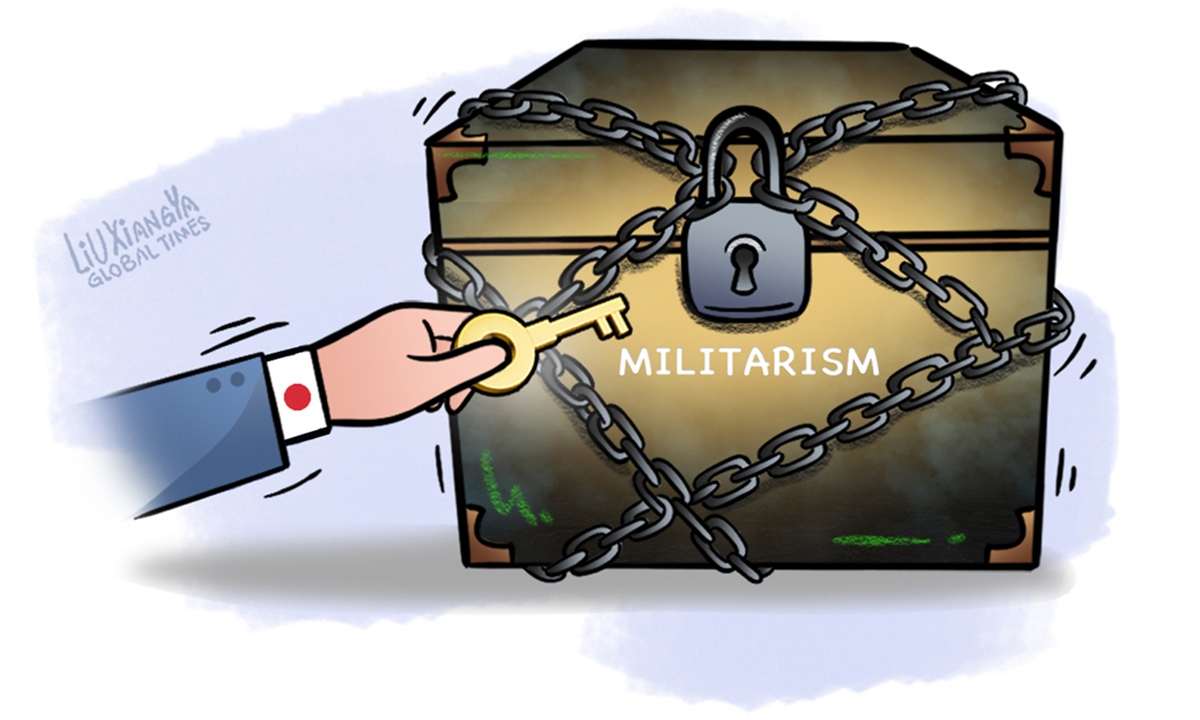
Illustration: Liu Xiangya/GT
GT: Amid the ongoing escalation of China-Japan tensions, how do you interpret the US stance?Yang: In the past, the US framed its role within the US-Japan treaty of mutual cooperation and security as the "spear" and Japan as the "shield." During my time as PLA Navy attaché at the Chinese Embassy in Washington DC, American officials described it to me exactly in those terms. Today, however, as China's comprehensive national strength and military capabilities continue to grow, the US is finding it increasingly difficult to cope with China's rise on its own. As a result, the US is deliberately pushing Japan to the forefront. However, the broader picture of China-US ties remains critically important. As long as the bilateral relationship remains generally stable, Japan will not dare to cross the line.
Huang: Trump's phone call to Takaichi was quite telling. According to media reports, he told her not to provoke China on the Taiwan question and to tone down her volume. Notably, no social media post followed the call. Shortly afterward, the US removed its Typhon mid-range missile system from western Japan.
At present, the US, at least the Trump administration, clearly prioritizes stabilizing relations with China over its ties with Japan.
GT: What is the root cause of the crisis currently facing the Takaichi cabinet?
Yang: Its crisis stems from whether it can withstand the pressure and costs imposed by China's strong countermeasures. We must fully anticipate the possibility of extreme actions from Japan while remaining clear-eyed about its vulnerabilities.
Japan's greatest weakness lies in the fact that it was once an economic powerhouse but remains a political dwarf - because it has never fully confronted its historical crimes. If Japan could face its past and move beyond it like Germany has done, the international community would not only accept it but even welcome its constructive role. Instead, Japan refuses to acknowledge history and keeps rubbing salt into the wounds of WWII victims. This behavior is, quite frankly, foolish. And that's not to mention that Japan's economy has been quite sluggish - making it impossible for Takaichi to implement Abenomics effectively.
Wang: It's not only China who finds Japan's actions unacceptable. The whole world finds them unacceptable as well. That's why, from what I've heard, Japan's pursuit of a permanent UN Security Council seat faces extensive opposition from many member states. This is one of the things that pains Japan the most. Because all it seeks is the influence of a world-class power. It has long been obsessed with joining the permanent members of the Security Council. Facing this kind of setback has dealt a heavy blow to its psyche.
GT: After this round of heightened tensions between China and Japan, do you see Japan as nearer to or farther from fulfilling the ambitions of its right-wing forces?
Huang: Farther. Takaichi came to power with the slogan "Japan is back." But a Japan that "comes back" from the past is a deeply troubling one. Japan cannot come "back" from the past - it can only move forward, by adhering to its Pacifist Constitution, refraining from launching wars or misusing military force, and becoming a truly peaceful nation. The phrase "Japan is back," therefore, should be seen as a warning bell.
If Japan chooses a healthy and normal path - abiding by the postwar international order and pursuing peaceful development - the international community would welcome it. But if it tries to revert to the old path of militarism and fascism, it would be walking straight into a dead end. Not only China, would respond resolutely, but all countries that once suffered from Japanese aggression would never stand idly by.
Xiang: From the perspective of certain forces in Japan, they might feel they are getting closer to their goals. However, any sober and objective observer would conclude that they are actually drifting ever further from their ambitions. The rhetoric and actions of Japan's right-wing forces only serve to confirm one thing: the resurgence of militarism from the ashes of defeat, making true reconciliation with Asian countries impossible. Under those circumstances, any notion of shedding its defeated-nation status is utterly out of the question.
Wang: After the PLA Navy's recent operations beyond the first island chain, its activities in the second island chain were essentially a strategic move to shape the situation. Japan's right-wing forces have provided us with a chance to shape and consolidate the military control capability of the PLA Navy and the PLA between the first and second island chains - and to maintain and strengthen that capability.
No matter how you look at it - Japan on its own, Japan backed by the US, or even with extra help from outside powers - none of these combinations are sufficient to challenge the overall Chinese national security situation.
RELATED ARTICLES