Insights from 2025 China-US economic and trade ties: Seeking ways to get along with each other through correct understanding
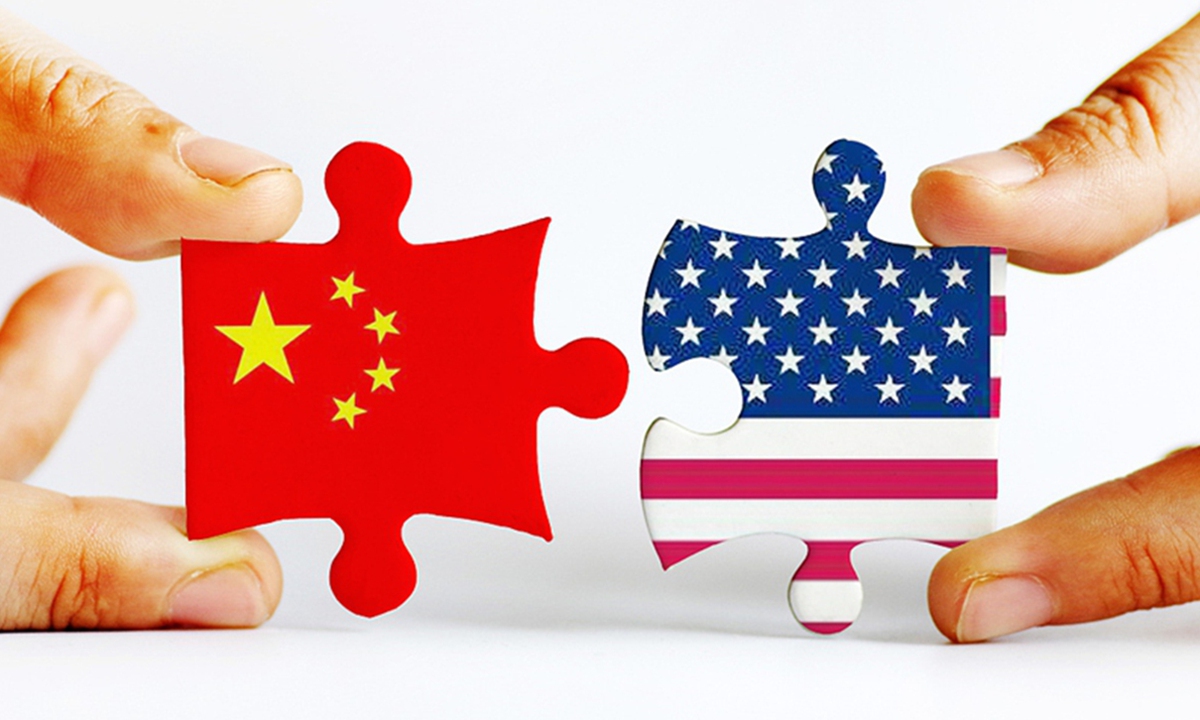
China US Photo: VCG
"If you are planning on decorating your home for the holidays, everything from artificial Christmas trees to lights, decorative wreaths and rings, you may want to start early." US media recently reported that due to the trade war and tariffs, Christmas goods are in short supply and prices are rising in the US market, forcing many Americans to adjust their holiday budgets.
In 2025, a tariff tsunami surged from the east coast of the Pacific, inflicting severe damage on the well-being of people worldwide, including Americans. This once again demonstrates that in today's world, where national interests are deeply intertwined, zero-sum games are untenable, while mutual benefit and win-win cooperation represent the right path for humanity.
The indulgence of some in the US with zero-sum thinking is a key reason for the ongoing turbulence in China-US economic and trade relations. From disregarding international trade rules to arbitrarily imposing tariffs and unilaterally provoking trade frictions, to overgeneralizing the concept of national security and imposing stringent regulatory measures in the technology sector - all these practices that disrupt normal economic cooperation stem from the outdated logic of "your loss is my gain" and "your rise is my fall."
In this era of a global village, extinguishing the light of others does not make one's own light shine brighter; blocking the path of others does not make one's own journey smoother. Playing zero-sum games under the guise of "reciprocity" and "fairness" ultimately harms others without benefiting oneself. The US imposition of tariffs has not only failed to resolve its trade deficit and industrial competitiveness issues but has also imposed heavy costs on American businesses and consumers. From port congestion caused by fluctuating tariff policies to massive losses suffered by US tech companies due to losing the Chinese market, real-world lessons abound. American industrial and business leaders on the front lines of trade have repeatedly called for the removal of tariffs to safeguard the stability of industrial and supply chains.
When Father's Day approached this year, an American TikTok creator posted a video recommending a solar-powered fan hat from Yiwu, China, as a gift for the occasion. The video garnered over 9 million views on the platform, sparking a buying frenzy. This small example reflects how China-US trade cooperation significantly enhances people's well-being. The essence of China-US economic and trade relations is mutual benefit and win-win cooperation, not zero-sum competition. After more than 40 years of development, the two economies have become highly complementary with deeply intertwined interests. Bilateral trade volume accounts for about one-fifth of the global trade, and industrial and supply chains have long formed an inseparable pattern where we all have a stake in each other's future.
At the eighth China International Import Expo, US companies secured the largest exhibition space for the seventh consecutive year, demonstrating the American business community's vote of confidence in the Chinese market through concrete actions. Attempting to sever this mutually beneficial relationship is both unfeasible and undesirable, as it would only lead to mutual losses.
The "Thucydides' Trap" is not historic fatalism. China and the US jointly finding an unprecedented way to get along with each other as major powers is one of the most critical issues of our era. The key to solving this challenge lies in establishing correct strategic understanding and abandoning outdated zero-sum thinking.
China does not challenge or seek to replace the US. It welcomes America's prosperity and development, and, in fact, China's progress presents opportunities for the US, and China-US cooperation helps the US better address its own challenges. Policymakers and figures across various sectors in the US acknowledge that trade with China helps alleviate inflationary pressures and improves people's livelihoods. In recent months, guided by the consensus reached by the two heads of state, the economic and trade teams of both countries have held five rounds of consultations, gradually clarifying approaches to address each other's concerns. This fully demonstrates that as long as zero-sum thinking is abandoned and equal consultation is upheld, China and the US can certainly find ways to properly resolve differences and enhance cooperation.
A winner-takes-all, zero-sum approach is not the path for human development. By broadening our horizons, we can see vast opportunities for cooperation. Both China and the US should resolutely choose dialogue over confrontation, pursue mutually beneficial cooperation rather than zero-sum games, and ensure that China-US economic and trade cooperation serves as the "ballast" rather than the "stumbling block" in the bilateral relationship.
Zhong Sheng is the People's Daily international news commentary column. opinion@globaltimes.com.cn
RELATED ARTICLES