Photo: screenshot from CCTV
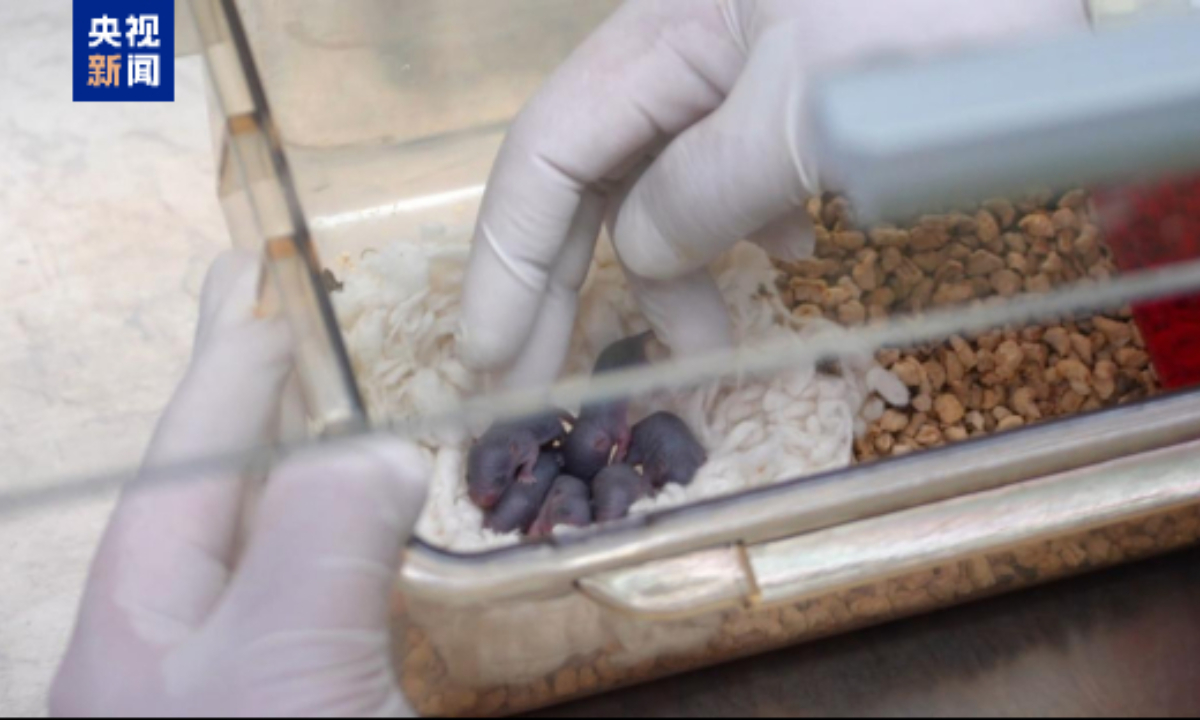
One female mouse, among the four experimental mice previously sent into space aboard the Shenzhou-21 crewed spacecraft, delivered nine pups around 6:00 am on December 10 after returning to Earth , China's state-owned broadcaster CCTV News reported on Saturday, citing the information from the Technology and Engineering Center for Space Utilization of the Chinese Academy of Sciences.Currently, six of the newborn mice are alive, representing a normal survival rate. This litter of "space mouse offspring" is now thriving under the attentive care of researchers, with the mother exhibiting normal nurturing behavior and the young displaying good vitality, the report said.
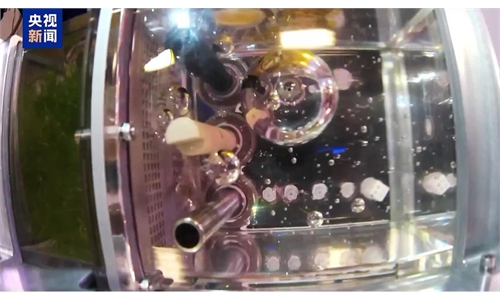
The four experimental mice were launched aboard the Shenzhou-21 crewed spacecraft on October 31, 2025, and entered the small-space-mammal breeding facility on the China Space Station to conduct survival and adaptation experiments in the space environment. They later returned to Earth aboard the Shenzhou-21 spacecraft on November 14, according to the report.
Wang Hongmei, a researcher at the Institute of Zoology of the Chinese Academy of Sciences, stated that this mission demonstrates that short-term spaceflight did not negatively affect the mice's fertility. It also provides an exceptionally valuable sample for studying the impact of the space environment on the early-life development of mammals, said Wang, according to the report.
The report noted that the space journey of these four mice was not without challenges. Due to adjustments in the Shenzhou-20 return plan, the mice faced a "food shortage" test during the later stages of the mission. Confronted with this unexpected situation, the ground research team promptly activated an emergency response mechanism, immediately conducting multi-plan assessments and ground verification.
For water replenishment, leveraging the external water-supply interface reserved in the space breeding facility and with the assistance of astronauts, the research team injected drinking water from the space station into the mouse experimental unit, quickly resolving the mice's drinking water issue.
Regarding food supply, as the mice's specialized feed could not be replenished on short notice, the research team urgently, with the help of the astronaut system, accessed the astronaut food inventory and screened various potential substitute foods such as compressed biscuits, corn, hazelnuts, and soy milk. Ground verification experiments were immediately conducted, focusing on testing the palatability of the foods, the health status of the mice after consumption, and the feasibility of on-orbit replenishment operations. After comprehensive evaluation, the research team ultimately selected soy milk as the emergency food for the mice and successfully completed soy milk replenishment on November 12 and 13.
The research team also utilized a pre-developed AI behavior analysis system to track the mice's movement trajectories, feeding, sleep, and other states in real time, accurately predicting feed consumption progress and providing crucial data support for emergency decision-making.
For this offspring born to the space-returned mice, scientists will continue conducting systematic research, with a focus on their growth and development curves, as well as changes in physiological and pathological characteristics. Furthermore, scientists will further observe the reproductive capacity of the offspring, attempting to obtain "second-generation" mice to delve deeper into the potential impact of the space environment on multigenerational inheritance and development in mammals, according to the report.
Global Times
RELATED ARTICLES