What's the significance behind the illustration of CCG's law enforcement patrol off Taiwan island?
By Fan Wei and Published: Dec 29, 2025 04:27 PM

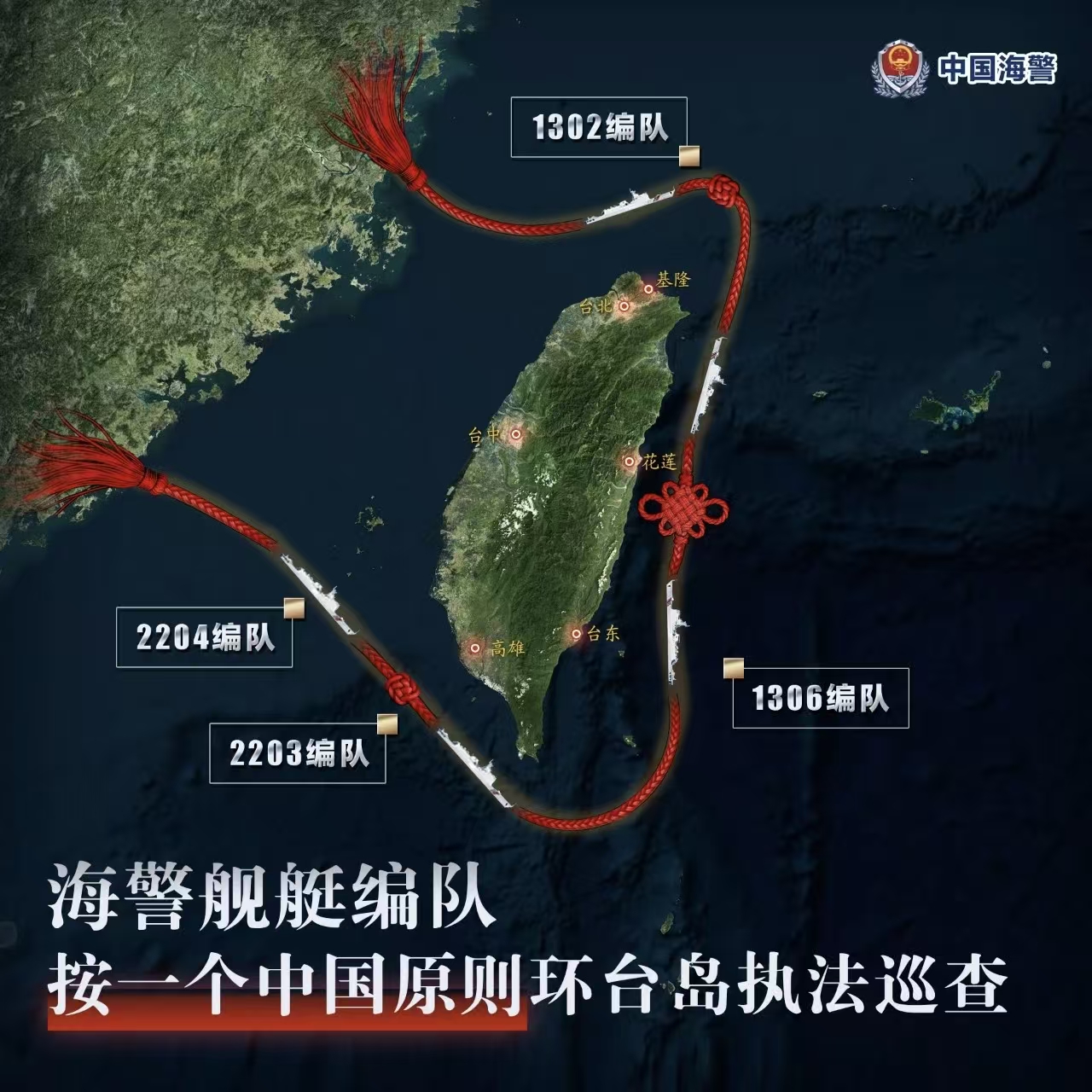
Photo: China Coast Guard
Zhu Anqing, spokesperson of the East Sea Bureau, the China Coast Guard (CCG), said that on Monday, the Fujian Coast Guard organized task forces to carry out law enforcement patrol in the waters surrounding the Taiwan island, conducting drills on subjects of joint protection of fishing activities, identification and verification, as well as interception and detention operations against unwarranted vessels. The drills tested capabilities of effective jurisdiction and efficient law enforcement. The CCG then released an illustration of its vessel task forces' law enforcement patrol off Taiwan island in accordance with the one-China principle.
The illustration shows that the CCG's 1302 Formation, 1306 Formation, 2203 Formation, and 2204 Formation weaved a tight blockade around the northern, eastern, southern, and southwestern areas of the island of Taiwan with red mooring lines and elegant Chinese knots, effectively encircling it.
It is a rope that encircles the province of Taiwan, tying a Chinese knot and binding the shared lineage and securing the reunification. The Global Times learned that the illustration released by the CCG takes the Chinese knot and mooring rope as its central symbols, intertwining the sovereignty narrative that "Taiwan is a province of China" with the cultural symbolism of "peace in the Taiwan Straits and reunification of the homeland." This has evoked an emotional resonance, encapsulated in the phrase, "One rope encircles the province, one knot reunifies China."
Among them, the Chinese knot symbolizes both security and stability, while also representing the traditional cultures across the Straits. The term "Chinese knot" was originally coined by renowned folk culture scholar Huang Yongsong from Taiwan island. The "panchang knot" selected in the illustration resembles the Chinese character Zhong (China), signifying that Taiwan is an inseparable part of China, and the coast guard enforces control over the main island and outer islands of Taiwan in accordance with the one-China principle. The two "zaojing knots" chosen correspond to the main ports and shipping routes in northern and southwestern Taiwan, respectively, symbolizing the CCG's commitment to safeguarding peace and stability in the Taiwan Straits.
The illustration employs mooring rope as a symbolic element, drawing on its practical function as a common tool on vessels that can be adjusted in tension based on sea conditions. By using "mooring rope" to represent maritime routes, it signifies the CCG's resolute commitment to curbing "Taiwan independence" separatist activities, with the implication that the higher such forces attempt to rise, the tighter the restraint will become. The choice of the color "red" connects lineage with legal principle, serving both as a warning to "Taiwan independence" separatist forces and as a representation of the legitimacy of the CCG's actions - much like a red rope safeguarding the knot, symbolizing the protection of the outer islands. Additionally, the phonetic similarity between "rope" and "province" (both pronounced as sheng in Chinese) reinforces the message that Taiwan is a province of China.
The illustration of the law enforcement patrol around the outer islands incorporates these creative concepts, utilizing coordinate points and the closest distances to demonstrate that the CCG has entered the so-called "restricted waters" during this operation for the purpose of law enforcement and patrols.
RELATED ARTICLES