New institutions challenge established monopoly in global finance
By Published: Dec 30, 2025 08:08 PM
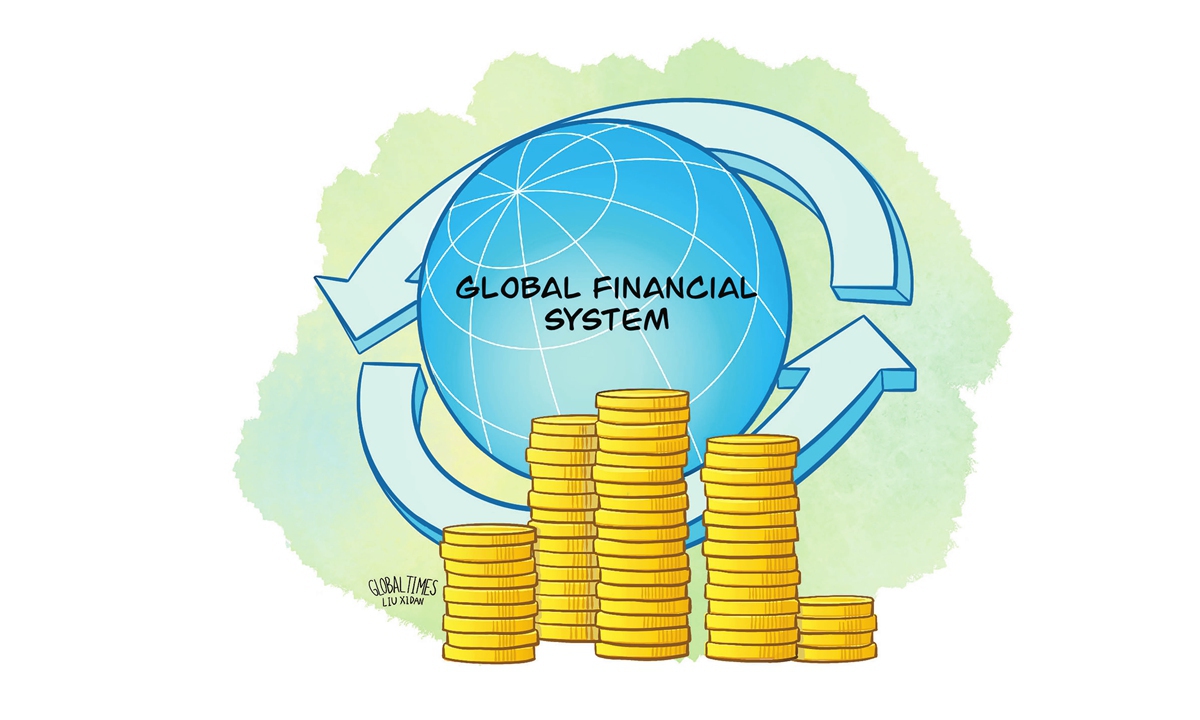
Illustration: Liu Xidan/GT
Actively promoting the reform process of the international financial system to adapt to changes in the global economic landscape is not only essential for advancing the international order toward a more just and equitable direction, but also a reasonable demand of the vast majority of developing countries.
On December 27, the International Monetary Fund (IMF) and the International Bank for Reconstruction and Development (IBRD), now a World Bank institution, celebrate 80 years since they officially came into existence in late 1945. These institutions became the two main pillars of the so-called Bretton Woods System (BWS), which was designed by the US at the end of WWII to stabilize global financial transactions, promote economic growth in war-torn countries, and last but not least, to cement American financial hegemony in the postwar world.
The initial BWS collapsed when the US had to move away from the fixed gold-denominated exchange rate of its national currency; however, both the IMF and IBRD not only survived this collapse, but also became even more influential and universal toward the end of the 20th century. The two institutions forged the so-called "Washington Consensus" - a list of market fundamentalism principles (liberalization of trade and finances, radical privatization, aggressive measures against inflation and budget deficits, etc.) that became one of the drivers pushing globalization at the turn of the century.
However, even at the peak of their international credibility and influence, the two pillars of the US-created global financial order demonstrated not only their power, but also their weaknesses. The formally "politically neutral" rules of the IMF and IBRD engagement have been accused by some of having many political strings attached and routinely used by Washington to advance specific US foreign policy goals.
At the same time, the changing balance of powers in the global economy and the global finance resulted in growing demands to make the international financial system more inclusive and democratic.
Since 2000, IMF quota shares have undergone two major reforms, with a part of voting shares having been moved from advanced economies to emerging markets. However, the US still maintains its veto powers with some 17 percent of IMF shares, which is almost three times more than China now has. A similar situation exists in IBRD.
The current US administration is unlikely to demonstrate more vision and more strategic thinking in advancing IMF and IBRD reforms; on the contrary, Washington now regards the IMF and the World Bank as excessively globalist institutions that allegedly have already diverted significant US resources without sufficient alignment to immediate American interests.
At the same time, the emerging centers of global economic and financial power have started to think about alternative multilateral instruments that they could put together within new non-Western groupings. BRICS has launched the New Development Bank and the BRICS Contingent Reserve Arrangement. The Shanghai Cooperation Organisation, in its turn, at its last summit meeting in Tianjin, approved the plan to build its own new development bank to provide non-US dollar financing to help members reduce the risk of sanctions and dollar volatility, with the currency probably being renminbi. So far, these new institutions remain relatively modest and even wobbly, but they have already challenged the former monopoly of old financial institutions in the global financial system by offering efficient alternatives for state borrowing and project funding.
Of course, the old financial institutions are unlikely to vanish into thin air in the foreseeable future. However, they will never regain the unique status that they enjoyed at the end of the 20th century. They will have their fair share in the global financial system, but not a monopoly on setting the rules within the system. This change will ultimately benefit all of us.
The author is a member of the Russian International Affairs Council. opinion@globaltimes.com.cn
RELATED ARTICLES