Exchanges between Gen Z of China, S.Korea key to deeper mutual understanding, Chinese experts say at seminar on bilateral people-to-people exchanges
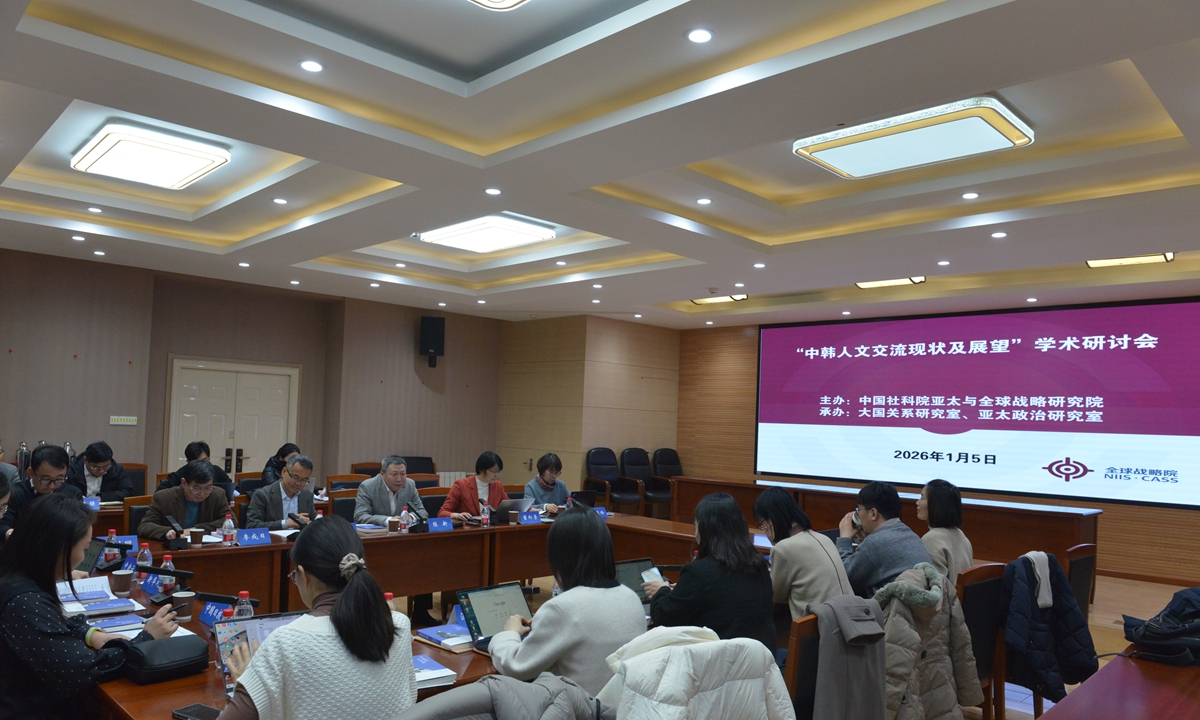
A symposium on the current status and prospects of China-South Korea people-to-people exchanges takes place at the National Institute of International Strategy at the Chinese Academy of Social Sciences in Beijing on January 5, 2026. Photo: Courtesy of NIIS CASS
Strengthening people-to-people ties, particularly among Gen Z, is vital for the continued enhancement of China-South Korea relations, experts said on Monday at a seminar hosted by the National Institute of International Strategy at the Chinese Academy of Social Sciences (NIIS CASS).The symposium on the current status and prospects of China-South Korea people-to-people exchanges comes at a pivotal moment as South Korean President Lee Jae-myung began his four-day state visit to China on Sunday.
Chen Xin, deputy director of NIIS CASS, stated in his opening remarks that, as important neighbors that cannot be moved away and cooperation partners that cannot be separated, China and South Korea bear an increasing responsibility to maintain regional peace amid a complex global landscape. He noted that President Lee's visit will further propel the positive momentum of bilateral relations.
The seminar featured a discussion of a critical biography on President Lee's life that was translated from South Korean into Chinese and published in China in November. Piao Guanghai, a research fellow at the CASS Institute of Information Studies and one of the book's translators, said that people-to-people exchanges between China and South Korea have been a highlight of bilateral ties since the establishment of diplomatic relations.
While such exchanges suffered setbacks due to some factors, including the "values-based diplomacy" of the Yoon Suk-yeol administration, the situation is now warming, said Piao, citing the mutual visa-free policies implemented in recent years as a key catalyst for this recovery.
Li Chengri, a research fellow at NIIS CASS and a co-translator of the biography, told the Global Times that as head-of-state diplomacy continues to deepen, such interactions between the two countries have injected momentum into bilateral relations. At the same time, an increasing number of young people in South Korea are benefiting from China's economic development, which in turn is helping improve public perceptions of China in South Korea. Currently, China-South Korea relations have emerged from a low point and will continue to improve, he said.
Furthermore, the Monday event saw the release of a research report on mutual perceptions among Gen Z in the two countries. According to the report, most young South Koreans view their country's relationship with China as vital and recognize China's growing international influence. The findings also suggest that younger generations in South Korea are more focused on personal experience and practical benefits; consequently, direct visits to China are the most effective way to eliminate misconceptions.
Scholars argued during the meeting that Gen Z represents the future of a country and plays an important role in bilateral relations between countries. According to Dong Xiangrong, a senior research fellow at NIIS CASS, to improve bilateral relations, China and South Korea should enhance political mutual trust and explore cooperative models in the new competitive landscape. They need to promote social and people-to-people exchanges, enhance mutual goodwill and foster mutual understanding between the two peoples, Dong added.
In terms of Gen Z's role in China-South Korea people-to-people exchanges, Wang Xiaoling, a research fellow at NIIS CASS, stated that China and South Korea should seek new common interests in industrial cooperation, with AI-driven cultural industries poised to become a promising new area of collaboration that could resonate with young people. Regarding people-to-people exchanges, Wang suggested that encouraging more South Koreans to visit China would directly help clear up misunderstandings.
The symposium concluded with young scholars from Chinese universities and representatives from the press and publishing sectors, discussing ways to foster objective mutual understanding between the Chinese and South Korean peoples, aiming to prevent future misunderstandings and ensure a stable, long-term China-South Korea friendship.
RELATED ARTICLES