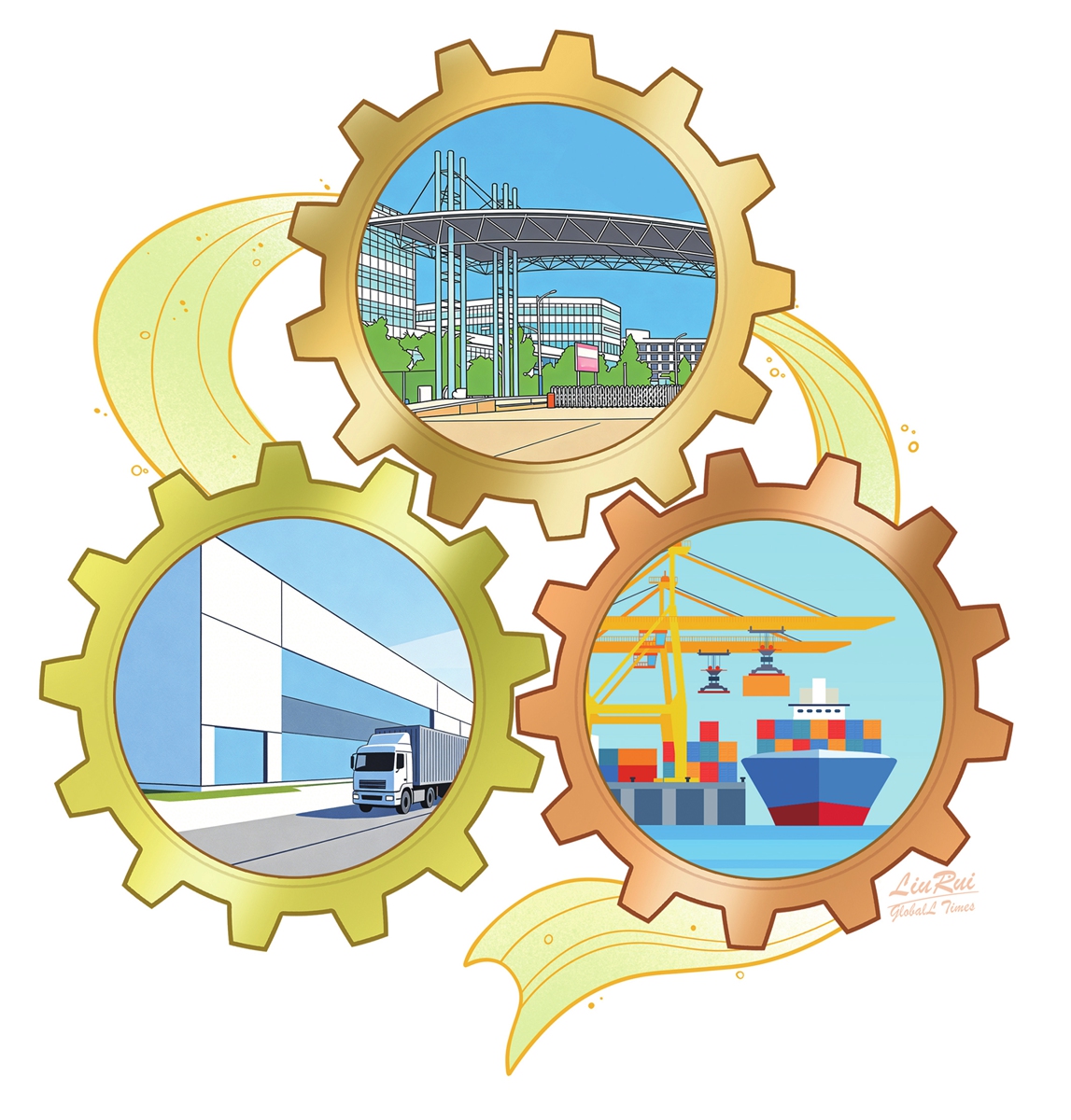
Illustration: Chen Xia/GT
Despite lingering uncertainty across global manufacturing, recent indicators suggest an improvement in Africa's industrial momentum. Data released by the China Federation of Logistics & Purchasing (CFLP) shows that Africa's manufacturing purchasing managers' index (PMI) rose above 50 in December, returning to expansion territory. At a time when global supply chains remain under strain and demand conditions are uneven, this suggests that Africa's manufacturing sector retains room for development, with opportunities emerging even amid broader uncertainty.The broader global picture remains subdued. Data released by the CFLP indicates that the global manufacturing PMI stood at 49.5 in December 2025, remaining in contraction territory. By contrast, Africa's manufacturing PMI rose to 50.7, up 1.3 from the previous month and once again moving above the 50 threshold. For 2025 as a whole, Africa's average manufacturing PMI was 50.2, an increase of 0.7 from 2024.
Broader economic projections point to a steady performance in sub-Saharan Africa. In its October regional economic outlook, the IMF noted that the outlook for the region is showing resilience, despite a challenging external environment. Economic growth is estimated to have remained steady at 4.1 percent in 2025 with a modest pickup predicted in 2026, supported by macroeconomic stabilization and reform efforts in key economies.
A key question is how this momentum can be sustained. Some economists point to manufacturing as a potential channel for supporting Africa's economic development. Experience from industrialized economies, as well as developing countries that have advanced through industrialization, indicates a close relationship between industrial capacity and broader economic growth. Expanding industrial activity in Africa could thus help provide a foundation for a steadier and more diversified economic performance over time.
In recent years, economic cooperation between China and Africa has expanded across multiple sectors, including manufacturing. Programs such as industrial park development and the strengthening of local supply chains have helped create conditions conducive to the growth of African industry. At the same time, the continent's current manufacturing performance - reflected in indicators such as the PMI - and its broader economic outlook provide a context in which collaboration in the manufacturing sector could be mutually reinforced.
From infrastructure and training to production and international sales, China-Africa industrial cooperation has been gradually deepening. Chinese enterprises have invested in industrial parks across a range of sectors, introducing capital, technology, and equipment into local industrial systems. These programs have supported local employment and skills development, helping to maintain momentum in the growth of Africa's manufacturing industry.
For example, in Cote d'Ivoire, the PK24 Industrial Park, built by China Light Industry Nanning Design Engineering Co, can process 50,000 tons of cocoa annually, marking a key step in the country's move up the global value chain, the Xinhua News Agency reported. Chinese companies are not just building factories - they are bringing integrated solutions to help local economies upgrade their agricultural processing value chains.
Data from the Report on Chinese Investment in Africa (2025), released in November 2025, shows that manufacturing accounted for 16.1 percent of Chinese companies' investment in Africa in various industries. Chinese firms are increasingly establishing a presence on the continent. For example, Chinese company Keda Industrial Group has achieved localized production of building materials in countries such as Kenya, accelerating the formation of local industrial clusters and ecosystems, while creating jobs and promoting technology transfer.
Kenyan journalist Victor K'Onyango, in an article headlined "Africa's industrial future depends on ties that work" that was published by the Xinhua News Agency on December 26, said that in recent years, China's cooperation with Africa has been at the center of the local industrialization process.
The article said that in countries such as Kenya, Ethiopia, Nigeria and Tanzania, Chinese co-built industrial parks and manufacturing hubs are reshaping local economies by enhancing local industrial capacity, strengthening local supply chains, and providing training opportunities for African engineers, technicians and entrepreneurs who will continue the work of local manufacturing development.
The current momentum in Africa's manufacturing sector, together with a broadly positive economic outlook, provides a supportive backdrop for continued China-Africa collaboration in industry. Expanding collaboration and building on local industrial capacity could contribute to more sustainable economic development, strengthening the manufacturing base while gradually integrating new technologies and skills across the region.
The author is a reporter with the Global Times. bizopinion@globaltimes.com.cn
RELATED ARTICLES