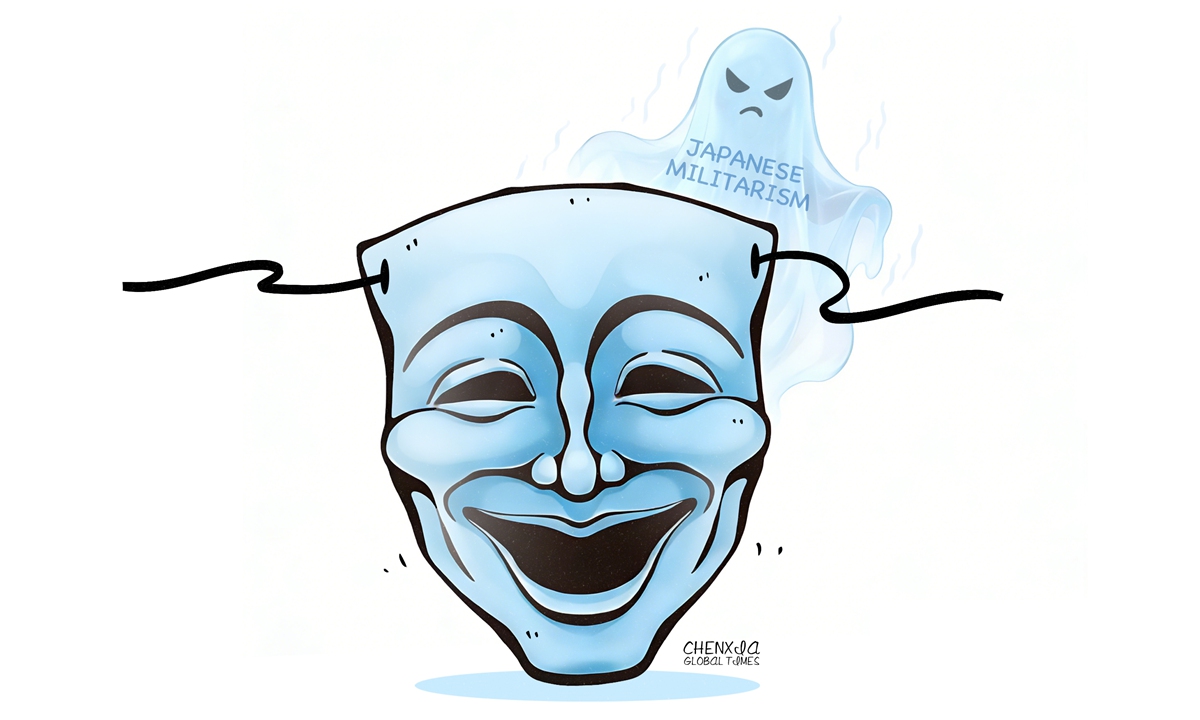
Illustration: Chen Xia/GT
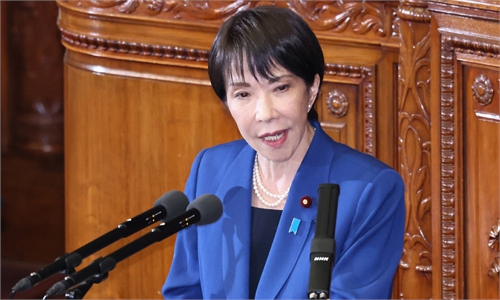
The China-Japan row concerning Japanese Prime Minister Sanae Takaichi's erroneous remarks on the Taiwan question continues on the diplomatic front. A handful of Japanese politicians are peddling a narrative of victimhood, portraying Japan as a "peace-loving nation" while describing China's response as "overreacting" or even "bullying."
The reality, however, tells a different story. Far from embracing genuine peace, some forces in Japan persist in distorting historical truths.
Evasion of historical responsibility
During the German Foreign Minister's visit to China late last year, the two sides had an in-depth discussion on the Taiwan question and Japan's recent provocations. The significance of these issues lies in their direct connection to the understanding of World War II (WWII) history and the attitude toward the postwar international order.
In terms of attitude, the contrast between Berlin and Tokyo could not be starker. Successive German leaders have explicitly condemned Nazi crimes, offered apologies and embedded atonement in law, education and reparations.
In contrast, Japan, also a defeated Axis power, has consistently shunned an apology while actively seeking to whitewash its wartime past. School textbooks have replaced "invasion" with "advance," downplayed the Nanjing Massacre as the "Nanjing Incident," and erased the atrocities committed by Unit 731 from historical accounts.
The 1995 Murayama Statement contained elements of "remorse" and "apology," yet it faced immediately domestic criticism and was diluted in subsequent official statements. The 2015 Abe Statement referenced "aggression" but stopped short of acknowledging Japan's responsibility, instead suggesting that the era of apologies was over.
Refusing to acknowledge its wrongdoings while blaming victims for "dwelling on history" is fundamentally inverting right and wrong. A 2025 NHK poll shows that only 35 percent of Japanese respondents regarded the war as aggression against Asian neighbors, underscoring the profound impact of historical distortion.
Cultivating a victim narrative
As the only country that has experienced atomic bombings, Japan applied for the UNESCO's "Memory of the World" program with relevant audio-visual archives and invited foreign dignitaries to Hiroshima and Nagasaki.
However, these actions consistently omit critical historical context. Exhibitions in Japan have largely focused on the suffering caused by the atomic bombs while barely mentioning Japan's own acts of aggression. A 2024 survey by a Japanese civic group in Nagasaki revealed that 94 percent of foreign respondents believed that such exhibits should include references to Japan's aggression and colonial rule. Despite this, the Japanese government has removed such contents from displays.
Accelerating military buildup
The Potsdam Declaration prohibited Japan from re-arming itself, and Article 9 of Japan's Constitution renounces war and the threat or use of force as means of settling international disputes. However, recent Japanese governments have incrementally weakened these constraints.
Citing "external threats," Japan has progressively relaxed restrictions on its military. Collective self-defense has been reinterpreted as permissible, arms export bans eased and defense spending increased for 13 consecutive years. For the 2025 fiscal year, Japan raised its defense budget to 2 percent of GDP ahead of schedule.
While some voices in Japan criticize China's military spending, Japan's per capita defense expenditure is more than three times that of China.
Data from Sweden Stockholm International Peace Research Institute (SIPRI) for 2024 shows sales by Japan's major defense contractors surged by 40 percent, the fastest growth worldwide, reflecting the rapid expansion of the country's domestic military-industrial complex.
Japan's nuclear posture has heightened the unease. While publicly advocating a nuclear-free world, Japan maintains large stockpiles of plutonium. Some political figures have even called for revising Japan's "Three Non-Nuclear Principles."
On the Taiwan question, Japan's actions are openly provocative. Plans to deploy missiles on Yonaguni Island, barely 110 km from Taiwan island, constitute a serious security concern. Such moves, coupled with aggressive rhetoric, clearly reveal strategic intentions of the Japanese government.
The Yasukuni Shrine
The Yasukuni Shrine remains a deeply offensive symbol to nations that suffered under Japanese aggression. It honors 14 Class-A war criminals, including individuals responsible for the war against China and the Pacific War, as well as the Nanjing Massacre.
To pay respects at such a site is to honor the worst perpetrators of WWII. Nevertheless, visits to Yasukuni Shrine by Japanese officials and politicians have become routine.
Prime Minister Takaichi was a frequent visitor before taking office. Recent reports suggest that she may visit the site again. Given the current state of China-Japan relations, such an act would be highly inflammatory and contradict Japan's stated desire for a stable bilateral relationship.
Justice may be delayed, but it will not be denied. Those who commit wrongs will be held accountable. Facing the ghosts of militarism, Japan must truly learn from history and express profound remorse for the crimes it has committed.
The author is a commentator on international affairs, writing regularly for Xinhua News, Global Times, China Daily, CGTN. opinion@globaltimes.com.cn
Now Latin America and the Caribbean face the turbulent path of overcoming the neocolonizing strategy of the "neighborhood bully" and strengthening diversified ties with other countries of the world that prioritize tangible, pragmatic and mutually beneficial cooperation, without geopolitical calculations or interference.
RELATED ARTICLES